

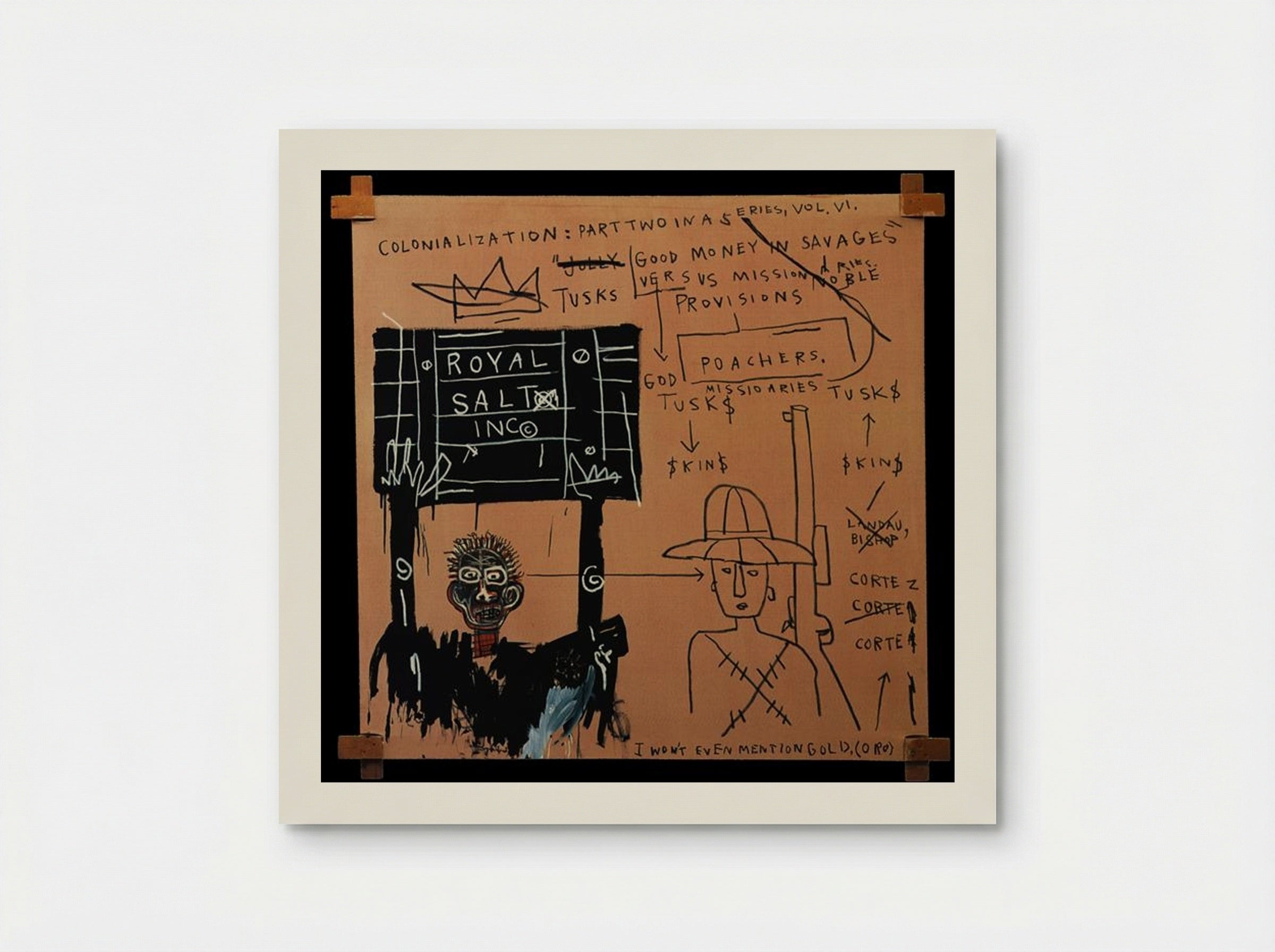
Native Carrying Some Guns, Bibles, Amorites on Safari - Jean-Michel Basquiat
Archival giclée
Frames arrive ready to hang
Secure checkout
Made to order
Description
A powerful 1982 work by Jean-Michel Basquiat that critiques colonial history through raw text, symbols, and stark graphic figures.
Jean-Michel Basquiat created this work in 1982, a period during which he produced some of his most direct critiques of colonial history and power structures. The composition functions as a visual essay, combining text, symbols, and figures to examine the intersection of commerce, religion, and exploitation. Basquiat employs a raw, immediate aesthetic, using oilstick to scrawl phrases across the surface that challenge the viewer to consider the mechanics of historical narratives. The work features a central figure alongside a sign for 'Royal Salt Inc.', a reference to the commodification of resources. Basquiat incorporates his signature crown motif, which often serves to elevate his subjects or comment on the nature of authority. The text, including phrases such as 'Good money in savages' and 'I won't even mention gold', acts as a biting commentary on the economic motivations behind colonial expansion. By juxtaposing these words with simplified, almost schematic drawings of figures and weaponry, the artist strips away the veneer of historical romanticism often associated with the era of exploration. Basquiat's approach to the canvas is deliberate, using the negative space of the raw background to allow the stark black lines to dominate. The inclusion of names like 'Cortez' and 'Bishop' links the imagery to specific historical figures, grounding the abstract critique in documented events. This piece demonstrates the artist's ability to synthesise complex socio-political themes into a singular, graphic image. It remains a stark example of his practice, where the act of mark-making becomes a form of historical reclamation. The work does not offer easy answers, instead presenting a fragmented, challenging view of the past that remains relevant to contemporary discussions on power and representation.
Return policy
Because every print is made to order, we don't offer change-of-mind returns, refunds or exchanges. If your order arrives faulty, damaged or incorrect, we'll replace it free of charge — just contact us within 48 hours of delivery. See our refunds page for full details.
Shipping
We ship worldwide, printing at the production hub nearest to your delivery address. Delivery times and costs vary by destination — you'll see the options available to you at checkout.
Manufacturing
Each print is produced to order using 12-colour giclée printing on FSC-certified archival paper. Designed in Britain and printed at your nearest production hub to reduce waste and speed up delivery.
Care and materials
Specific Features
Every Solis piece is made to order with archival, gallery-quality materials built to last.
- Museum-grade giclée printing for rich, fade-resistant colour
- Archival matte fine-art paper, FSC-certified
- Multiple sizes and framing options available
- Frames in black, natural wood, dark wood or white
- Framed prints arrive ready to hang
Care & Cleaning
To keep your artwork looking its best:
- Dust gently with a soft, dry cloth
- Avoid prolonged direct sunlight
- Never use liquid cleaners on the print or canvas surface
- Keep in a dry, room-temperature space
- Handle prints with clean, dry hands
Materials & Sizing
Museum-grade giclée on FSC-certified archival matte paper, with framed and canvas options.
- Paper sizes: A4, A3, A2, A1, A0 and B2 (50×70 cm)
- Canvas: XS (20×30 cm) to Large (60×90 cm)
- Frames: black, natural wood, dark wood or white
Native Carrying Some Guns, Bibles, Amorites on Safari - Jean-Michel Basquiat

Artist Biography
Jean Michel Basquiat
He had no formal art training. He dropped out of school at seventeen and slept on park benches and friends' floors. He sold hand-painted postcards and t-shirts. He gate-crashed a restaurant where the critic Henry Geldzahler was eating with Andy Warhol and handed them a postcard. Warhol bought one. The art world opened.
By twenty-one he was showing in galleries. By twenty-two he was the youngest artist ever invited to Documenta in Kassel. The paintings are dense, layered, furious: text fragments, anatomical drawings, crown symbols, crossed-out words, references to Black history, jazz, boxing, anatomy textbooks, and street signage. They look unplanned but they are not. The crossed-out words are deliberate. He wanted you to read them, then register the erasure.
He and Warhol collaborated on a series of paintings in 1984 and 1985. The relationship was complicated by the art market's tendency to treat Basquiat as Warhol's protege rather than his peer, and by the fact that Warhol, older and more established, got better reviews for the joint work. Basquiat pulled away.
He died of a heroin overdose in 1988, at twenty-seven. His paintings now sell for over 100 million dollars. He would have found that both satisfying and absurd.
Why Choose Us ?
Damage-free delivery guarantee
Fast Shipping
Museum-Quality Materials
You May Also Like