

Passionflower - Piet Mondrian
Archival giclée
Frames arrive ready to hang
Secure checkout
Made to order
Description
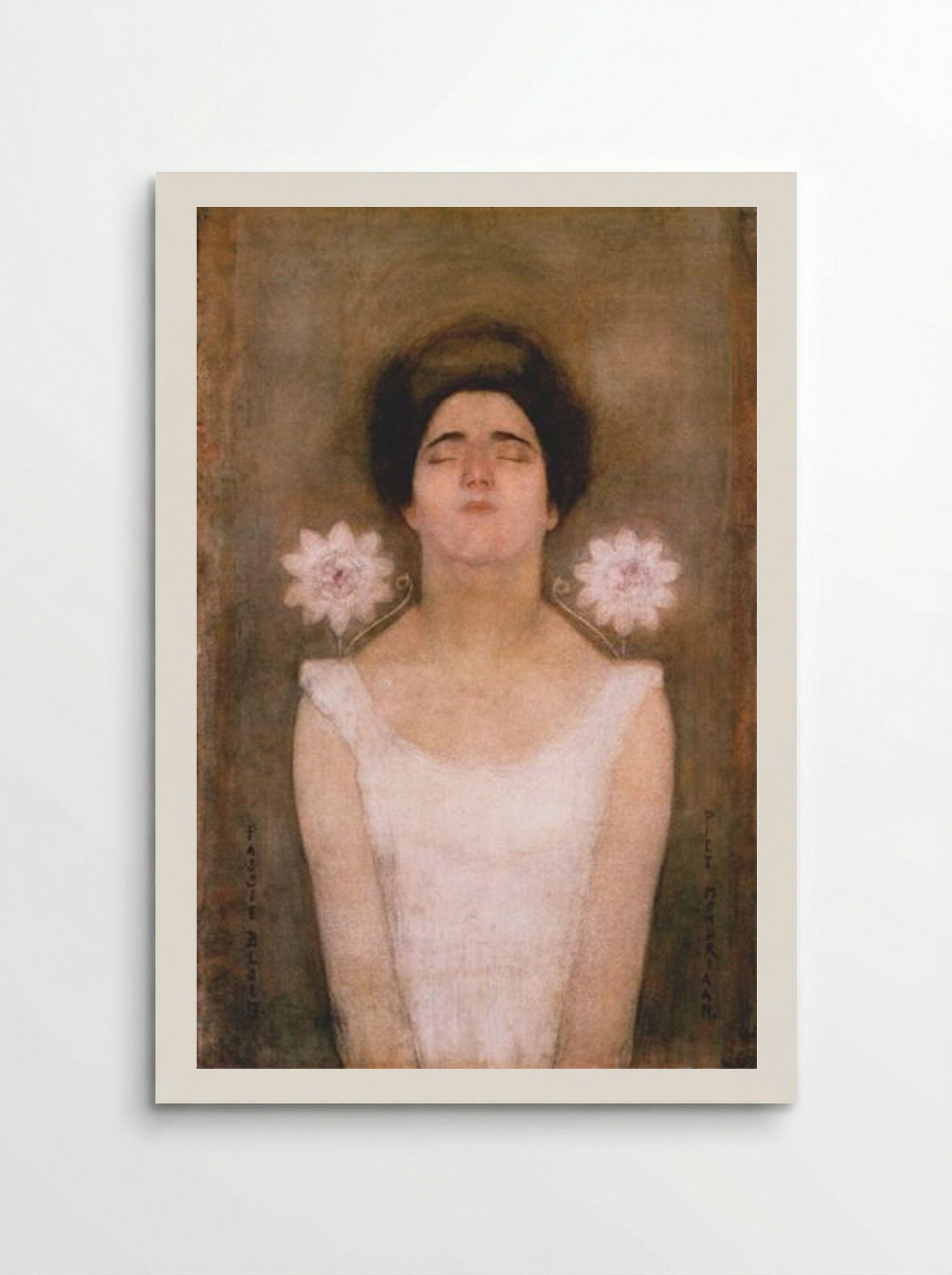
A departure from his later geometric style, Piet Mondrian's 'Passionflower' is an oil painting featuring a serene woman flanked by passionflowers, rendered in soft, muted tones.
Piet Mondrian, the Dutch painter born in 1872, is best known for his later abstract works, yet his early output included symbolist and naturalistic paintings. This oil on canvas work, titled 'Passionflower', exemplifies his earlier style, before his complete abstraction. The painting depicts a young woman with closed eyes, her face serene and contemplative. Two passionflowers, rendered in soft pinks and whites, are positioned symmetrically on either side of her head, seemingly emerging from her shoulders. The colour palette is muted, dominated by earthy browns and creams, which creates a dreamlike atmosphere. The woman's white dress is simply rendered, drawing attention to her face and the delicate flowers. The composition is symmetrical, with the figure centred and the flowers mirroring each other. This symmetry adds to the overall sense of calm and balance. The brushwork is soft and blended, contributing to the ethereal quality of the piece. 'Passionflower' offers a glimpse into Mondrian's artistic development, showing his early interest in symbolism and spirituality before he moved towards the geometric abstraction that would define his mature work.
Return policy
Because every print is made to order, we don't offer change-of-mind returns, refunds or exchanges. If your order arrives faulty, damaged or incorrect, we'll replace it free of charge — just contact us within 48 hours of delivery. See our refunds page for full details.
Shipping
We ship worldwide, printing at the production hub nearest to your delivery address. Delivery times and costs vary by destination — you'll see the options available to you at checkout.
Manufacturing
Each print is produced to order using 12-colour giclée printing on FSC-certified archival paper. Designed in Britain and printed at your nearest production hub to reduce waste and speed up delivery.
Passionflower - Piet Mondrian

Artist Biography
Piet Mondrian
Mondrian's move towards abstraction was gradual but decisive. He was influenced by Cubism after moving to Paris, but he ultimately distilled his art to its most essential elements. This radical simplification led to the birth of De Stijl, a Dutch artistic movement that sought universal harmony through pure abstraction. Mondrian believed that by reducing painting to its fundamental components – line, colour, and form – he could reveal a deeper, more spiritual reality.
Though he lived and worked in Europe for much of his life, Mondrian eventually settled in New York City during World War II. His final paintings, such as "Broadway Boogie Woogie," reflect the vibrant energy of his new urban environment. This iconic work, with its pulsating rhythms and dynamic composition, stands as a testament to Mondrian's enduring quest to capture the essence of modern life through the language of pure abstraction. His legacy continues to inspire artists and designers today.
Our Features
Designed for Lasting Impact
Specific Features
Every Solis piece is made to order with archival, gallery-quality materials built to last.
- Museum-grade giclée printing for rich, fade-resistant colour
- Archival matte fine-art paper, FSC-certified
- Multiple sizes and framing options available
- Frames in black, natural wood, dark wood or white
- Framed prints arrive ready to hang
Care & Cleaning
To keep your artwork looking its best:
- Dust gently with a soft, dry cloth
- Avoid prolonged direct sunlight
- Never use liquid cleaners on the print or canvas surface
- Keep in a dry, room-temperature space
- Handle prints with clean, dry hands
Materials & Sizing
Museum-grade giclée on FSC-certified archival matte paper, with framed and canvas options.
- Paper sizes: A4, A3, A2, A1, A0 and B2 (50×70 cm)
- Canvas: XS (20×30 cm) to Large (60×90 cm)
- Frames: black, natural wood, dark wood or white
Why Choose Us ?
Damage-free delivery guarantee
Fast Shipping
Museum-Quality Materials
Artist Biography
Piet Mondrian
Mondrian's move towards abstraction was gradual but decisive. He was influenced by Cubism after moving to Paris, but he ultimately distilled his art to its most essential elements. This radical simplification led to the birth of De Stijl, a Dutch artistic movement that sought universal harmony through pure abstraction. Mondrian believed that by reducing painting to its fundamental components – line, colour, and form – he could reveal a deeper, more spiritual reality.
Though he lived and worked in Europe for much of his life, Mondrian eventually settled in New York City during World War II. His final paintings, such as "Broadway Boogie Woogie," reflect the vibrant energy of his new urban environment. This iconic work, with its pulsating rhythms and dynamic composition, stands as a testament to Mondrian's enduring quest to capture the essence of modern life through the language of pure abstraction. His legacy continues to inspire artists and designers today.
You May Also Like