

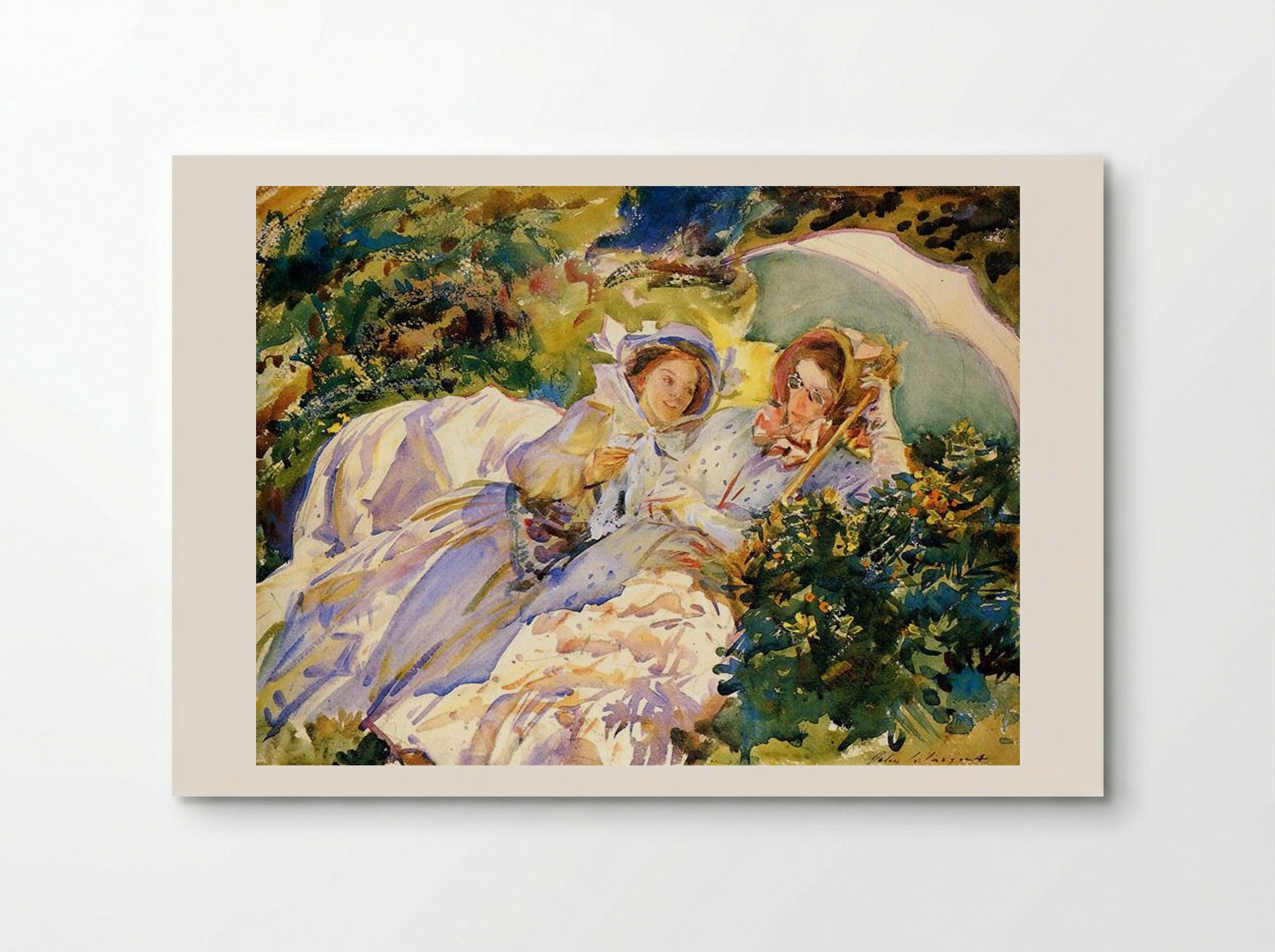

Simplon Pass: The Tease - John Singer Sargent
Archival giclée
Frames arrive ready to hang
Secure checkout
Made to order
Description
John Singer Sargent's watercolour 'Simplon Pass: The Tease' captures a moment of leisure in the Swiss Alps. Two women recline under a parasol, rendered with Sargent's characteristic impressionistic brushwork and attention to light.
John Singer Sargent, an American artist known for his portraiture and landscapes, painted 'Simplon Pass: The Tease' in watercolour. The work depicts two women reclining in a verdant outdoor setting, likely during his travels in the Swiss Alps. Sargent's impressionistic style is evident in the loose brushwork and the focus on capturing the fleeting effects of light and atmosphere. The women, dressed in light-coloured clothing, are positioned under the shade of a parasol, which diffuses the sunlight and creates a soft, luminous effect. The surrounding foliage is rendered with quick, gestural strokes, conveying a sense of spontaneity and immediacy. The composition is informal and relaxed, reflecting the leisure and informality of the scene. Sargent's skill in capturing the nuances of light and colour is apparent in the way he renders the textures of the clothing, the foliage, and the skin tones of the figures. The watercolour medium allows for a fluidity and transparency that enhances the overall sense of lightness and airiness. 'Simplon Pass: The Tease' exemplifies Sargent's ability to combine portraiture with elements of impressionistic landscape painting, creating a work that is both visually appealing and evocative of a particular time and place.
Return policy
Because every print is made to order, we don't offer change-of-mind returns, refunds or exchanges. If your order arrives faulty, damaged or incorrect, we'll replace it free of charge — just contact us within 48 hours of delivery. See our refunds page for full details.
Shipping
We ship worldwide, printing at the production hub nearest to your delivery address. Delivery times and costs vary by destination — you'll see the options available to you at checkout.
Manufacturing
Each print is produced to order using 12-colour giclée printing on FSC-certified archival paper. Designed in Britain and printed at your nearest production hub to reduce waste and speed up delivery.
Care and materials
Specific Features
Every Solis piece is made to order with archival, gallery-quality materials built to last.
- Museum-grade giclée printing for rich, fade-resistant colour
- Archival matte fine-art paper, FSC-certified
- Multiple sizes and framing options available
- Frames in black, natural wood, dark wood or white
- Framed prints arrive ready to hang
Care & Cleaning
To keep your artwork looking its best:
- Dust gently with a soft, dry cloth
- Avoid prolonged direct sunlight
- Never use liquid cleaners on the print or canvas surface
- Keep in a dry, room-temperature space
- Handle prints with clean, dry hands
Materials & Sizing
Museum-grade giclée on FSC-certified archival matte paper, with framed and canvas options.
- Paper sizes: A4, A3, A2, A1, A0 and B2 (50×70 cm)
- Canvas: XS (20×30 cm) to Large (60×90 cm)
- Frames: black, natural wood, dark wood or white
Simplon Pass: The Tease - John Singer Sargent

Artist Biography
John Singer Sargent
He was born in Florence to American expatriate parents and grew up moving between European cities. He never lived in America until he was middle-aged. He studied under Carolus-Duran in Paris, who taught him to paint directly from observation without underdrawing: load the brush, find the right tone, put it down in one stroke. The method required extraordinary hand-eye coordination and supreme confidence. Sargent had both.
Madame X, painted in 1884, nearly ended his career. The portrait of Virginie Amelie Avegno Gautreau, an American socialite in Parisian society, showed her in a black dress with one shoulder strap hanging off. The Salon audience was scandalised. Sargent repainted the strap in its proper position but the damage was done. He left Paris for London and rebuilt.
In London he became the portraitist of choice for the Anglo-American upper class. The technique is astonishing: he painted quickly, in long single-session sittings, and the brushwork has a fluency that makes other portraitists look laborious. The Wyndham Sisters, Lady Agnew of Lochnaw, and the portrait of Theodore Roosevelt show what he could do at full stretch.
He eventually did stop. After 1907 he largely abandoned portraits for watercolours and the murals at the Boston Public Library and the Museum of Fine Arts. The watercolours, painted on travels through Italy, Spain, and the Middle East, are looser and freer than the portraits and possibly better. He died in London in 1925, at sixty-nine.
Why Choose Us ?
Damage-free delivery guarantee
Fast Shipping
Museum-Quality Materials
You May Also Like