

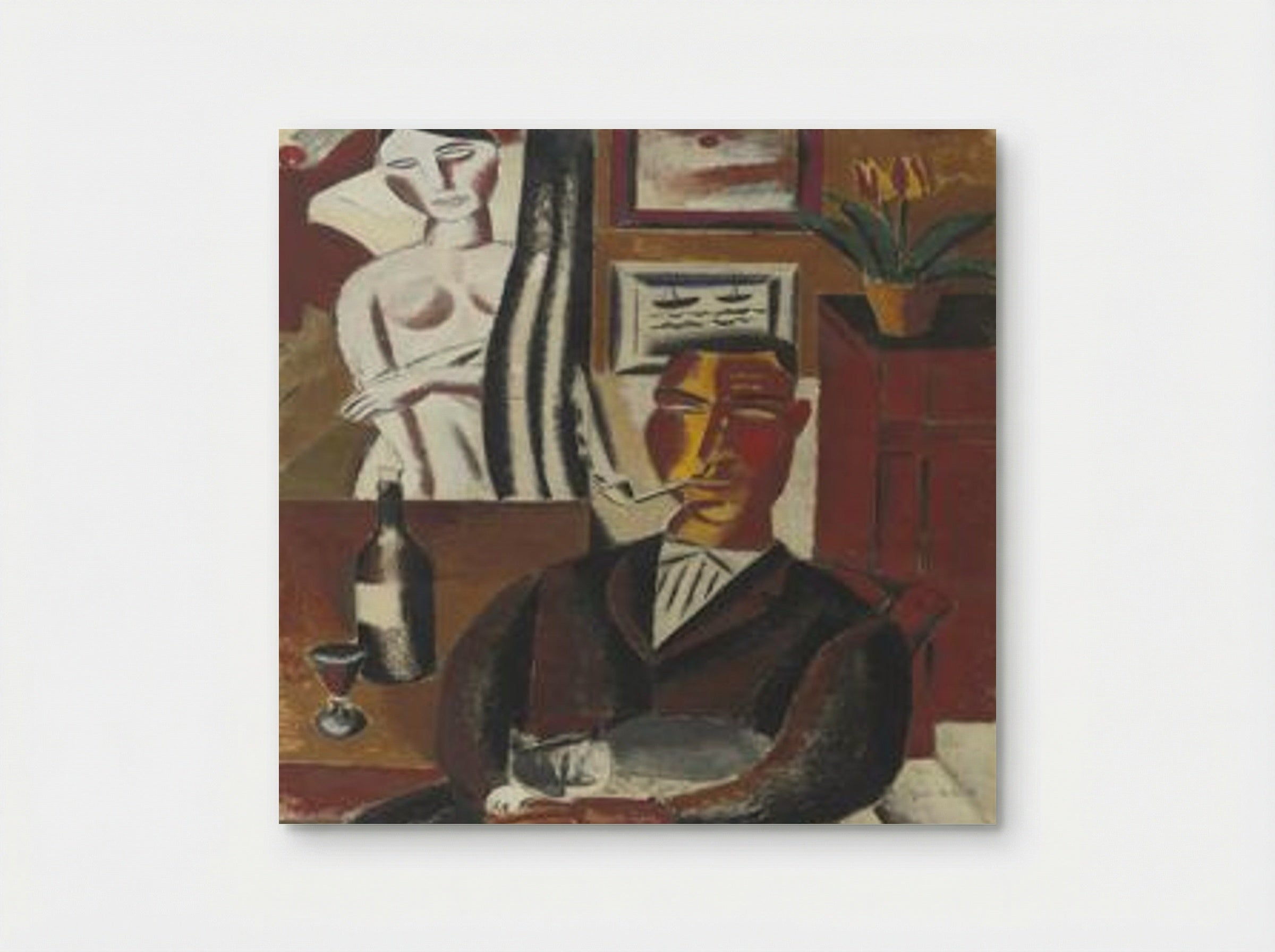
The Man with the Bottle - Gustave de Smet
Archival giclée
Frames arrive ready to hang
Secure checkout
Made to order
Description
A striking portrait by Gustave de Smet, 'The Man with the Bottle' features simplified forms and a muted palette, characteristic of Flemish Expressionism.
Gustave de Smet (1877-1943) was a Belgian painter associated with Flemish Expressionism. His work often features simplified forms, flattened perspectives, and a muted palette, reflecting the influence of Cubism and Expressionism. De Smet's subjects commonly include domestic scenes, portraits, and townscapes, treated with a distinctive blend of introspection and stylisation. 'The Man with the Bottle' exemplifies de Smet's mature style. The painting depicts a man seated with a pipe, a bottle, and a glass nearby. Behind him, a nude woman stands next to a striped curtain. The composition is carefully arranged, with a limited range of colours that create a sense of quiet contemplation. The figures are rendered with simplified, geometric forms, characteristic of de Smet's approach to portraiture. The overall effect is one of understated tension and psychological depth.
Return policy
Because every print is made to order, we don't offer change-of-mind returns, refunds or exchanges. If your order arrives faulty, damaged or incorrect, we'll replace it free of charge — just contact us within 48 hours of delivery. See our refunds page for full details.
Shipping
We ship worldwide, printing at the production hub nearest to your delivery address. Delivery times and costs vary by destination — you'll see the options available to you at checkout.
Manufacturing
Each print is produced to order using 12-colour giclée printing on FSC-certified archival paper. Designed in Britain and printed at your nearest production hub to reduce waste and speed up delivery.
Care and materials
Specific Features
Every Solis piece is made to order with archival, gallery-quality materials built to last.
- Museum-grade giclée printing for rich, fade-resistant colour
- Archival matte fine-art paper, FSC-certified
- Multiple sizes and framing options available
- Frames in black, natural wood, dark wood or white
- Framed prints arrive ready to hang
Care & Cleaning
To keep your artwork looking its best:
- Dust gently with a soft, dry cloth
- Avoid prolonged direct sunlight
- Never use liquid cleaners on the print or canvas surface
- Keep in a dry, room-temperature space
- Handle prints with clean, dry hands
Materials & Sizing
Museum-grade giclée on FSC-certified archival matte paper, with framed and canvas options.
- Paper sizes: A4, A3, A2, A1, A0 and B2 (50×70 cm)
- Canvas: XS (20×30 cm) to Large (60×90 cm)
- Frames: black, natural wood, dark wood or white
The Man with the Bottle - Gustave de Smet
Why Choose Us ?
Damage-free delivery guarantee
Fast Shipping
Museum-Quality Materials
You May Also Like