

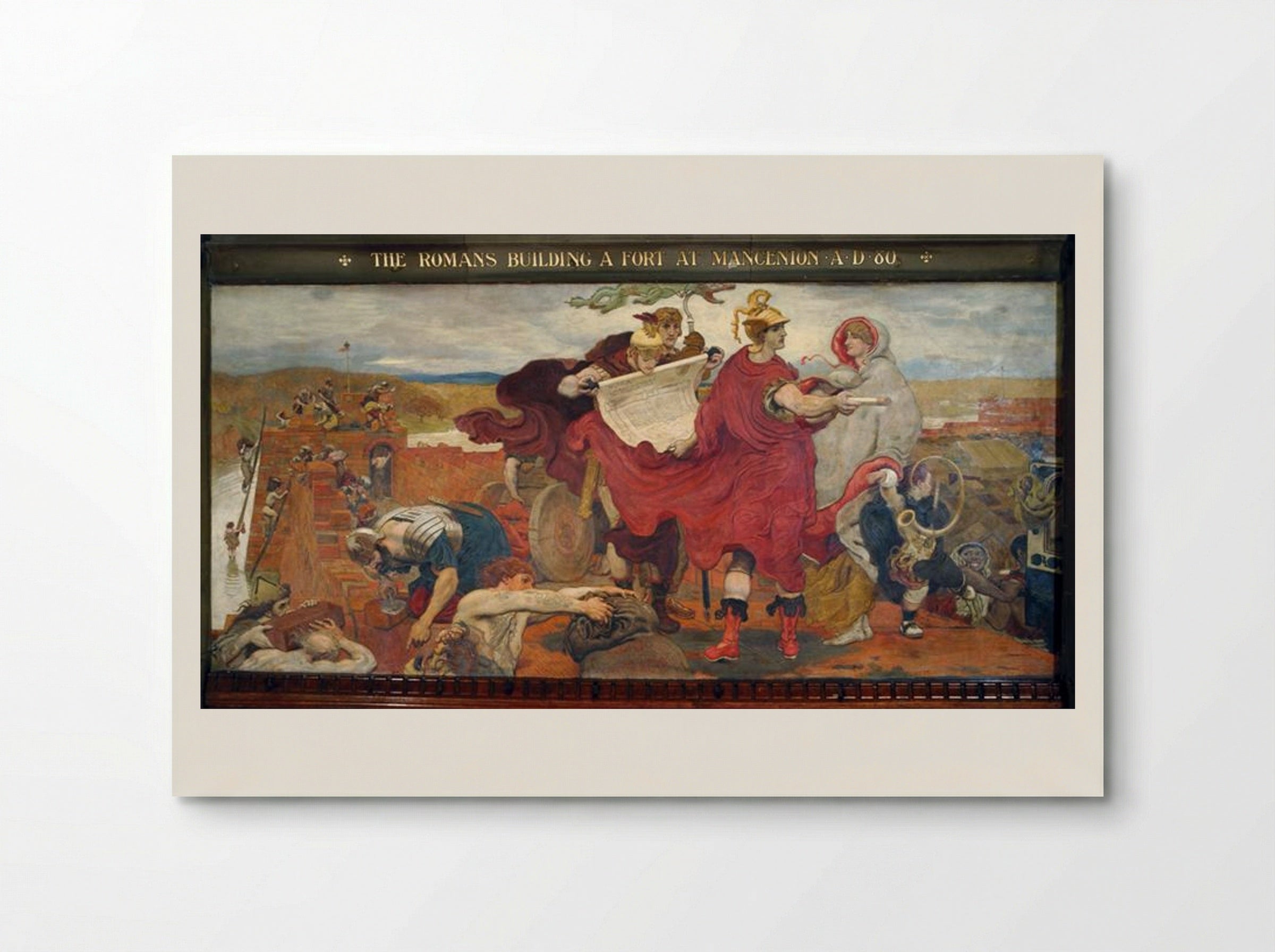
The Romans Building a Fort at Mancenion - Ford Madox Brown
Archival giclée
Frames arrive ready to hang
Secure checkout
Made to order
Description
A historical mural by Ford Madox Brown depicting General Agricola supervising the construction of the Roman fort at Manchester in A.D. 80.
Ford Madox Brown produced this work as the first in a series of twelve murals for the Great Hall of Manchester Town Hall. The scene depicts the Roman general Agricola supervising the construction of a fort at Mancenion, the Roman name for Manchester, in A.D. 80. Brown used the Gambier Parry process, a method of spirit fresco painting, to ensure the durability of the murals in the damp climate of northern England. This technique involved mixing pigments with wax and resin. The composition focuses on Agricola, who stands in the centre wearing a red cloak and a gilded helmet. He holds a scroll containing the architectural plans for the fort. Beside him, his wife and daughter observe the progress. The daughter wears a hooded cloak, shielding her from the wind. In the background, Roman soldiers and British captives labour to build the stone walls. Brown includes specific historical details, such as the legionary standards and the leather armour of the workers. A centurion stands nearby, holding a vine staff as a symbol of his rank. Brown avoided idealised depictions of history. He chose instead to show the physical effort and the mundane aspects of construction. The figures are muscular and their poses are strained. The palette consists of earthy reds and ochres alongside blue tones, which contrast with the pale skin of the Roman family. This mural is a record of Brown's interest in local history and his desire to create public art that documented the origins of the city. The artist conducted extensive research into Roman military dress and engineering to achieve accuracy. He even included a small detail of a soldier carving an inscription into a stone block. The work reflects the Victorian interest in the Roman occupation of Britain as a precursor to their own empire.
Return policy
Because every print is made to order, we don't offer change-of-mind returns, refunds or exchanges. If your order arrives faulty, damaged or incorrect, we'll replace it free of charge — just contact us within 48 hours of delivery. See our refunds page for full details.
Shipping
We ship worldwide, printing at the production hub nearest to your delivery address. Delivery times and costs vary by destination — you'll see the options available to you at checkout.
Manufacturing
Each print is produced to order using 12-colour giclée printing on FSC-certified archival paper. Designed in Britain and printed at your nearest production hub to reduce waste and speed up delivery.
Care and materials
Specific Features
Every Solis piece is made to order with archival, gallery-quality materials built to last.
- Museum-grade giclée printing for rich, fade-resistant colour
- Archival matte fine-art paper, FSC-certified
- Multiple sizes and framing options available
- Frames in black, natural wood, dark wood or white
- Framed prints arrive ready to hang
Care & Cleaning
To keep your artwork looking its best:
- Dust gently with a soft, dry cloth
- Avoid prolonged direct sunlight
- Never use liquid cleaners on the print or canvas surface
- Keep in a dry, room-temperature space
- Handle prints with clean, dry hands
Materials & Sizing
Museum-grade giclée on FSC-certified archival matte paper, with framed and canvas options.
- Paper sizes: A4, A3, A2, A1, A0 and B2 (50×70 cm)
- Canvas: XS (20×30 cm) to Large (60×90 cm)
- Frames: black, natural wood, dark wood or white
The Romans Building a Fort at Mancenion - Ford Madox Brown

Artist Biography
Ford Madox Brown
He was born in Calais in 1821, trained across Europe, and settled in London. Though never an official member of the Pre-Raphaelite Brotherhood, he was their most important older ally and the teacher who most shaped their ambitions. His insistence on painting outdoors in natural light, often to the point of physical discomfort, and his dense, moralising compositions made him a bridge between the Nazarenes he had studied with in Rome and the young English radicals who followed.
He also designed stained glass and furniture for Morris and Co. He died in 1893, at seventy-two.
Why Choose Us ?
Damage-free delivery guarantee
Fast Shipping
Museum-Quality Materials
You May Also Like