

Fine Art Poster
From $39
A giclée print on 200gsm matte fine art paper, using a twelve-colour process for accurate, fade-resistant colour. Supplied unframed, delivered flat or rolled.



Archival giclée
Frames arrive ready to hang
Secure checkout
Made to order
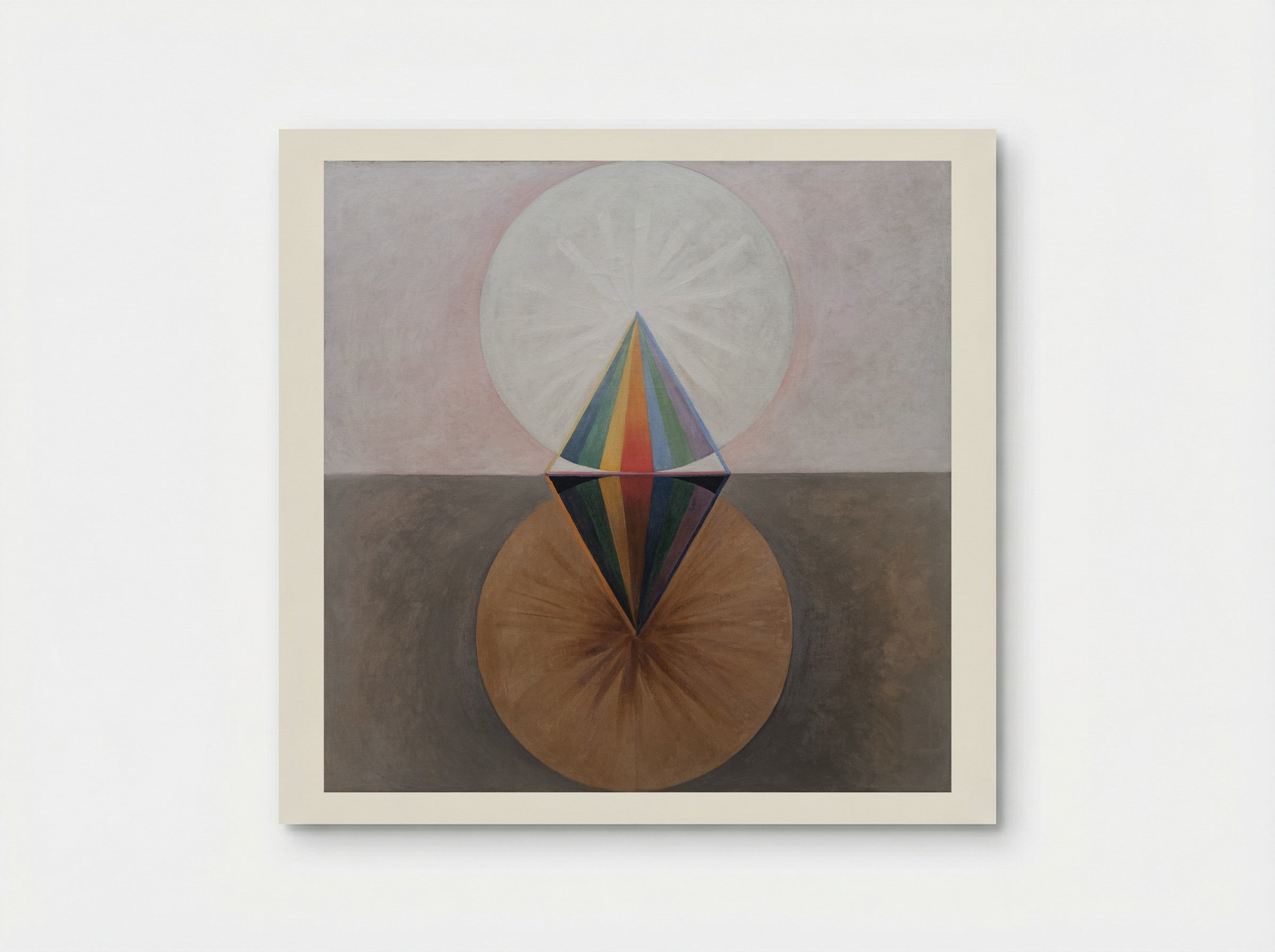
A geometric composition from 1915 by Hilma af Klint, exploring themes of duality and spiritual harmony through balanced, prismatic forms.
The Swan (No. 17) is a work from the series titled The Swan, created by Swedish artist Hilma af Klint in 1915. This series explores themes of duality, spiritual evolution, and the reconciliation of opposites. The composition is divided horizontally, separating the upper and lower halves of the canvas with a distinct horizon line. At the centre of the work sits a geometric form, resembling a diamond or a double-ended prism. This shape is segmented into vertical bands of colour, transitioning through a spectrum that suggests a prismatic light effect. The upper portion of the prism is set against a pale, circular background, while the lower portion is anchored by a darker, circular base. These circular elements evoke celestial or earthly spheres, grounding the more abstract geometric form. Af Klint was a pioneer of abstract painting, working in relative isolation from the mainstream art movements of her time. Her practice was deeply influenced by her interest in spiritualism, theosophy, and anthroposophy. She viewed her artistic output as a means to visualise complex metaphysical concepts that existed beyond the physical realm. The symmetry and balance present in this piece reflect her search for harmony between opposing forces, such as light and dark, or spirit and matter. Unlike many of her contemporaries who moved toward abstraction through the reduction of representational forms, af Klint developed a unique visual language based on symbols and geometry. The application of paint is precise, allowing the colours within the central prism to maintain a clear, structured appearance. This print captures the subtle textures of the original oil paint, providing a clear view of the artist's deliberate brushwork and the muted, earthy tones that define the background. It is a piece that invites quiet contemplation of form and balance.
You might also like
Because every print is made to order, we don't offer change-of-mind returns, refunds or exchanges. If your order arrives faulty, damaged or incorrect, we'll replace it free of charge — just contact us within 48 hours of delivery. See our refunds page for full details.
We ship worldwide, printing at the production hub nearest to your delivery address. Delivery times and costs vary by destination — you'll see the options available to you at checkout.
Each print is produced to order using 12-colour giclée printing on FSC-certified archival paper. Designed in Britain and printed at your nearest production hub to reduce waste and speed up delivery.
Specific Features
Every Solis piece is made to order with archival, gallery-quality materials built to last.
Care & Cleaning
To keep your artwork looking its best:
Materials & Sizing
Museum-grade giclée on FSC-certified archival matte paper, with framed and canvas options.
The Artwork
The Swan
Our guide to the original work behind this print.

Artist Biography
Made to order
Every piece is printed to order. These are the five finishes, and what makes each one different.
From $39
A giclée print on 200gsm matte fine art paper, using a twelve-colour process for accurate, fade-resistant colour. Supplied unframed, delivered flat or rolled.

From $119
The same fine art print in a solid wood frame with UV-protective acrylic glaze and rigid backing. Five frame colours. Arrives ready to hang.

From $189
A deeper solid wood frame: 33mm deep with a 20mm face and Perspex glaze. The print sits unmounted for a clean gallery presentation. Black, white or natural.

From $59
Hand-stretched canvas with neat gallery-wrapped edges, giving the artwork surface texture and depth. Arrives ready to hang.

From $175
Stretched canvas set in a floating wood frame, our most substantial finish. Arrives ready to hang.
Why Choose Us ?
Damage-free delivery guarantee
Fast Shipping
Museum-Quality Materials
You May Also Like
We use cookies to measure our marketing and see which prints people love.We use cookies to measure our marketing.
By continuing to browse, you agree · Privacy Policy