


In summer 1967, Agnes Martin walked out of her New York studio at the bottom of Manhattan, gave away most of her materials, sold or destroyed the canvases she had not been able to sell, bought a pickup truck and a small camping trailer, and drove west. She was fifty-five years old. She did not paint again for seven years.
She had been working in New York since 1957 and had been part of the loose group of artists living at Coenties Slip, a small block of derelict buildings near the South Street Seaport. Her neighbours had included Robert Indiana, Ellsworth Kelly, Jack Youngerman, and Lenore Tawney. By 1965 her paintings were being shown at the Robert Elkon Gallery and acquired by major collectors. She had a New York reputation. She was leaving it deliberately.
Saskatchewan
Martin was born in 1912 in Maklin, a small farming town in the Canadian province of Saskatchewan. Her father died when she was two. Her mother, a strict Presbyterian, raised her and her three brothers on a small farm during the prairie depression of the 1920s and 1930s. The childhood was poor, isolated, and unhappy. Martin would later describe her mother's emotional coldness as one of the formative facts of her life.
She left home as soon as she could. She trained as a teacher in Vancouver in the early 1930s, taught in rural Canadian schools, and moved to the United States in 1932 to take care of a pregnant sister. She became an American citizen in 1950. She studied painting at Columbia Teachers College in New York from 1941 to 1942 and again from 1951 to 1952, after which she moved to New Mexico for the first time and taught painting at the University of New Mexico.
New York
The first significant period in her painting life began in 1957, when Betty Parsons, the New York dealer, visited her in New Mexico and invited her to come to New York. Parsons, who had been Pollock's and Rothko's first dealer in the 1940s, recognised something in Martin's early gridded work and offered her a New York show.
Martin moved to New York that year. She took the small loft at Coenties Slip and began producing the work that would make her reputation: large square canvases (most often 1.83 metres on a side) covered with delicately ruled grids of horizontal and vertical lines, drawn in pencil over a pale ground of oil or acrylic wash. The grids were calculated but slightly imperfect. The hand of the maker was always visible in the slight wavering of the lines and the small variations in pressure.
The paintings were difficult to photograph and almost impossible to reproduce. They had to be seen in person. At close range they revealed the labour of the pencil work; at a distance of a few metres they began to fill the visual field with a kind of even, vibrating light. The paintings were neither minimalist (the hand was too visible) nor abstract expressionist (the gesture was too restrained). They occupied a position of their own.
The Departure
The departure from New York in 1967 was triggered by several events in close succession. Ad Reinhardt, the painter Martin most admired among her contemporaries, died in August 1967. The Coenties Slip buildings, where she had lived for ten years, were being demolished for new construction. Martin had also suffered (and would continue to suffer) from auditory hallucinations and what she described as catatonic episodes, which had brought her to McLean Hospital outside Boston for several extended stays in the early 1960s. Her doctors had diagnosed her with paranoid schizophrenia.
The combination of personal grief, the loss of the studio neighbourhood, and the strain of New York life made her decide to leave. She had been considering it for some time. The summer of 1967 was when she acted.
The Seven Years
For the next seven years, Martin lived in various places in New Mexico. She camped in the truck for the first year, then bought a small piece of land near the Cuba area in 1968 and built an adobe house and studio with her own hands. She did not paint. She wrote: small notebooks of meditations and prose poems, several of which would later be published. She read Daoist and Zen Buddhist texts. She listened to classical music. She lived almost entirely alone.
The seven-year break has been the subject of much speculation. Martin herself, asked about it later in life, was usually opaque. She said the break had been about "wanting to think." She gave no other detailed explanation. The break should probably be understood as a deliberate strategic withdrawal: she had been working at a certain level in New York and wanted to come back to painting only when she had something different to say.
The Return
Martin began painting again in 1974, in her adobe studio outside Cuba. She was sixty-two. The new work was related to the pre-1967 grids but was different in important ways: the colour was no longer just a pale ground but had become the primary visual event of the paintings; the grids were less prominent, sometimes replaced by horizontal bands of pale wash; the formats had widened slightly.
The first new paintings were shown at the Pace Gallery in New York in 1975. The reception was strong but cautious; many critics needed to be reminded who Martin was, after the seven-year absence. By the late 1970s, her reputation had been re-established.
Taos
In 1992, after eighteen years in the Cuba house, Martin moved to Taos, the small town in the Sangre de Cristo Mountains north of Santa Fe. She was eighty. She bought a small modern studio building near the centre of town and an adjacent house. She painted there nearly every day until her death.
The Taos years produced her most concentrated late work. The paintings were now slightly smaller (often 1.5 metres square), with horizontal bands of pale colour washed across the canvas: pinks, blues, yellows, and greys. The grids were sometimes invisible, the colour bands carrying the painting on their own. Each painting was titled with a single word: Friendship, Innocent Love, Untroubled Mind, Lovely Life.
The titles read as instructions to the viewer about what the painting was offering. Martin had become explicit, in her late writing and her late conversations, about her view that the paintings were vehicles for specific emotional states. "The paintings are not landscapes," she said in a 1989 interview. "They are about what life feels like when it is at its best."
The Influence
By the 1990s, Martin had become a foundational figure for a younger generation of painters who were working in pared-down, attentive, contemplative modes. Painters as different as Sean Scully, Susan Rothenberg, Brice Marden, and Vija Celmins all named her as an important precedent. The Tate Modern's 2015 retrospective in London, which travelled to the Solomon R. Guggenheim in New York and Los Angeles County Museum of Art, made her standing as one of the central American painters of the second half of the twentieth century explicit.
The reception was not universal. Some critics found the late work too repetitive. Others found the late writing's invocation of "joy" and "innocent love" too earnest. The work was also accused of being apolitical in a period when much of the most-discussed American art was explicitly political.
The defence of the work has usually rested on the structure rather than the content. Martin had developed, over forty years of painting after 1957, a way of using a small set of formal devices (grid, band, pale colour, soft graphite) to produce paintings that operated on the viewer at a specific physiological frequency. The paintings work, when they work, because of how the eye reads them at close range.
The End
Martin died on 16 December 2004, aged ninety-two, in Taos. She had continued to paint until shortly before her death. The last canvases (now mostly in private collections) are smaller than the standard 1.5-metre square, and the bands of colour are even more reduced.
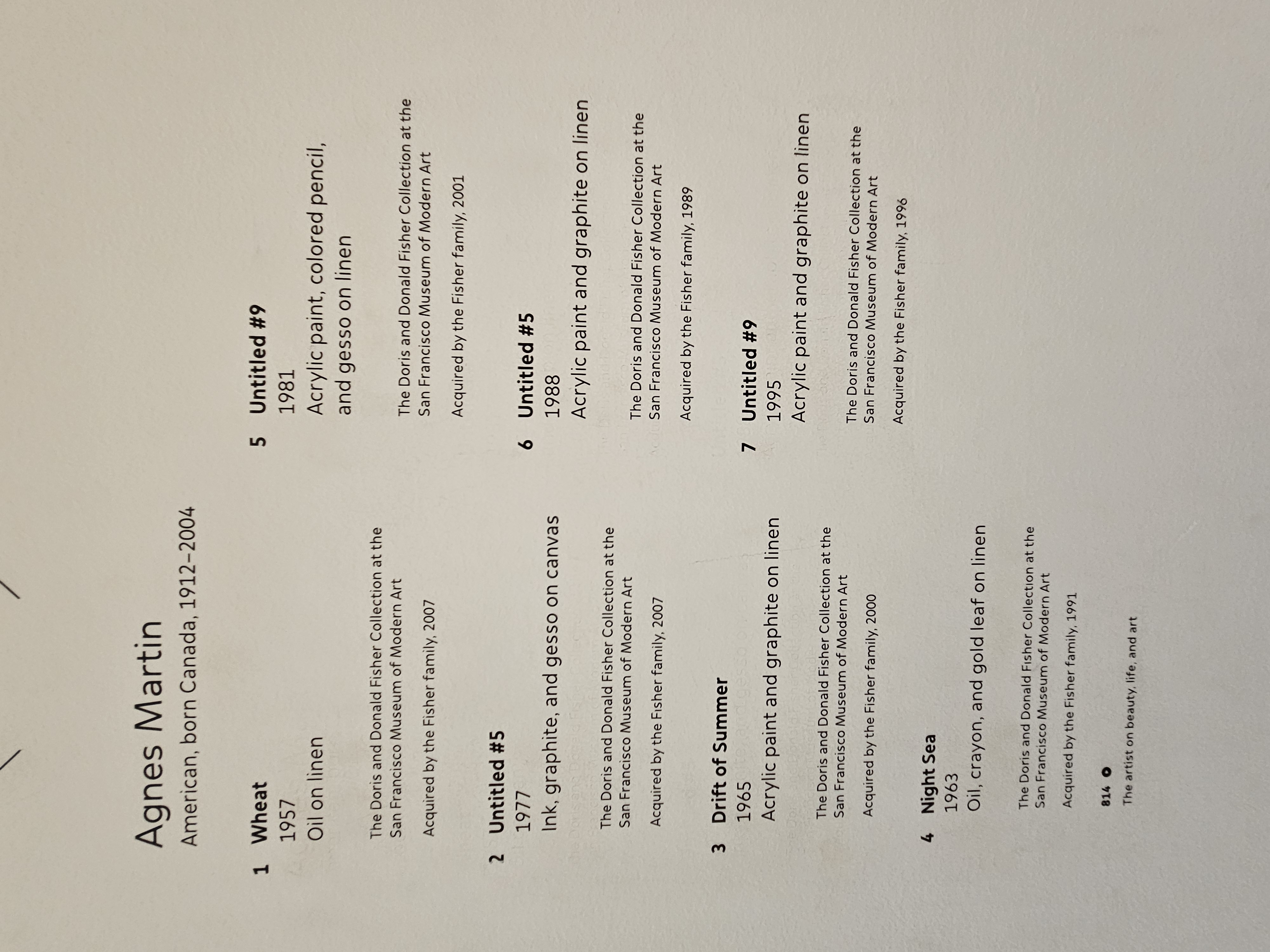
The Harwood Museum in Taos has a permanent room of seven late Agnes Martin paintings. The Dia Beacon, in upstate New York, has a permanent installation of the major mid-period paintings. The Tate Modern and the Museum of Modern Art each hold significant individual works. The Agnes Martin Foundation, established in her will, manages her archive and the disposition of her remaining works.
What the Departure Was For
The seven-year break from painting between 1967 and 1974 has come to look, in retrospect, like the most important decision of Martin's career. She had been a successful New York painter; she could have continued and done well. By leaving, she let her work reset. By returning at sixty-two, she gave herself another thirty years of working at the highest level she ever reached.
Martin painted for forty-seven years total. Almost all the work that matters most was made after she was sixty. The pre-1967 grids are foundational, but the post-1974 paintings (the Cuba paintings, the Taos paintings, the late horizontal bands) are what most viewers now think of when they think of an Agnes Martin painting.
She had decided, in 1967, that what she had to say required her to stop talking first. The decision was unusual. It produced, in the end, the strongest second act in twentieth-century American painting.


