


In the fifth month of 1794, kabuki fans in Edo started seeing a name they had never encountered before: Tōshūsai Sharaku. Over the following ten months, ending in the first month of 1795, the publisher Tsutaya Jūzaburō issued somewhere around 140 to 150 print designs under that name, almost all of them portraits of kabuki actors, with a few sumo wrestlers and warriors included. Then the prints stopped, and Sharaku vanished. No later work bears his name, no contemporary diary mentions him, and his identity is still argued over today. The strongest candidate is a minor Noh actor called Saitō Jūrōbei.
Ten Months, One Publisher, About 150 Prints
Japanese lunar-calendar months do not map cleanly onto Western ones, so scholars date Sharaku's debut to the fifth month of Kansei 6, which ran from 29 May to 26 June 1794. His opening batch was twenty-eight ōkubi-e, or large-head bust portraits, in the ōban sheet size, tied to plays running that month at Edo's three licensed kabuki theatres: the Miyako-za, the Kiri-za and the Kawarazaki-za. All twenty-eight were printed against mica grounds, most of them dark grey or near-black, that made the actors' faces glint under lamplight. Every print in the Sharaku catalogue, without exception, was issued by one man: Tsutaya Jūzaburō, the leading print and book publisher in Edo. No rival publisher's name appears anywhere in his output.
The catalogue itself is unusually short. Reference works list him simply as "Tōshūsai Sharaku, active 1794 to 1795" because that is all that can be proven: a working name attached to a run of prints between two fixed dates, nothing before and nothing after. Even the total is an estimate. Specialists have counted as few as 140 and as many as roughly 150 designs, depending on whether preparatory drawings and disputed sheets are included in the tally.
Faces Built to Unsettle
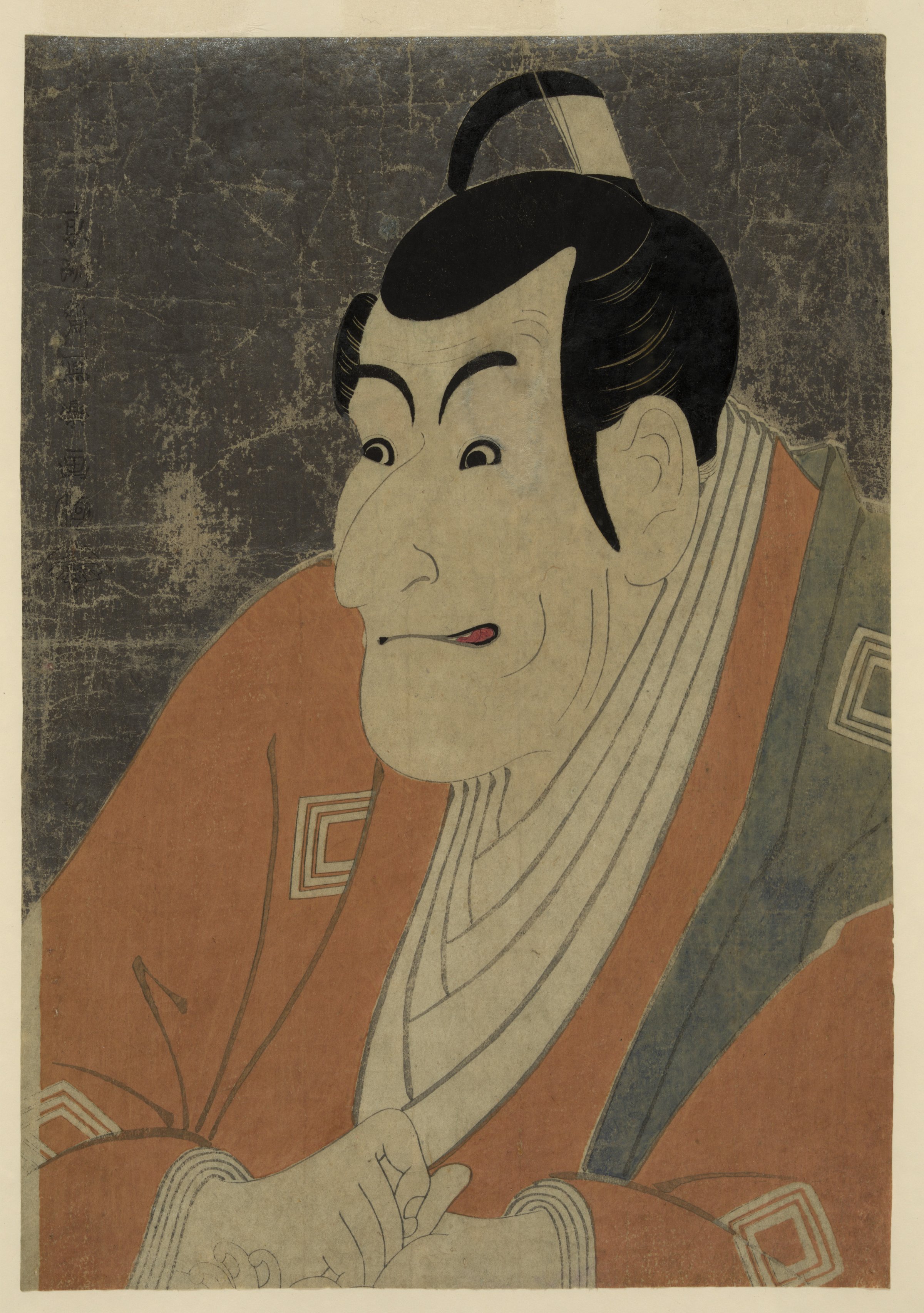
The twenty-eight ōkubi-e are what made Sharaku's name, and what still draw crowds to exhibitions of his work today. Take the actor Ōtani Oniji III, shown as the servant Edobei in the play Koi Nyōbō Somewake Tazuna, staged at the Kawarazaki-za. Sharaku crops in tight on the face: a jutting nose, a curled lip, fingers spread and hooked as the character gropes toward his victim. It is not a flattering picture. It is a picture of a man performing villainy, drawn by someone more interested in the psychology of the role than in the vanity of the actor playing it.
Sharaku applied the same scrutiny to heroic roles, not just villainous ones. In a companion print from the same production, Ichikawa Ebizō appears as the samurai Takemura Sadanoshin in the moment before he takes his own life to preserve his honour, hands clenched, eyes strained under the weight of the decision. Earlier designers working in bust portraiture, Katsukawa Shunkō and Shun'ei among them, had stayed closer to flattering convention. Sharaku's contemporary Utamaro was doing something related in his portraits of women, reading mood and character rather than settling for prettiness, and Sharaku pushed that same instinct further, to the edge of caricature.
A Falling Off, Batch by Batch
After the ōkubi-e, Sharaku's output declined in stages that scholars still use to divide his career into four periods. A second batch of thirty-eight designs followed in the seventh and eighth months of 1794: thirty half-length portraits on plain yellow grounds in the narrow hosoban format, and eight pairs of actors kept on the white or dark mica grounds of the debut series. A third batch, in the eleventh month of 1794, moved into hosoban and the mid-sized aiban format and is generally judged weaker again. A fourth and final batch, fifteen hosoban prints from the first month of 1795, carries a different signature form from the rest and is the least admired of the four periods. Somewhere in this run Sharaku also produced two warrior prints and at least one sumo design, minor by count but proof that Tsutaya was still willing to try him in other genres before the commissions ended for good.
Why the Prints May Not Have Sold
The oldest explanation for Sharaku's disappearance is commercial: his prints stopped selling. Edo's actor-print buyers generally wanted a favourite performer flattered. Sharaku gave them faces distorted by effort, vanity or malice, and later writers assumed that actors, their fans, or the theatres themselves objected. Tsutaya had reason to be careful about objections. Three years earlier, in 1791, censors enforcing the Kansei Reforms had fined him half his personal wealth over books he had published by the writer Santō Kyōden, ruled to have broken the new decency laws. A publisher already punished once for pushing too far had a clear motive to drop a designer causing him trouble a second time.
Recent researchers are less certain that unpopularity explains everything. No sales record survives, and no contemporary complaint documents actors or audiences reacting against him; the idea rests mostly on inference from the prints themselves. Other explanations compete with it: that Sharaku lost the co-operation of the actors he depicted and so could no longer sit close enough to draw them, or that Tsutaya simply redirected his money toward other designers, Utamaro among them, once the novelty wore off. None of these theories has displaced the others. What is certain is that after the first month of 1795, the commissions ended.
Fifty Years of Silence, Then a Name
For half a century after 1795, nobody wrote down who Sharaku was. The earliest surviving attempt appears only in 1844, in an expanded edition of the Ukiyo-e Ruikō (Ukiyo-e Miscellany) revised by Saitō Gesshin. It gives Sharaku's real name as Saitō Jūrōbei and an address: Kyōbashi Hatchōbori, in what is now central Tokyo. That is the entire biographical record. No portrait of him survives, no family history, no explanation of why a name attached to roughly 150 prints should surface only after fifty years of silence.
Ignored at Home, Rediscovered Abroad
Sharaku's reputation did not travel well within Japan. Through the nineteenth century, Japanese writing on ukiyo-e treated him as a minor figure beside more prolific and more popular designers. What changed his standing was a book published in Munich in 1910: Sharaku, by the German art historian Julius Kurth. Kurth set the actor busts beside Rembrandt and Velázquez, arguing that Sharaku belonged among the major portraitists of any tradition, not just among ukiyo-e specialists. The book arrived at the height of Japonisme, when European collectors were already assembling print collections and looking for the next name to champion. A second, expanded edition followed in 1922. Japanese scholarship caught up afterwards, reclaiming an artist whose reputation had, by then, already been made somewhere else.
The Noh Actor Theory
Saitō Gesshin's 1844 identification remains the theory most specialists take seriously, and later research has added circumstantial detail to it. Saitō Jūrōbei was a Noh performer employed by the Hachisuka family, daimyō of the Awa domain (present-day Tokushima), who kept a residence in Edo at Kyōbashi Hatchōbori, matching the 1844 address exactly. Domain records show the Awa lord in Edo from the sixth day of the fourth month of 1793, then absent from the twenty-first day of the fourth month of 1794 until the second day of the fourth month of 1796, travelling to his domain under the shogunate's sankin-kōtai (alternate-attendance) system. If Jūrōbei did not have to travel with him, he would have been free in Edo for almost exactly the window in which Sharaku was active. A Noh programme from 1816 lists a performer of the same name, confirming that a Noh actor called Saitō Jūrōbei genuinely existed, though that alone does not prove he was Sharaku. Other candidates have been proposed since, none with comparable supporting detail. Most standard references now treat the identification as the leading theory rather than as settled fact.
If Saitō Jūrōbei really was Sharaku, he went back to performing Noh and never designed another print. Kabuki's most unsparing portraitist worked for ten months, then chose, or was made, to disappear.


