


In the early twelfth century, in the Northern Song capital of Bianjing (modern Kaifeng), a court painter finished a handscroll 25 centimetres high and about 5.25 metres long. Unrolled section by section, right to left, it shows the city and its river in one continuous view: open fields give way to suburbs, suburbs to a crowded bridge, the bridge to a gated wall and a market street beyond. A modern count puts the human population of the scene at 814, alongside dozens of boats, pack animals and buildings. The scroll carries no signature and no date. Both the painting's title and its attribution to the painter Zhang Zeduan come from a single note, written by the scholar Zhang Zhu in 1186 and mounted onto the scroll as a colophon, decades after the paint had dried.
A painting this size, this old and this precisely populated would be remarkable if it merely survived. By modern count it shows 28 boats, 60 animals, about 170 trees and some 30 buildings, and, at its centre, one bridge that very nearly fails. That it survives at all, carrying this much information, makes it less a single image than a continuous record, made by someone who had clearly watched before he painted.
An Unnamed Painter, Named Later
Zhang Zhu's colophon is short. It states that the painter, Zhang Zeduan, was a native of Dongwu (present day Zhucheng, in Shandong). He studied as a young man, then travelled to the capital and took up painting, excelling at jiehua, ruled-line painting done with a straight edge rather than free brushwork: boats, carts, bridges, market streets, moats and city walls. Zhang Zhu cites an earlier catalogue, Mr Xiang's Evaluation of Pictures, which places two of the artist's works in the "divine class", the highest rank available. One was a Regatta on West Lake, not otherwise known today. The other, named only by title, fits this scroll better than anything else Zhang Zhu mentions.
That is the entire biographical record. Later reference works give Zhang Zeduan dates, 1085 to 1145, and a post at the Hanlin Painting Academy under Emperor Huizong, but these rest on inference rather than on any surviving document. Much of what might have confirmed or corrected them was lost a few decades after the scroll was painted, when Jin dynasty armies overran Bianjing in 1127 and the Song court fled south. The painting may be a rare survivor of exactly the world it shows.
Even the title is less settled than a museum label suggests. Zhang Zhu wrote his colophon on the day after the Qingming festival of 1186, which may be no more than an accident of timing, though it has encouraged readers who want Qingming to mean the spring festival of tomb sweeping rather than the alternative sense, peace and brightness, a stock phrase for good government. Scholars have argued for both readings, and for a deliberate double meaning. Zhang Zhu did not resolve the question; he simply supplied the title that later cataloguers kept.
A Painting Built to Be Unrolled
Along the River During the Qingming Festival is painted in ink and colour on silk, and it was never meant to hang on a wall. A handscroll is stored rolled up in a box and opened a stretch at a time on a table, read right to left the way Chinese text runs, and rolled closed again behind the viewer's hands as a new stretch opens ahead. There is no single vantage point from which the whole composition can be seen at once, not even now, when a photograph can flatten the whole 5.25 metres onto one screen.
The route follows the river outward from open country. Willows and a train of pack animals appear first, then the outskirts of the city: inns and a boat under repair, farmers bringing produce in by cart. The pace quickens as the buildings close in, building toward the painting's acknowledged centre: a wooden bridge arcing over the water, thick with pedestrians, above a river crammed with boats. Past the bridge, the scroll runs through a city gate and along a street lined with shops and stalls, before the paint stops and the silk ends.
Shops, Doctors and a Line of Camels
What the scroll records is commerce, not ceremony. Restaurants advertise themselves with cloth banners and timber signboards. Wine shops, noodle stalls, a doctor's clinic and a fortune teller's table appear along the main street, each with customers and staff occupied in specific, legible tasks rather than posed for the painter. Porters carry loads on shoulder poles. Ox carts and handcarts compete with sedan chairs for road space, and a line of camels, heavy with cargo, files through one of the city gates, a reminder that Bianjing's markets were fed by overland trade as well as by the river.
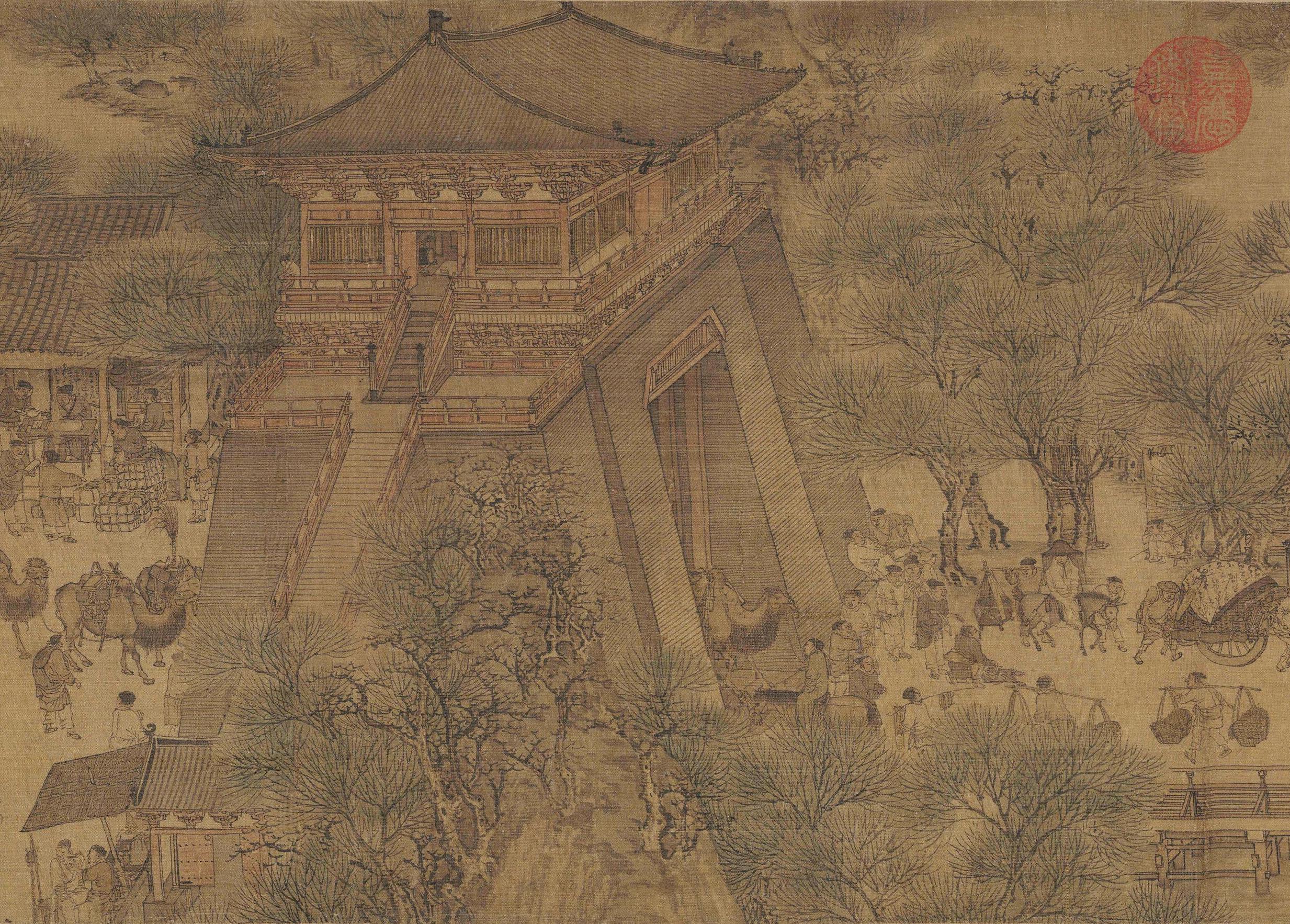
The river itself was a working waterway before it became a subject for a court painter. The Bian canal linked Bianjing to the network that carried grain from the south to feed the capital, and the scroll shows the traffic that depended on it: barges being loaded and unloaded alongside a boatyard where rope and rigging are under repair. Zhang Zhu's colophon singles out boats and bridges as the artist's particular strength, and the density of nautical detail, different hull types, the way a mast is raised or struck, supports the idea that whoever painted this had watched real boats closely before drawing one.
The Bridge That Nearly Failed
The scroll's best-known passage is a single moment of near disaster. At the painting's midpoint, a wooden bridge without a single pier in the water arcs across the Bian river in a single span of about 20 metres, built from interlocking timbers pinned and wedged together rather than nailed, a technique sometimes called beam weaving. Contemporaries called it the Rainbow Bridge, Hongqiao, for its shape. In the painting, a large boat approaches with its mast still raised, seconds from striking the underside of the arch. Boatmen shout and haul at ropes. A man leans from the rail to pass down a line, while a crowd presses in along the bridge to watch.
The bridge was real enough to rebuild. In 2000, the bridge scholar Tang Huancheng, working with a team from MIT for a television documentary, reconstructed a span using only the joinery visible in the painting: no nails, no piers, interlocking timbers carrying the load through friction and geometry alone. The finished bridge, built by hand in a Chinese village, held the weight of a water buffalo without strain. A nine-hundred-year-old painting had supplied a working engineering drawing.
Why It Is Called China's Mona Lisa
The comparison is a modern one, and it does not rest on shared subject matter or style. The Mona Lisa is a single face; the Qingming scroll is a crowd of 814 individually posed strangers. What the two paintings share is a fame that has outgrown ordinary art history: both are the one work most people can name from their tradition, and both draw crowds who queue for hours to see an object that photographs already show them in full.
The Chinese comparison also carries a note the Louvre's painting does not. The scroll has been read for centuries as a document as much as a picture, cited by economic historians for shop layouts and by naval historians for hull design. Leonardo's picture keeps its secret (why does she smile) with total economy. Zhang Zeduan's scroll works by accumulation, 814 separate lives rather than one ambiguity, and its fame rests on being exhaustive rather than enigmatic. That is arguably the harder trick.
The Qing Court's Version, Enlarged
The original scroll was copied and reinvented throughout the rest of imperial history, each new version updating the fashions and architecture to its own period while keeping the title and the same journey from country to city. The most elaborate remake was finished in 1736, the first year of the Qianlong Emperor's reign, the work of five court painters: Chen Mei, Sun Hu, Jin Kun, Dai Hong and Cheng Zhidao. Their version runs to about 11.5 metres, more than double the length of the Song original, painted in stronger colour and finer, more even brushwork suited to Qing taste rather than Northern Song habit.
This Qing court version now belongs to the National Palace Museum in Taipei, part of the imperial collection moved from Beijing during the Chinese civil war. It has been exhibited and reproduced more often than the fragile Song original, and for many visitors it is the version they meet first: more colourful and easier to photograph from end to end.
A Painting Too Fragile to Show
The Song original stays in Beijing, in the Palace Museum inside the Forbidden City, and it is shown rarely and briefly. Nearly a millennium of rolling and unrolling has left the silk fragile, and conservators limit its exposure to light and to the physical stress of display. When it has travelled (to Hong Kong in 2007, to Tokyo in 2012) queues formed for hours, and viewing time per visitor was cut to seconds on a moving walkway. For most people, in China and outside it, the scroll is known through reproduction: prints, screens, textbook plates, and now high-resolution scans that let a viewer do on screen what the silk itself can no longer safely do very often, unroll from end to end.
The Same Dynasty, a Different Register
It is worth setting this scroll against the other object the Northern Song is best known for among collectors: its ceramics. The celadon bowls and Ru ware of the same court, the same decades, pursue almost the opposite effect: plain surfaces and a single glaze, nothing added for the eye to read as a story. Zhang Zeduan's scroll is the crowded, noisy counterpart to that restraint, proof that the dynasty which prized a bowl for what it left out also produced a painter who left almost nothing out. Read side by side, the two traditions describe one court from opposite ends: the quiet of the kiln and the noise of the river.


