



Albert Lynch
- portrait
- genre painting
Albert Lynch built his career on one subject above all others: the fashionable women of Belle Époque Paris, rendered in pastel and watercolour with a technical fluency that won him three Salon prizes before 1900[1]. His origins were more tangled than his canvases suggest. Born on 26 September 1860[1] in Gleisweiler, Prussia, to a Peruvian merchant father and a German mother whose own father was a landscape painter based in Paris, Lynch grew up amid artistic connections and cross-national identities.
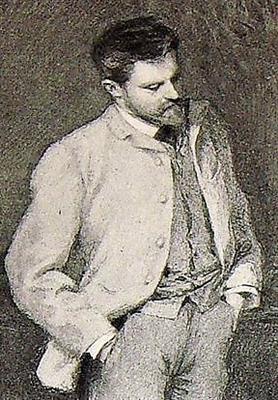
Biography
He trained at the École des Beaux-Arts in Paris under Gabriel Ferrier and Henri Lehmann, first exhibiting at the Paris Salon in 1879[1]. Awards came at the Salon in 1890 and 1892; a gold medal followed at the Exposition Universelle in 1900. He continued exhibiting at the Salon until at least 1934, maintaining a consistent output across more than half a century.
Alongside his portrait[1] and figure work, Lynch contributed illustrations to major literary publications of the period, including works by Alexandre Dumas fils, Honoré de Balzac, and Henry Becque. These commissions brought his refined draughtsmanship to a wide readership and linked him to the cultural life of the Third Republic.
He favoured pastel and gouache over oil, preferring the immediate luminosity they offered for depicting skin, fabric, and indoor light. In 1930[1] he moved to Monaco, where he died in 1950[1]. His work remains sought after for the way it captures the elegance and surface pleasure of a Parisian era that ended with the First World War.
Timeline
- 1860Born in Gleisweiler, Prussia on September 26th.
- 1879First exhibited at the Paris Salon.
- 1890Award at the Salon.
- 1892Award at the Salon.
- 1900Gold medal at the Exposition Universelle.
- 1930Moved to Monaco.
- 1934Exhibited at the Salon.
- 1950Died in Monaco.
Notable Works
Tap to view larger.
Next stop
Browse the movements →
Every movement in the collection, from the Renaissance to Pop art.
Related Artists

Frequently Asked Questions
What is Albert Lynch known for?
Albert Lynch is known for his depictions of fashionable Parisian women during the Belle Époque. His technical skill in pastel and watercolour earned him three Salon prizes before 1900[1].What is Albert Lynch's most famous work?
It is difficult to name one single work as Albert Lynch's most famous. He was a prolific artist, and his popularity varied during his career and after his death. Lynch was known for his elegant portraits of women, often depicted in scenes of leisure or domestic life. These paintings and drawings capture the Belle Époque aesthetic, and were popular with the upper classes. Lynch's works often appeared as illustrations in books and magazines, increasing his visibility. He gained recognition at the Salon de Paris, receiving medals in 1890[1] and 1892. His style, while not associated with any particular movement, appealed to a wide audience due to its grace and beauty. While there isn't one specific piece that overshadows all others, his collective body of work has secured his place in art history.What should I know about Albert Lynch's prints?
Albert Lynch was a late 19th-century artist who worked in painting and drawing, and whose art was reproduced as prints. When considering prints of his work, it is helpful to understand the terminology around printmaking, as well as the ethics of print marketing. Since the late 19th century, sophisticated photomechanical techniques have allowed for high-quality reproductions of existing artworks. This has created a need to distinguish between an original print (made by the artist as a print) and a reproduction (copy of a work in another medium). Original prints are often sold in limited editions, where the number of prints is limited by the life of the plate. Some publishers also impose limits to increase the value of a print. All prints in a limited edition should be numbered (for example, 12/25, meaning print number 12 from an edition of 25). The artist typically signs and numbers the prints in pencil. Some artists also create a small number of artist's proofs, which are numbered separately (for example, 5/100 AP).What style or movement did Albert Lynch belong to?
Albert Lynch (1851-1933[1]) was a Peruvian artist who achieved recognition in Paris. He is best known for his elegant portraits of women, and his work is often associated with the Belle Époque. This period, roughly from the late 19th century to the start of World War One, saw an interest in romanticism and idealism in art. Lynch's style incorporates elements of academic art, which valued technical skill and classical themes. He also drew inspiration from Impressionism, particularly in his use of light and colour. Although not strictly an Impressionist, Lynch adopted some of their techniques, such as capturing the fleeting effects of light and atmosphere. His paintings often feature soft, diffused light and delicate pastel shades. Lynch's artistic approach blends academic precision with Impressionistic sensibilities, resulting in a distinctive style that appealed to the tastes of his time.What techniques or materials did Albert Lynch use?
The term "technique" in art refers to the manual and mechanical operations that act upon raw materials; these shape and mould the materials according to specific artistic intentions. It is a complex of processes, not just a method of execution. Understanding an artist's techniques requires knowledge of the materials used and how they behave. When analysing paintings, one must consider the type of paint (oil, watercolour, gouache, or acrylic) and the ground or support. The condition of the artwork is also a factor, as paintings can suffer damage from accidents, neglect or cleaning. Artists are not always restricted by their chosen medium. Choices are made that exist outside the constraints of materials. Examining the relationship between the qualities of the medium, the techniques used, and the aesthetic decisions made by the artist is essential to understanding art history.What was Albert Lynch known for?
Albert Lynch, a Peruvian artist who spent his career in France, was known for genre paintings. Genre painting depicts scenes of everyday life. Often, these paintings portray ordinary people engaged in common activities. Genre painting gained popularity in the Netherlands during the 17th century; artists such as Johannes Vermeer created celebrated examples. Vermeer's *The Milkmaid* (circa 1657-1658[1]) presents a domestic scene of a woman in a simple kitchen. In 19th-century Britain, William Maw Egley painted *Omnibus Life in London* (1859), another example of the genre. Lynch's work fits within this tradition, focusing on scenes of daily life. These paintings offer insights into the customs, manners, and social interactions of a particular time and place. By capturing moments from ordinary life, genre paintings provide a window into the everyday experiences of people throughout history.When did Albert Lynch live and work?
Albert Lynch was active as a painter during the late 19th and early 20th centuries. Details of his life are scarce, but his exhibition history provides some information. Lynch's work appeared in various shows, mainly in France, during the late 1800s. He exhibited ten paintings at the Salon des Indépendants in Paris in both 1896[1] and 1897. Lynch also contributed to the Société Internationale de Peinture et de Sculpture. Lynch's paintings were included in group exhibitions with other artists, such as Jean Beraud, Paul Chabas, and Henri Le Sidaner. These exhibitions often took place at venues like the Grafton Galleries. While specific biographical details remain limited, Lynch's artistic activity places him firmly within the artistic circles of his time.Where can I see Albert Lynch's work?
It is difficult to pinpoint exactly where one might view works by Albert Lynch, as his paintings often appear in private collections and at auction. However, some museums with collections of similar art from the same period include: the Metropolitan Museum of Art (New York); the Los Angeles County Museum of Art (LACMA); the Minneapolis Institute of Arts; the Royal Ontario Museum (Toronto); the Virginia Museum of Fine Arts (Richmond); the Wolfsonian at Florida International University (Miami Beach); Brighton Museum & Art Gallery (UK); Manchester Art Gallery (UK); the National Museums of Scotland, Royal Museum (Edinburgh); and the Victoria & Albert Museum (London). Checking the online collections catalogues of these museums, and others with holdings of late 19th- or early 20th-century French[1] art, may turn up works by Lynch in public collections.Where was Albert Lynch from?
Albert Lynch was born in Germany. Strasbourg, in Alsace-Lorraine, was his birthplace. He was born on 16 September 1886[1]. In 1904, after leaving the Ecole des Arts et Métiers in Strasbourg, Lynch visited Paris. During this trip, he published his poetry for the first time. From 1905 to 1907, he studied at the Kunstschule of Weimar. In 1908, he moved to Paris, where he attended the Académie Julian. Later, in 1909, Lynch relocated to Switzerland. There, in 1911, he became a founder of the Moderner Bund group. The following year, he met Robert and Sonia Delaunay in Paris, as well as Vasily Kandinsky in Munich. Lynch participated in the Erste deutsche Herbstsalon in 1913 at Der Sturm gallery in Berlin. After returning to Paris in 1914, he became acquainted with Guillaume Apollinaire, Max Jacob, and Pablo Picasso. In 1915, he moved to Zurich, where he executed collages, often in collaboration with his future wife, Sophie Taeuber.Who did Albert Lynch influence?
It is difficult to say precisely who Albert Lynch influenced directly. However, one can identify artists with similar subject matter or technique. Lynch's paintings often depicted fashionable women in domestic settings, a theme also explored by artists such as Pierre Auguste Renoir and Alfred Stevens. Like Lynch, they captured the elegance of contemporary life. Technically, Lynch's smooth, academic style shares similarities with other late 19th-century artists such as William-Adolphe Bouguereau and Jean-Léon Gérôme. These artists prioritised realism and technical skill. It is important to note that influence can be a complex thing. It is not always a direct relationship, and artists may be inspired by a variety of sources. Without more specific information, it is hard to name particular artists who were definitely affected by Lynch's work.Who influenced Albert Lynch?
It is difficult to say with certainty who influenced Albert Lynch, as sources do not directly address this question. However, we can look at some of his contemporaries and predecessors to gain insight. Lynch was active during a period of significant artistic change. The late 19th century saw the rise of Impressionism and Post-Impressionism, with artists such as Renoir, Seurat, and Bonnard challenging traditional academic styles. These artists, along with figures like Fragonard and Ingres, were admired by some later artists, for example William Baziotes. The artistic community of the time was one of collaboration and debate. Artists often met to discuss ideas and critique each other's work. This environment of shared creativity and critical exchange could have influenced Lynch's artistic development. The emphasis on flora, fauna, and figures also made the exhibits artistic.Who was Albert Lynch?
Albert Lynch (1851-1912[1]) was a Peruvian-French[1] painter. Born in Peru, he later moved to Paris and became part of the French art scene. Lynch was known for his elegant portraits of women. He worked in a style influenced by the Belle Époque, often depicting his subjects in fashionable dresses and settings. His paintings and drawings captured the grace and beauty of women during that era. He exhibited at the Salon, an important annual art exhibition in Paris, and gained recognition for his skill as a portraitist. Lynch's work was popular among the upper classes, and he received commissions from wealthy patrons. Although he is not as widely known as some of his contemporaries, Albert Lynch's paintings offer a glimpse into the aesthetic preferences of the late 19th and early 20th centuries. His focus on portraying women in a refined and flattering manner made him a successful artist during his lifetime.
Sources
Editorial draws on the following primary and tertiary references for Albert Lynch.
- [1] wikipedia Wikipedia: Albert Lynch Used for: biography, birth dates, death dates, identifiers, movement attribution, nationality.
- [2] book Post-impressionism : cross-currents in European painting Used for: biography.
- [3] book Post-impressionism : cross-currents in European painting Used for: biography.
Editorial overseen by Solis Prints. Sources verified 2026-09-16. Click a source for details, or hover over [N] in the page above to preview.
Editorial standardsMethodologyCorrectionsAI disclosureAbout the editorial team