



Elisabeth Jerichau-Baumann
- genre painting
- portrait
When Elisabeth Jerichau-Baumann presented her paintings to Queen Victoria at Buckingham Palace in 1852[1], it confirmed what the Copenhagen art world already suspected: this Polish-born painter had achieved something rare for a woman in the nineteenth century, a career of genuine international standing.
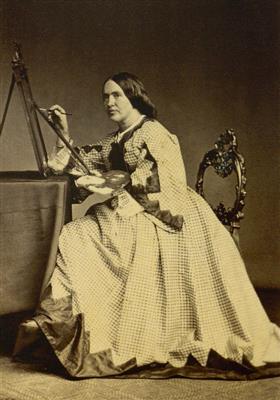
Biography
Born in Warsaw in 1819[1], she trained at the Kunstakademie Düsseldorf before travelling to Rome, where she met Danish[1] sculptor Jens Adolf Jerichau. They married in 1846[1] and settled in Copenhagen, where she would spend the rest of her career while also maintaining strong ties to the European exhibition circuit. She won the Thorvaldsen Medal, exhibited at the Paris World Fairs of 1867 and 1878, and received sustained patronage from Queen Louise of Denmark.
Her most singular achievement was her access to the Ottoman world. On two extended journeys to Egypt and the Eastern Mediterranean (1869[1]-70 and 1874-75), she documented harem life from the inside, a perspective unavailable to male Orientalist painters. Works such as "An Egyptian Fellah Woman with her Baby" (1873) and "An Egyptian Pot Seller at Gizeh" (1876-78) combine the precision of the Düsseldorf school with a directness born of genuine encounter. Her harem paintings are neither fantasy nor voyeurism; they are records made possible by her gender.
At home in Copenhagen, she also produced portraits of Danish[1] literary and cultural figures. Her 1850[1] likeness of Hans Christian Andersen is among the most recognisable images of the writer. She died in Copenhagen in 1881[1], leaving nine children, several of whom also became painters.
Timeline
- 1819Born in Warsaw, Poland.
- 1846Married Danish sculptor Jens Adolf Jerichau in Rome.
- 1850Painted a portrait of Hans Christian Andersen in Copenhagen.
- 1852Presented her paintings to Queen Victoria at Buckingham Palace.
- 1867Exhibited at the Paris World Fair.
- 1869Made the first of two extended journeys to Egypt and the Eastern Mediterranean (1869-70).
- 1873Painted "An Egyptian Fellah Woman with her Baby".
- 1874Made the second journey to Egypt and the Eastern Mediterranean (1874-75).
- 1878Exhibited at the Paris World Fair.
- 1881Died in Copenhagen, leaving nine children.
Notable Works
Tap to view larger.
Next stop
Browse the movements →
Every movement in the collection, from the Renaissance to Pop art.
Related Artists
Frequently Asked Questions
What is Elisabeth Jerichau-Baumann known for?
Elisabeth Jerichau-Baumann is particularly known for gaining access to the Ottoman world and documenting harem life from an insider's perspective. Her gender allowed her a viewpoint that male Orientalist painters could not access, resulting in works that combine precision with a directness born of genuine encounter.What should I know about Elisabeth Jerichau-Baumann's prints?
Elisabeth Jerichau-Baumann was a Polish-Danish[1] artist, mainly a painter, during the 19th century. Information about her printmaking is scarce, but understanding the context of printmaking during her career offers some insight. The fine art etching process was greatly admired at the time. In 1887, a Manchester print collector asked, "Etchings are fashionable here just now, have you got any?" Publishers began issuing magazines especially devoted to etching to meet the demand. *The Etcher*, a London-based journal, ran from 1879[1] to 1883. Continental prints had a rich tradition. By 1880, the Printsellers’ Association noted that it was not compelled to declare the number of proof impressions of etchings, so full details of editions are not available. Original prints include woodcuts, engravings, linocuts, mezzotints, etchings, lithographs or serigraphs. These are produced by hand by the artist. In a true original print, the work is created specifically to be a print. Each print is considered an original because the artist creates the artwork directly on the plate, woodblock, etching stone or screen.What style or movement did Elisabeth Jerichau-Baumann belong to?
Elisabeth Jerichau-Baumann was a Realist painter. Realism, an artistic movement that began in France in the 1850s, moved away from the idealised subject matter and dramatic compositions of Romanticism. Instead, Realist artists sought to depict everyday subjects and contemporary life in an objective, unidealised manner. Realism was, in part, influenced by the social and political changes brought about by the Industrial Revolution. Artists wanted to represent the realities of modern life, including the lives of ordinary people. Courbet was a Realist, and one painter acclaimed his realism (though that painter's identity is not Jerichau-Baumann). Realism was a broad movement, and individual artists had their own approaches and styles. Some Realist painters focused on social issues, while others were more interested in depicting the natural world or scenes from everyday life.What techniques or materials did Elisabeth Jerichau-Baumann use?
Elisabeth Jerichau-Baumann was a painter. The analysis of materials used in artworks of the seventeenth-century churches in Latvia, for example, reveals the employment of techniques such as applying a chalk-glue ground or an ochre in oil ground. Pigments commonly used then included indigo and smalt for blue colours. Natural ultramarine was rare. Gilding was achieved through water-gilding techniques, sometimes followed by oil-based mordant gilding. Wood carvings were often silvered and glazed with colours. These decorative methods show the period's broader artistic practices. Glass-painting techniques involved opaque linear contours, with colour or tonal value achieved through melting. This created a filter of light. Hues appeared through selective absorption or diffusion, using metal ions dissolved in glass and vitreous paint. Glass painters adopted methods from oil paintings, using colour naturalistically and introducing light sources and shadows. Leading connected glass pieces, while larger glass pieces interlocked.What was Elisabeth Jerichau-Baumann known for?
Elisabeth Jerichau-Baumann (born in Żoliborz, Warsaw, Poland, in 1819[1]; died in Copenhagen in 1881[1]) was a portrait[1] painter, known for her depictions of prominent figures and historical subjects. Jerichau-Baumann gained recognition for her ability to capture the likenesses and personalities of her sitters. She painted portraits of European royalty, aristocrats, and intellectuals, securing commissions across Europe. Her subjects included Queen Alexandra and the Danish[1] royal family. Beyond portraiture, Jerichau-Baumann explored historical and mythological themes in her work. These paintings often featured dramatic compositions and idealised figures. She exhibited her works internationally, including at the World Exhibition in Paris in 1867[1], contributing to her reputation. Her artistic output includes a range of genres, displaying her versatility as a painter.When did Elisabeth Jerichau-Baumann live and work?
Elisabeth Jerichau-Baumann was born Anna Maria Elisabeth Baumann in Żoliborz, Warsaw, on 21 November 1819[1]. She died in Copenhagen on 11 July 1881[1]. Jerichau-Baumann was a Polish-Danish[1] painter. She married the sculptor Jens Adolf Jerichau in 1846[1] and settled in Denmark. However, she travelled extensively throughout her career. During the 1850s, she visited Paris, where she painted portraits of Alexandre Dumas and the actress Rachel Félix. She also spent time in Berlin and Rome. In 1869-1870[1], she travelled to the Middle East and Greece, visiting Egypt, Palestine, Syria, and Constantinople (now Istanbul). These travels influenced her artistic output, leading to Orientalist themes. Jerichau-Baumann is known for her portraits and historical paintings. Her work often depicted prominent figures and explored themes of national identity and cultural exchange. She achieved considerable recognition during her lifetime, exhibiting her work internationally and receiving commissions from royal families and other important patrons.Where can I see Elisabeth Jerichau-Baumann's work?
Elisabeth Jerichau-Baumann's paintings can be viewed in several European museums. In Germany, her work is held by the Nationalgalerie and the Brücke Museum, both in Berlin; the Kunsthalle in Bremen; the Ludwig Museum and Wallraf-Richartz Museum, both in Cologne; the Folkwang Museum in Essen; the Kunsthalle in Hamburg; and the Niedersächsisches Landesmuseum in Hanover. Other German venues include the Von der Heydt Museum in Wuppertal and the Bayerische Staatsgemäldesammlungen in Munich. Outside of Germany, museums with her paintings include the Musée d’Orsay in Paris; the Musée National de l’Art Moderne, also in Paris; and the National Gallery of Scotland in Edinburgh. These collections provide opportunities to examine her artistic output.Where was Elisabeth Jerichau-Baumann from?
Elisabeth Jerichau-Baumann was Danish[1]. She was born in Żoliborz, Warsaw, on 21 November 1819[1]. At the time of her birth, Warsaw was part of Congress Poland; her parents were German. Jerichau-Baumann spent her childhood in Poland, but her family moved to Germany when she was about ten years old. She began her artistic training at the Düsseldorf Academy. Later, she moved to Rome, where she lived for a number of years. She married Jens Adolf Jerichau, a Danish sculptor, in 1846[1]. After her marriage, she moved to Copenhagen and became a naturalised Danish citizen. Although she lived in Denmark for much of her adult life, she travelled extensively throughout Europe and the Middle East. She died in Copenhagen on 11 July 1881[1].Who did Elisabeth Jerichau-Baumann influence?
While direct influences are difficult to establish definitively, Elisabeth Jerichau-Baumann's work can be situated in relation to broader artistic movements. Emilie Mediz-Pelikan, an Austrian Impressionist, may have been influenced by French Impressionism, and she stands alongside artists such as Theodor von Hormann, Tina Blau, Rudolf Quittner, Otto von Thoren, and Olga Wisinger-Florian, who incorporated new theories as autonomous artistic means. Mediz-Pelikan studied Impressionist innovations and met formal criteria, such as subject, light, and colour, even if she failed to consistently abide by the concept of breaking down the picture scientifically into spectral colours. Her paintings share similarities with Claude Monet's seascapes, conveying a sense of distance and endlessness through the merging of sky, water, and sand in an atmosphere of bright colour and light. She captured moments with figures wandering across the picture, reminiscent of Monet's work.Who influenced Elisabeth Jerichau-Baumann?
Elisabeth Jerichau-Baumann's artistic development occurred in a milieu influenced by various artists and movements. Christoffer Wilhelm Eckersberg, who taught at the Copenhagen academy, had a significant effect on Romantic painting and is considered the father of Danish[1] painting. His work displays a classical architectural style reminiscent of Giovanni Battista Piranesi. Eckersberg's compositional approach, particularly his frontal views, also recalls Jean-Auguste-Dominique Ingres, another student of Jacques-Louis David. Bertel Thorvaldsen, a sculptor and friend of Eckersberg, also provided inspiration. The age-old rivalry between painting and sculpture, a topic of debate since the Renaissance, is alluded to in Eckersberg's work, possibly as a homage to Thorvaldsen. Jerichau-Baumann would have been exposed to these influences and debates as part of the artistic environment of her time.Who was Elisabeth Jerichau-Baumann?
Elisabeth Jerichau-Baumann (1819[1]-1881[1]) was a Polish-Danish[1] artist who primarily painted portraits. She was born in Żoliborz, Warsaw, and later settled in Denmark. Jerichau-Baumann achieved considerable recognition during her lifetime. She gained acclaim for her portraiture, receiving commissions from European royal families and high society. Her work often presented her subjects in a romanticised, flattering manner, which contributed to her popularity. Although portraiture was her speciality, Jerichau-Baumann also explored historical and mythological subjects. These works often featured female figures and demonstrated her academic training. She travelled extensively throughout Europe and the Middle East, drawing inspiration from different cultures and incorporating them into her art. Jerichau-Baumann's artistic output included a range of paintings, from intimate portraits to large-scale compositions. Her success allowed her to live and work independently, a notable achievement for a female artist in the 19th century.Why are Elisabeth Jerichau-Baumann's works important today?
Elisabeth Jerichau-Baumann's art is significant because it provides insight into the lives and representations of women in the 19th century. As women were often excluded from formal art education, Jerichau-Baumann, like Artemisia Gentileschi and Elisabetta Sirani, gained training through family connections. Sirani, for example, was trained by her father and later established an academy for women artists. Jerichau-Baumann's work contributes to a larger understanding of female artists who challenged social norms. Sirani's paintings of historical women, such as Cleopatra, presented them as strong and intelligent figures, rather than sensual objects, countering typical portrayals by male artists. This approach aimed to elevate the status of women in Bolognese culture. Similarly, Jerichau-Baumann's portraits and genre scenes offer a female perspective on society, challenging traditional representations. Examining her art allows us to analyse how women artists navigated and subverted gendered expectations through their creative work.
Sources
Editorial draws on the following primary and tertiary references for Elisabeth Jerichau-Baumann.
- [1] wikipedia Wikipedia: Elisabeth Jerichau-Baumann Used for: biography, birth dates, death dates, identifiers, movement attribution, nationality.
- [2] book Charlotte Mullins, A Little History of Art Used for: biography.
- [3] book Getty Conservation Institute, Ancient and Historic Metals: Conservation and Scientific Research, part 1 of 3 Used for: stylistic analysis.
- [4] book Brodskaya Nathalia, Brodskaya Nathalia - Symbolism Used for: biography.
- [5] book Getty, Getty - Ancient and Historic Metals Conservation Used for: stylistic analysis.
- [6] book guggenheim-edvardmunch00munc Used for: biography.
- [7] book Lilian H. Zirpolo, Historical Dictionary of Baroque Art and Architecture Used for: biography.
- [8] book Masterpieces of western art : a history of art in 900 individual studies from the Gothic to the present day Used for: biography, stylistic analysis.
- [9] book Hodge, Susie, 1960- author, The short story of women artists : a pocket guide to movements, works, breakthroughs, & themes Used for: biography.
Editorial overseen by Solis Prints. Sources verified 2026-09-16. Click a source for details, or hover over [N] in the page above to preview.
Editorial standardsMethodologyCorrectionsAI disclosureAbout the editorial team