



Amalia Lindegren
- portrait
The painting that made Amalia Lindegren's reputation, "Lillans sista bädd" (The Final Rest of The Little One), depicted a dead child in a rural Swedish[1] interior, and it travelled across three continents over the following three decades: Paris in 1867[1], Philadelphia in 1876, Chicago in 1893. That a Swedish genre painting of such specific emotional weight achieved that degree of exhibition reach said something about the universality Lindegren had found in her chosen subjects.
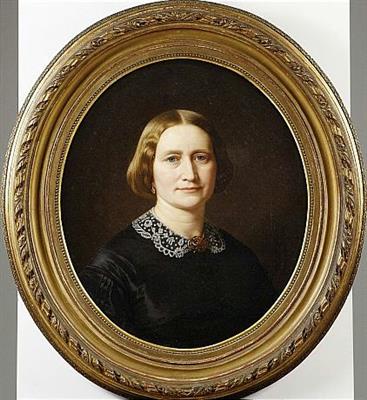
Biography
Born in Stockholm on 22 May 1814[1], she came from circumstances that would inflect her work throughout her career. The illegitimate daughter of the nobleman Benjamin Sandels, she was adopted after her mother's death by Sandels's wealthy widow, a position she later described as humiliating. The recurring motif of sad, isolated girls in her paintings is widely understood as autobiographical. She began selling drawings in the 1830s, moved into oils in 1839[1], and studied under Sofia Adlersparre from 1842. When the sculptor Carl Gustaf Qvarnström's endorsement secured her a place at the Royal Swedish[1] Academy of Fine Arts in 1849, she was among only four women admitted that year.
An academy scholarship the following year made her the first woman the institution had sent to Paris for study, where she trained under Léon Cogniet and Ange Tissier. She continued through Munich and Rome before returning to Sweden in 1856[1], the same year she was elected to full academy membership. A study trip to Dalarna in 1857 provided the peasant interiors and rural children that became her most commercially successful subject matter. She was soon considered one of the two most fashionable portrait[1] painters in Sweden, alongside Uno Troili, and received commissions including a portrait of Queen Louise of the Netherlands.
She died on 27 December 1891[1], having received the Litteris et Artibus award, her status as the leading Swedish[1] woman painter of her generation long established.
Timeline
- 1814Born in Stockholm on 22 May. She was the illegitimate daughter of nobleman Benjamin Sandels.
- 1830Began selling drawings.
- 1839Started working with oils.
- 1842Studied under Sofia Adlersparre.
- 1849Secured a place at the Royal Swedish Academy of Fine Arts.
- 1850Received an academy scholarship, becoming the first woman sent to Paris for study.
- 1856Elected to full academy membership and returned to Sweden.
- 1857A study trip to Dalarna provided her with peasant interiors and rural children as subject matter.
- 1867Her painting "Lillans sista bädd" (The Final Rest of The Little One) was exhibited in Paris.
- 1891Died on 27 December. She had received the Litteris et Artibus award.
Notable Works
Tap to view larger.
Next stop
Browse the movements →
Every movement in the collection, from the Renaissance to Pop art.
Related Artists



Frequently Asked Questions
What is Amalia Lindegren known for?
Amalia Lindegren is known for her genre paintings, particularly those depicting peasant interiors and rural children, which became her most commercially successful subject matter. She was also considered one of the most fashionable portrait[1] painters in Sweden, receiving commissions such as a portrait of Queen Louise of the Netherlands.What is Amalia Lindegren's most famous work?
Amalia Lindegren (1814[1]-1891[1]) was a Swedish[1] artist known for her genre scenes and portraits. Although she produced a substantial body of work, her most recognised painting is generally considered to be "The Little Match Girl" ("Flickan med svavelstickorna"). Completed in 1855[1], "The Little Match Girl" depicts a young girl in a state of poverty. The subject is drawn from Hans Christian Andersen's story of the same name, published in 1845. Lindegren's choice of subject matter reflects an interest in social realism, a common theme in European art during the mid-19th century. Lindegren's painting is admired for its sensitive portrayal of the child's vulnerability. The artist uses a muted colour palette, which adds to the overall melancholy mood of the piece. "The Little Match Girl" is part of the collection of the Nationalmuseum in Stockholm, and it continues to be one of Lindegren's most reproduced and discussed works.What should I know about Amalia Lindegren's prints?
Amalia Lindegren (1814[1]-1891[1]) was a Swedish[1] artist, primarily a painter. She is known for genre scenes and portraits. While Lindegren was a painter and not a photographer, prints of her paintings were made and sold during her lifetime, a common practice at the time. Prints of paintings allowed wider distribution of an artist's work, making it accessible to a broader audience beyond those who could view or afford the original artworks. These prints were often produced using techniques such as engraving or lithography. It is important to note that photographic prints, like those produced by Julia Margaret Cameron, became increasingly popular during the same period. Cameron sold her photographs through dealers such as Colnaghi and William Spooner. These prints came in various formats, including cartes-de-visite and larger mounted prints. Some prints even had signatures lithographed onto the mount to increase their value. If you are considering purchasing a print associated with Amalia Lindegren, ensure that you research the printmaking process used and its provenance. Understanding these aspects will help you assess the print's authenticity and value.What style or movement did Amalia Lindegren belong to?
Amalia Lindegren (1814[1]-1891[1]) was a Swedish[1] artist. Although it is difficult to assign her to one specific movement, she is generally associated with the Düsseldorf school of painting. This school refers to a group of artists who studied at or were influenced by the Düsseldorf Academy in Germany. It was active mainly from the 1830s to the 1860s. The Düsseldorf school is known for its emphasis on detailed realism, often with sentimental or anecdotal subject matter. Artists associated with the school produced paintings that were technically skilled and aimed to evoke emotional responses in the viewer. Many artists from the Nordic countries, including Sweden, were drawn to the Düsseldorf Academy. Lindegren's style incorporates elements of realism and genre painting, fitting within the broader scope of 19th-century European art movements.What techniques or materials did Amalia Lindegren use?
Information about Amalia Lindegren's specific techniques and materials is scarce in the provided texts. However, the passages do offer some general context about artistic techniques during the periods before and contemporary to her. Artists of the time, like El Greco, prepared canvases with animal-skin size and a ground of red ochre and gesso tempered with linseed oil. El Greco sketched compositions with black oil paint, possibly charcoal black tempered with linseed oil. He blocked in light areas with white or pale grey oil paint and modified underpainting with oil glaze applied with a bristle brush. Brice Marden primed canvases with turps-thinned Flake White, sanding the surface when dry. He mixed standard artist's oil colour with a medium of wax and turpentine, applying it with a brush and working it over with a spatula and knife. These examples show the range of materials and methods available to artists. Understanding these techniques helps in analysing the aesthetic decisions made by artists and how they engage with their chosen medium.What was Amalia Lindegren known for?
Amalia Lindegren (1814[1]-1891[1]) was a Swedish[1] artist known for her genre paintings and portraits. She was one of the first women to study at the Royal Swedish Academy of Fine Arts. Lindegren gained recognition for her depictions of everyday life, particularly scenes of rural Sweden. Her painting *The Little Match Seller* (1855[1]) is one example; it shows a young girl in a moment of reflection. Other well-known works include *Sunday Afternoon in a Dalecarlian Cottage* and *Reading Lesson*. These paintings often portray children and families, offering glimpses into the domestic sphere. In addition to genre scenes, Lindegren was a skilled portrait[1] painter. She received commissions from prominent members of Swedish society. Her portraits are characterised by their attention to detail and ability to capture the personality of the sitter. Through her genre paintings and portraits, Lindegren provided insights into Swedish life during the 19th century.When did Amalia Lindegren live and work?
Amalia Lindegren (1814[1]-1891[1]) was a Swedish[1] artist. She is known for genre scenes and portraits. Lindegren was born in Stockholm on 22 May 1814[1]. Her artistic training began at the Swedish Royal Academy of Fine Arts in 1842. She studied there until 1849. In 1850, she travelled to Paris. There, she studied with Léon Cogniet and Jean-Baptiste Ange Tissier. She also spent time in Düsseldorf and Munich. In 1856, Lindegren received a state grant that enabled her to travel for further study. She went to Rome. Lindegren became an agré (a type of member) at the Swedish Royal Academy in 1853. She exhibited at the Exposition Universelle in Paris in 1855. She also exhibited in London in 1862. Lindegren received the Litteris et Artibus medal in 1865. She died in Stockholm on 27 December 1891.Where can I see Amalia Lindegren's work?
Amalia Lindegren (1814[1]-1891[1]) was a Swedish[1] artist known for genre painting and portraits. To find her works, it is best to consult museum websites and collection catalogues. Many museums have increased their online presence through social media, or virtual exhibitions on their websites. Some museums are temporarily closed; others are open with timed entry ticketing to limit the number of visitors at one time. All require masks. It is always best to check the websites for hours and restrictions. For example, the Cincinnati Art Museum showed the exhibition *Frank Duveneck: American Master* through March 2021. The Reynolda House Museum of American Art, in Winston-Salem, North Carolina, has assembled an exhibition, *Girlhood in American Art*, which was on view through March 2021. The Baltimore Museum of Art showed Joan Mitchell (March to July 2021).Where was Amalia Lindegren from?
Amalia Lindegren was born in Stockholm, Sweden, in 1814[1]. Her early life was difficult. She was orphaned at a young age and then adopted by a noble family. Lindegren's artistic talent was recognised early. She received her initial training at the Konstfack University College of Arts, Crafts and Design in Stockholm. Later, she studied at the Royal Swedish[1] Academy of Fine Arts, also in Stockholm. In 1850[1], she became the first woman to receive a travel stipend from the Academy. This grant enabled her to study art in Paris, where she spent a significant period. She also travelled to other parts of Europe, including Italy. These travels broadened her artistic horizons and exposed her to different styles and techniques. Lindegren's background and education were instrumental in shaping her career as a painter.Who did Amalia Lindegren influence?
It is difficult to identify specific individuals who were directly influenced by Amalia Lindegren. Information about Swedish[1] art suggests a general openness to international trends, with Swedish artists integrating into the global context relatively quickly. The Swedish art scene exhibits eclecticism, with artists adopting a relativistic attitude, changing expressions and views freely. Geographic factors play a role, with Stockholm holding a dominant position, although regional centres like Gothenburg and Malmo counterbalance it to some extent. Young artists in Sweden experiment in many directions, with German neo-expressionism having a major impact. However, some teachers note that these artists sometimes lack a historical awareness, which affects their work. There is also a growing interest among young artists in developments in neighbouring Scandinavian countries.Who influenced Amalia Lindegren?
Amalia Lindegren's artistic development occurred during a period of significant change in European art. Initially, Lindegren adhered to realism, a style that aimed to depict subjects objectively and truthfully. Later in her career, around 1890[1], she came under the influence of Impressionism. This movement, which originated in France, emphasised capturing the fleeting impressions of light and colour. Max Liebermann, a German painter and printmaker, also transitioned from realism to Impressionism around the same time. Like Lindegren, Liebermann began his career with realistic depictions before embracing the looser brushwork and emphasis on light that characterise Impressionism. He studied at the Weimar Academy from 1868 to 1872. He was inspired by Mihaly von Munkácsy, and he spent time in Paris, where he followed the work of Courbet, Millet, and Ribot.Who was Amalia Lindegren?
Amalia Lindegren (1814[1]-1891[1]) was a Swedish[1] artist, primarily a painter. She is known for genre scenes and portraits. Lindegren studied at the Swedish Royal Academy of Arts. She later travelled to Paris and Munich to further her training. In 1856[1], Lindegren received a state grant that allowed her to travel for five years to study art in continental Europe. She visited Paris, Rome, and other cities. Her work often depicted everyday life, particularly of rural people. One of her best-known paintings is "The Little Match Girl" (1855), inspired by Hans Christian Andersen's story. Lindegren's art is characterised by its realistic style and attention to detail. She became an associate of the French Salon in 1857. Lindegren was elected to the Swedish Royal Academy of Arts in 1856. She is considered one of Sweden's most significant female artists of the 19th century.
Sources
Editorial draws on the following primary and tertiary references for Amalia Lindegren.
- [1] wikipedia Wikipedia: Amalia Lindegren Used for: biography, birth dates, death dates, identifiers, movement attribution, nationality.
- [2] book Dorling Kindersley, Artists: Inspiring Stories of the World's Most Creative Minds Used for: biography.
- [3] book Masterpieces of western art : a history of art in 900 individual studies from the Gothic to the present day Used for: biography.
- [4] book Erwin Panofsky, The Codex Huygens And Leonardo Da Vinci's Art Theory Used for: biography.
Editorial overseen by Solis Prints. Sources verified 2026-09-16. Click a source for details, or hover over [N] in the page above to preview.
Editorial standardsMethodologyCorrectionsAI disclosureAbout the editorial team