



Andrea Palladio
No other Renaissance architect reshaped the built world of Northern Europe as profoundly as the son of a Vicentine miller who went by the name of a Greek goddess of wisdom. Born Andrea di Pietro in Vicenza in 1508[1], he worked first as a stonemason before the humanist scholar Gian Giorgio Trissino recognised his talent, educated him in classical theory, and gave him the name Palladio after Pallas Athena. It was an act of patronage that changed architectural history.
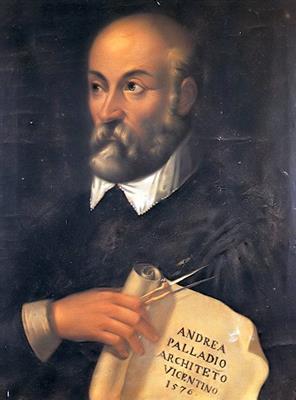
Biography
Palladio spent decades studying Roman ruins at first hand, emerging with a systematic grasp of antiquity's proportional logic that he encoded in his I quattro libri dell'architettura (1570[1]). The four books reached the offices of architects from London to Philadelphia, their copper engravings making his villas and churches replicable without a visit to the Veneto. The result was a style named after him, traced through Lord Burlington's Chiswick House (1729) to the colonnaded fronts of American federal buildings.
His two greatest works stand poles apart in setting. The Villa Rotonda, outside Vicenza (begun 1567[1]), was designed for the retired monsignor Paolo Almerico: a perfectly symmetrical cube with four identical Ionic porticoes and a central domed rotunda, modelled on the Pantheon. No farming happened here; it was a building conceived purely for the pleasures of educated sight. San Giorgio Maggiore in Venice (begun 1565) solved an older puzzle, stacking two interlocking temple fronts on the facade to account for both the tall nave and the lower aisles, producing a composition that reads correctly from the water.
Of the roughly forty villas Palladio designed on the Venetian mainland for landowners reclaiming agricultural territory from marshes, nineteen still stand. He died in 1580[1], but the architecture he codified outlasted every other Renaissance system.
Timeline
- 1508Born Andrea di Pietro in Vicenza, the son of a miller.
- 1565Began work on San Giorgio Maggiore in Venice.
- 1567Began designing the Villa Rotonda near Vicenza for Paolo Almerico.
- 1570Published "I quattro libri dell'architettura", which codified his architectural principles.
- 1580Died in 1580. He designed approximately forty villas on the Venetian mainland.
Notable Works
Tap to view larger.
Next stop
Browse the movements →
Every movement in the collection, from the Renaissance to Pop art.
Related Artists


.jpg!Portrait.jpg)
Frequently Asked Questions
What is Andrea Palladio known for?
Andrea Palladio is known for reshaping the built world of Northern Europe during the Renaissance. He is also known for his book I quattro libri dell'architettura (1570[1]), which codified his systematic grasp of antiquity's proportional logic, and for his designs of villas and churches.Who was Andrea Palladio?
Andrea Palladio, born Andrea di Pietro in Vicenza in 1508[1], was the son of a Vicentine miller. He initially worked as a stonemason before Gian Giorgio Trissino recognised his talent and educated him in classical theory. Trissino also gave him the name Palladio.What was Andrea Palladio's art style?
The Palladian style of architecture was a popular variant on the revival of classicism found across Europe in the 18th century. The style references the buildings of Andrea Palladio, whose fame rests on his classical palaces, villas, and churches found across the Veneto, as well as his publication of I quattro libri dell’architettura.How did Andrea Palladio die?
Andrea Palladio died in 1580[1] at the age of 72.
Sources
Editorial draws on the following primary and tertiary references for Andrea Palladio.
- [1] wikipedia Wikipedia: Andrea Palladio Used for: biography, birth dates, death dates, identifiers, movement attribution, nationality.
- [2] book Elizabeth Gilmore Holt; Project Muse, A Documentary History of Art, Volume 2 _ Michelangelo and the Mannerists, The Baroque and the Eighteenth Century Used for: biography, stylistic analysis.
- [3] book Elizabeth Gilmore Holt; Project Muse, A Documentary History of Art, Volume 2 _ Michelangelo and the Mannerists, The Baroque and the Eighteenth Century Used for: biography, stylistic analysis.
- [4] book Elizabeth Gilmore Holt; Project Muse, A Documentary History of Art, Volume 2 _ Michelangelo and the Mannerists, The Baroque and the Eighteenth Century Used for: biography, stylistic analysis.
Editorial overseen by Solis Prints. Sources verified 2026-10-07. Click a source for details, or hover over [N] in the page above to preview.
Editorial standardsMethodologyCorrectionsAI disclosureAbout the editorial team