



Andrzej Wróblewski
The career of Andrzej Wróblewski lasted barely a decade before a mountaineering accident in the Tatra Mountains ended it in March 1957[1], at 29. In that span, the Kraków-trained painter produced work that remains among the most searingly direct responses to Poland's wartime destruction.
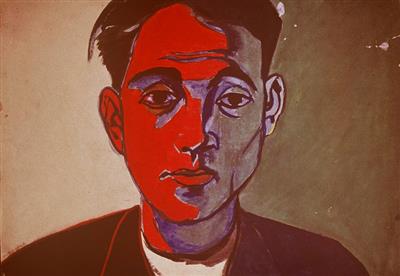
Biography
Born in Wilno in 1927[1] to a law professor and a painter mother who taught him woodcut technique, Wróblewski studied simultaneously at the Kraków Academy of Fine Arts and the Jagiellonian University from 1945[1], a double track that gave his painting an intellectual underpinning rare for his generation. His most celebrated works are the Rozstrzelania (Executions) series of the late 1940s, in which elongated, distorted figures face firing squads with an almost medieval flatness. Rozstrzelanie V (1949) is emblematic: the palette stripped down, the bodies barely differentiated from the ground they will fall to.
During the early 1950s, the Communist authorities demanded socrealism, and Wróblewski complied, though with evident discomfort; the work from this period has a compliance that reads as its own kind of critique. By the mid-1950s he had returned to a more personal figurative language. His output was extraordinary for someone who died so young: approximately 150 oil paintings and 1,400 drawings.
The posthumous market has been remarkable. Two Married Women (1949[1]), from the Societal Contrasts series, sold in November 2021 for 13.4 million złoty, making it the most expensive Polish[1] artwork sold at auction. During his lifetime he also published more than 80 articles in Polish arts journals, arguing for an art that could carry moral weight without collapsing into illustration.
Timeline
- 1927Born in Wilno to a law professor and a painter mother.
- 1945Began studies at the Kraków Academy of Fine Arts and the Jagiellonian University.
- 1949Created "Rozstrzelanie V", part of the Rozstrzelania (Executions) series.
- 1949Painted "Two Married Women", from the Societal Contrasts series.
- 1950During the early 1950s, he complied with the Communist authorities' demand for socrealism.
- 1957Died in a mountaineering accident in the Tatra Mountains in March, aged 29.
Notable Works
Tap to view larger.
Next stop
Browse the movements →
Every movement in the collection, from the Renaissance to Pop art.
Related Artists

Frequently Asked Questions
What is Andrzej Wróblewski known for?
Andrzej Wróblewski is known for his searingly direct responses to Poland's wartime destruction. His most celebrated works are the Rozstrzelania (Executions) series of the late 1940s.What is Andrzej Wróblewski's most famous work?
It is difficult to identify one single "most famous" work by Andrzej Wróblewski, as his output was varied and his career was cut short by his early death. However, certain pieces are more widely recognised and discussed than others. Wróblewski is particularly known for his series of paintings titled "Executions". These works, created in the late 1940s and early 1950s, depict scenes of violence and death, often with a stark and unsettling quality. The paintings reflect the trauma and moral complexities of postwar Poland. One example is "Execution with a Physiologist" (1949[1]), which exists in multiple versions. Other notable works include his "Queues" series and various portraits and figure studies. These paintings often explore themes of alienation, social commentary, and the human condition. Wróblewski's art offers a critical perspective on the realities of his time.What should I know about Andrzej Wróblewski's prints?
Andrzej Wróblewski, like many artists of his era, engaged with printmaking due to its accessibility and its increasing popularity as an art form. Polish[1] art schools of the time provided a structured programme that allowed students to explore diverse media, with painting, drawing, and printmaking techniques all receiving equal attention. Economic factors also played a role. After 1945[1], a high demand for posters led many artists, including painters and printmakers, to poster design for financial reasons. This influx of artists from various disciplines enriched poster art, introducing unique perspectives and techniques. Printmakers often turned to traditional methods, such as linocut and metal techniques, possibly due to limited access to contemporary technology. The exchanges between fine art and utilitarian art became very close, particularly in the 1970s, with linocut, serigraphy, and photo-offset being used in both fields. During the 1980s, political factors influenced poster art, leading to a preference for black and white designs and simplified forms.What techniques or materials did Andrzej Wróblewski use?
Andrzej Wróblewski's practice involved diverse media and techniques. He is known for his oil paintings, often characterised by simplified forms and a restricted colour palette. His subjects ranged from the personal to the political, reflecting the anxieties of postwar Poland. Wróblewski also experimented with gouache, ink, and collage, sometimes combining these media in a single work. These mixed-media pieces allowed him to explore texture and form in different ways. His approach to painting involved both careful planning and spontaneous execution. Some works show evidence of detailed preliminary sketches, while others appear to have been created more intuitively. He often worked in series, revisiting the same themes and motifs in multiple variations. This allowed him to explore different compositional and colouristic possibilities. Wróblewski's work demonstrates a willingness to experiment and push the boundaries of traditional painting techniques.What was Andrzej Wróblewski known for?
Andrzej Wróblewski (1927[1]-1957[1]) was a Polish[1] painter and graphic artist. He is known for work that combined figurative and abstract elements. Wróblewski studied at the Academy of Fine Arts in Kraków. His early pieces often dealt with the trauma and social issues of post-war Poland. He developed a distinctive style characterised by simplified forms, stark colours, and a sense of unease. His subject matter included war, death, and social alienation. He experimented with various styles, including socialist realism, but he moved toward more personal and expressive modes. Wróblewski's work gained recognition after his early death at the age of 29. He is considered one of Poland's most important post-war artists.When did Andrzej Wróblewski live and work?
Andrzej Wróblewski was born in Warsaw on 15 November 1922. During the Second World War, from 1939[1] to 1945, he lived in the countryside near Warsaw. Because all art schools were closed, he studied painting with Professor F. Kowarski, a painter of romantic realism. Wróblewski presented his work at the Academy of Fine Arts, Warsaw, in 1946. After passing art history examinations, he received a Master's degree in painting. Between 1936 and 1938, he travelled in Western Europe. He visited museums in Paris, Vienna, Venice, Florence, Rome, Naples and Istanbul. Wróblewski started teaching in the Department of Graphics at the Warsaw Academy of Fine Arts in 1954; he continued until 1961.Where was Andrzej Wróblewski from?
Andrzej Wróblewski was Polish[1]. Janusz Maria Brzeski, a protagonist of the Kraków avant-garde, was born in Warsaw in 1907. He created designs, prints, photographs, and films. After a period in Italy and France, he produced architectural projects and book illustrations in Kraków. He designed the Poznań and Silesian pavilions at the Polish national exhibition before returning to Paris. There, he worked in graphic design for the magazine *Vu*. Brzeski's drawings and collages combined photographic techniques with automatic drawing, demonstrating an affinity for Surrealism. In 1930[1], his montages satirised the Freudian thesis that sex is the principal driving force in human endeavours. Back in Poland, he created abstract photograms using negative photomontage, also used in his experimental films. With Kazimierz Podsadecki, he organised a Modernist photography exhibition and started a film studio to finance experimental films. Brzeski critiqued the automatisation of human life, expressing a fear of impending destruction. He also painted, wrote art criticism, and worked as a graphic designer and inspector of art publishers for the Polish ministry of art and culture.Who did Andrzej Wróblewski influence?
Andrzej Wróblewski died at the age of only 29, so his direct influence on other artists was limited. However, his distinctive approach to representing the trauma and alienation of the postwar era has resonated with later generations of Polish[1] artists. His simplified, often distorted figures and stark colour palettes prefigured some trends in later Polish art, particularly in the work of artists dealing with similar themes of social and political unease. Wróblewski's focus on everyday life, combined with his unflinching portrayal of suffering, set a precedent for a more direct and engaged form of art in Poland. His paintings continue to be studied and exhibited, ensuring his ideas reach new audiences. Although not fitting neatly into any specific movement, Wróblewski's art has links with Expressionism and Socialist Realism; his individual style defies easy categorisation.Who influenced Andrzej Wróblewski?
Andrzej Wróblewski's influences are difficult to pin down. He died young, and his artistic style changed rapidly in response to the shifting political environment of postwar Poland. Some scholars suggest the horrors of the Second World War, and the stark realism of war photography, shaped his aesthetic. Others point to the influence of early modernists such as Pablo Picasso, Fernand Léger, and the German Expressionists. The crude, direct style of folk art may also have been a factor. It is also possible to see the impact of particular paintings. For example, some have noted similarities between Wróblewski's "Execution" series (1949[1]) and Picasso's "Guernica" (1937). However, Wróblewski's work is also distinct from these possible influences, with its own unique approach to colour, composition, and subject matter. He synthesised elements from diverse sources into a personal artistic language.Who was Andrzej Wróblewski?
Andrzej Wróblewski was a Polish[1] painter who died at the age of 29 in a mountaineering accident. He produced work that remains among the most direct responses to Poland's wartime destruction.Why are Andrzej Wróblewski's works important today?
Andrzej Wróblewski, who died young in 1957[1], produced work that is important for several reasons. His art provides a visual record of Poland during and immediately after the Second World War. Wróblewski's paintings often grapple with difficult subjects, such as war, trauma, and social change. His distinctive style, which combined elements of realism and abstraction, allowed him to express complex emotions and ideas. The works are not straightforward propaganda; instead, they present a nuanced perspective on the era. His series "Executions" (1949[1]) is a well-known example of his engagement with wartime trauma. The paintings depict the act of execution in a stark and unsettling manner. Wróblewski's willingness to confront such subjects makes his art relevant for understanding the psychological impact of conflict. Wróblewski's work also reflects the debates about artistic expression that took place in post-war Poland. His move towards abstraction, while still addressing social issues, puts him in dialogue with international art movements of the time.What was Andrzej Wróblewski's art style?
During the early 1950s, Andrzej Wróblewski complied with the Communist authorities' demand for socrealism, though with evident discomfort. By the mid-1950s he had returned to a more personal figurative language.
Sources
Editorial draws on the following primary and tertiary references for Andrzej Wróblewski.
- [1] wikipedia Wikipedia: Andrzej Wróblewski Used for: biography, birth dates, death dates, identifiers, movement attribution, nationality.
- [2] book guggenheim-guggenheimintern1958sven Used for: biography.
- [3] book guggenheim-guggenheimintern1960sven Used for: biography.
- [4] book guggenheim-guhe00solo Used for: biography.
Editorial overseen by Solis Prints. Sources verified 2026-10-15. Click a source for details, or hover over [N] in the page above to preview.
Editorial standardsMethodologyCorrectionsAI disclosureAbout the editorial team