

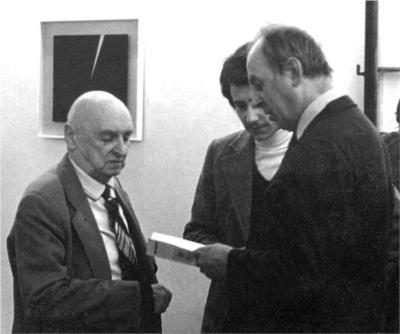
Edward Krasinski
Edward Krasinski arrived at his signature gesture at age forty-three: a continuous horizontal line of blue Scotch tape applied at exactly 130 centimetres from the floor across every surface of every space he occupied. Walls, furniture, objects, visitors: the tape interrupted everything equally, at the same height, without comment. From 1968[1] until his death in 2004[1], it became inseparable from his identity as an artist.
Biography
Born in Lutsk in 1925[1] (now western Ukraine), Krasinski studied at the Academy of Fine Arts in Kraków before moving to Warsaw in 1954[1]. He painted in a surrealist mode for over a decade, holding his first solo exhibition only in 1965, when he was already forty. The following year, he joined Tadeusz Kantor and others in founding the Foksal Gallery, Warsaw's primary platform for conceptual experimentation throughout the late communist period.
His most celebrated gesture came at the 1970[1] Tokyo Biennial, where he telexed the organisers the word "BLUE" repeated 5,000 times, producing an 80-metre strip of paper that was subsequently encased in bulletproof glass. The tape and the telex were related moves: both used a single, minimal act to stake out territory and make it strange.
Behind the Iron Curtain, Krasinski's international profile developed slowly. His first solo exhibition outside Poland was held in Paris in 1988[1]; New York saw his work only in 2002, at the Anton Kern Gallery. He died in Warsaw in April 2004[1]. Retrospectives at the Tate and the Stedelijk have since confirmed his place among the essential figures of post-war European conceptualism.
Timeline
- 1925Born in Lutsk, now western Ukraine.
- 1954Moved to Warsaw.
- 1965Held his first solo exhibition at 40.
- 1966Joined Tadeusz Kantor and others in founding the Foksal Gallery in Warsaw.
- 1968Began using a continuous horizontal line of blue Scotch tape at 130 centimetres from the floor in his work, at 43.
- 1970Telexed the word "BLUE" repeated 5,000 times to the Tokyo Biennial, producing an 80-metre strip of paper.
- 1988Held his first solo exhibition outside Poland in Paris.
- 2002His work was shown in New York at the Anton Kern Gallery.
- 2004Died in Warsaw in April.
Next stop
Browse the movements →
Every movement in the collection, from the Renaissance to Pop art.
Related Artists


Frequently Asked Questions
What is Edward Krasinski known for?
Edward Krasinski is best known for his signature gesture: a continuous horizontal line of blue tape applied at 130 centimetres from the floor across every surface. This practice began in 1968[1] and continued until his death, becoming integral to his artistic identity.What is Edward Krasinski's most famous work?
It is difficult to identify Edward Krasinski's single most famous work, but his practice involved the placement of a standard blue horizontal stripe at a consistent height (130cm) in varied locations. Krasinski used this stripe in installations, sculptures, and interventions in existing spaces. The stripe, often affixed with tape, was a constant element in his work from the late 1960s onward. It can be seen as a signature or a visual device that unifies his diverse output. While Krasinski produced many sculptures and installations, the blue stripe remains his best-known motif. It is recognisable, and it encapsulates his artistic concerns with space, intervention, and the blurring of boundaries between art and the everyday.What should I know about Edward Krasinski's prints?
Edward Krasinski was a Polish[1] artist, but the reference passages concern Félix-Stanislas Jasinski, a Polish-born, French-naturalised etcher. Jasinski made his name in Paris, etching works after romantic Old Masters. Jasinski is known for his reproductions of works by Edward Burne-Jones. Arthur Tooth published Jasinski's etching after Botticelli’s Primavera in 1892. Burne-Jones admired this work, which led to Jasinski reproducing Burne-Jones's pieces. Jasinski etched Burne-Jones’s The Golden Stairs; the print was issued by Arthur Tooth in 1894 in an edition of 375. In 1896, Jasinski created The Mirror of Venus after Burne-Jones; Burne-Jones thought it was etched "divinely". Tooth issued it in a limited edition of 400 Artist Proofs. The following year, Jasinski etched Burne-Jones’s The Annunciation, which Tooth offered in a limited edition of 350 Artist Proofs. Tooth presented the plate to the South Kensington Museum (now the Victoria and Albert Museum). Jasinski etched Burne-Jones's Love among the Ruins for Agnew’s, publishing it in 1899.What style or movement did Edward Krasinski belong to?
Edward Krasinski (1925[1]-2004[1]) defies easy categorisation, but his work is often associated with neo-avant-garde tendencies in Polish[1] art after 1945[1]. This label encompasses a range of experimental practices that reacted against socialist realism and engaged with international developments in art. Krasinski's practice included sculpture, installation, and happenings. He is perhaps best known for his use of blue adhesive tape, which he applied to surfaces, objects, and spaces, creating linear interventions that disrupted conventional perceptions. These interventions were often playful and absurd, questioning the boundaries between art and everyday life. While his work shares some affinities with movements like Minimalism and Conceptual Art, Krasinski maintained a distinct artistic identity. His art was characterised by a sense of humour, improvisation, and a rejection of rigid theoretical frameworks. He participated in important exhibitions and events that helped to shape the development of contemporary art in Poland and beyond.What techniques or materials did Edward Krasinski use?
Edward Krasinski is known for his use of simple materials to create striking visual effects. He frequently employed ordinary, industrial materials in his constructions and installations. One of his signature techniques was the application of a horizontal stripe of blue tape, usually at a height of 130cm, across various surfaces and objects within a space. This simple addition served to disrupt perceptions of space and challenge conventional notions of art. Krasinski's work often incorporated found objects, such as furniture, branches, and everyday items, which he would then combine and modify. He used paint, wire, and other basic materials to join these elements together, creating dynamic and often humorous arrangements. His approach was characterised by a playful experimentation with form and space, transforming the mundane into the unexpected.What was Edward Krasinski known for?
Edward Krasinski, a Polish[1] artist, is best known for his abstract art, particularly his use of blue tape. He employed this simple material in a distinctive way, applying it horizontally at a consistent height (130cm or 170cm from the ground) across various surfaces, including walls, objects, and even outdoor environments. Krasinski's practice challenged traditional notions of sculpture and space. He often created installations that interacted with existing architecture, blurring the lines between the artwork and its surroundings. The blue tape acted as a unifying element, connecting disparate objects and spaces, and creating a sense of continuity. While Krasinski's work appears simple, it engages with complex ideas about perception, space, and the nature of art itself. His interventions are often playful and humorous, disrupting expectations and inviting viewers to reconsider their relationship to the environment. He worked in this vein from the late 1960s until his death in 2004[1].When did Edward Krasinski live and work?
Edward Krasinski was born in Warsaw on 15 November 1925[1]. He died in the same city in 2004[1]. Krasinski's artistic career began after the Second World War. He studied at the Academy of Fine Arts in Warsaw, and he graduated in 1954[1]. There, he met and collaborated with architects such as Zamecznik, Soltan, and Hansen. These collaborations led to discussions of visual problems. His work gained recognition during the liberalisation of cultural policy in Poland in 1956. In 1958, he developed his theory of reversed perspective. That same year, he presented his abstract paintings as free-standing elements in an environment, at an exhibition called "Painting in Space" in Warsaw. Krasinski's work was included in "Polish[1] Painting Now" at the Stedelijk Museum, Amsterdam, in 1959. He created an environment in collaboration with Stan Zamecznik.Where can I see Edward Krasinski's work?
Edward Krasinski's artworks have been exhibited in many locations. These include the National Gallery of Scotland (Edinburgh), the Scottish National Gallery of Modern Art (Edinburgh), and the Burrell Collection (Glasgow). Other UK locations include the Brighton Museum & Art Gallery, the Geffrye Museum (London), the Manchester Art Gallery, and the Victoria & Albert Museum (London). In the United States, museums that sometimes exhibit his work are the Charles Hosmer Morse Museum of American Art (Winter Park, Florida), the Los Angeles County Museum of Art, the Metropolitan Museum of Art (New York), the Minneapolis Institute of Arts, the Museum of Modern Art (New York), the Virginia Museum of Fine Arts (Richmond), and the Wolfsonian at Florida International University (Miami Beach). Outside the UK and USA, his work has been shown at the Royal Ontario Museum (Toronto).Who did Edward Krasinski influence?
It is difficult to identify specific artists who were directly influenced by Edward Krasinski. Influence can take many forms; it is not always a simple matter of one artist imitating another. Some scholars argue that artistic influence is not just about one generation inspiring the next. Instead, contemporary artists can alter how we perceive artists of the past. For example, Willem de Kooning claimed Courbet as a point of reference. De Kooning's declaration of interest affects how we respond to Courbet's art; the mid-century artist's words invite us to see the nineteenth-century painter in a new light. Krasinski's work might have had a similar, if less direct, effect. His use of colour and form, and his exploration of space, could have resonated with later artists. However, without specific documentation or critical analysis, it is hard to name particular individuals who absorbed Krasinski's ideas into their own practice.Who influenced Edward Krasinski?
Edward Krasinski appears to have been influenced by a number of artists and movements. Wassily Kandinsky's ideas had an impact on the Abstract Expressionist movement, of which Krasinski was a part. Hans Hofmann, a teacher who brought modern European art ideas to the United States in 1930[1], also had an impact. Hofmann's painting style combined Cubism, Expressionism, Surrealist psychology, and Fauvist colour. Krasinski seems to have been drawn to Jackson Pollock's work, which resonated with him and opened the way for him to make his own mark. He also investigated and sought to understand the methods of Old Masters, Cubists, and artists such as Manet, Monet, Miró, and Gorky. He made abstract responses to their works, such as his version of Manet's painting called Fish (Still Life) from 1864.Why are Edward Krasinski's works important today?
Edward Krasinski (1925[1]-2004[1]) was a Polish[1] artist known for his interventions in exhibition spaces. He is particularly noted for his use of blue adhesive tape, which he applied horizontally at a consistent height (130cm) across walls, objects, and sometimes even outdoor environments. Krasinski's practice challenged traditional notions of sculpture and painting. His installations often blurred the lines between the artwork and its surroundings. By incorporating existing architectural elements and everyday objects, he created a dialogue between the art and the space it occupied. His work is significant because it prefigured later developments in installation art and site-specific art. Krasinski's playful and often humorous approach to art-making also provides a counterpoint to more serious or didactic artistic statements. His use of simple materials and gestures opened up new possibilities for artistic expression, influencing subsequent generations of artists interested in spatial interventions and conceptual art.
Sources
Editorial draws on the following primary and tertiary references for Edward Krasinski.
- [1] wikipedia Wikipedia: Edward Krasinski Used for: biography, birth dates, death dates, identifiers, movement attribution, nationality.
- [2] book Beard, Lee, 1973- author, Butler, Adam, author; Van Cleave, Claire, author; Fortenberry, Diane, author; Stirling, Susan, author, Beard, Lee, 1973- author, Butler, Adam, author; Van Cleave, Claire, author; Fortenberry, Diane, author; Stirling, Susan, author - The Art Book_ New Edition, Mini Format Used for: biography.
- [3] book Fred S. Kleiner, Gardner's Art through the Ages Used for: biography.
- [4] book guggenheim-guggenheimintern00frye Used for: biography.
- [5] book guggenheim-transfsi00wald Used for: biography.
Editorial overseen by Solis Prints. Sources verified 2026-10-15. Click a source for details, or hover over [N] in the page above to preview.
Editorial standardsMethodologyCorrectionsAI disclosureAbout the editorial team