



Aristarkh Lentulov
When Aristarkh Lentulov returned to Moscow from Paris in 1911[1], he brought Cubism and Orphism back with him in a way few Russian[1] painters could match. He had spent a year studying under Jean Metzinger and Henri Le Fauconnier, absorbing the grammar of fragmented planes at close quarters. Both Kandinsky and Malevich acknowledged his influence on Russian modernism.
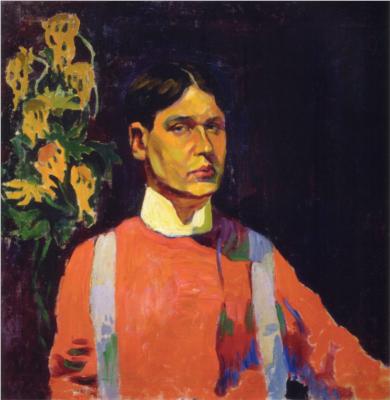
Biography
Born in 1882[1] into a priest's family in Nizhny Lomov, he trained across Penza, Kiev, and Saint Petersburg before the Paris trip changed his direction entirely. The following year he co-founded the Jack of Diamonds group, a Moscow exhibiting society that became one of the most combative platforms in pre-revolutionary Russian[1] art.
His 1913[1] canvases are the peak of his achievement. *Saint Basil's Cathedral*, *Ringing*, and *Moscow* shatter architectural subjects into cascading planes of colour, treating Russia's most recognisable buildings not as monuments but as problems in pictorial structure. The approach owed something to Delaunay's Orphism but arrived at something distinctly Russian[1] in its exuberance.
After the Revolution he threw himself into public art, designing Moscow's decorations for the first anniversary in 1918[1] and producing murals for the Poets' Café. He later taught at VKhUTEMAS and chaired the Society of Moscow Artists from 1928 until his death in 1943[1].
Timeline
- 1882Born in Nizhny Lomov to a priest's family.
- 1911Returned to Moscow from Paris, bringing Cubism and Orphism influences.
- 1911Studied under Jean Metzinger and Henri Le Fauconnier in Paris.
- 1912Co-founded the Jack of Diamonds group in Moscow.
- 1913Painted "Saint Basil's Cathedral", "Ringing", and "Moscow".
- 1918Designed Moscow's decorations for the first anniversary of the Revolution.
- 1918Produced murals for the Poets' Café.
- 1928Became chairman of the Society of Moscow Artists.
- 1943Died in Moscow at 61. He was chairman of the Society of Moscow Artists at the time.
Notable Works
Tap to view larger.
Next stop
Post-Impressionism →
Explore the artists and ideas of Post-Impressionism.
Related Artists


Frequently Asked Questions
What is Aristarkh Lentulov known for?
Aristarkh Lentulov is known for bringing Cubism and Orphism to Russia. His 1913[1] canvases, such as *Saint Basil's Cathedral*, *Ringing*, and *Moscow*, are considered the peak of his achievement, shattering architectural subjects into planes of colour. After the Revolution, he designed Moscow's decorations for the first anniversary in 1918 and produced murals for the Poets' Café.Who was Aristarkh Lentulov?
Aristarkh Lentulov was a Russian[1] painter who brought Cubism and Orphism back from Paris in 1911[1]. He had studied under Jean Metzinger and Henri Le Fauconnier, and his influence was acknowledged by Kandinsky and Malevich. He co-founded the Jack of Diamonds group in 1912 and later taught at VKhUTEMAS.How did Aristarkh Lentulov die?
Aristarkh Lentulov died in 1943[1] at the age of 61.
Sources
Editorial draws on the following primary and tertiary references for Aristarkh Lentulov.
- [1] wikipedia Wikipedia: Aristarkh Lentulov Used for: biography, birth dates, death dates, identifiers, movement attribution, nationality.
- [2] book Natalya Strizhkova Andrei Sarabyanov, Art and Power_ The Russian Avant-garde under Soviet Rule, 1917–1928 Used for: biography.
- [3] book guggenheim-grerussi00schi Used for: biography.
- [4] book Yevgenia Petrova (editor), Origins of the Russian avant-garde_ celebrating the 300th anniversary of St. Petersburg_ the Walters Art Museum, Baltimore (13 February-25 May 2003), Fine Arts Museums of San Francisco (29 June-21 September 2003) Used for: biography, stylistic analysis.
- [5] book J. E. Bowlt, Russian Art of the Avant Garde - Theory and Criticism 1902-1934 Used for: stylistic analysis.
- [6] book edited and translated by John E. Bowlt, Russian Art of the Avant-Garde_ Theory and Criticism 1902-1934 (The Documents of 20th-Century Art) (English and Russian Edition) Used for: stylistic analysis.
- [7] book Russian art of the avant-garde : theory and criticism, 1902-1934, with 105 illustrations Used for: biography.
- [8] book Peter. Leek, Russian Painting Used for: biography.
Editorial overseen by Solis Prints. Sources verified 2026-10-14. Click a source for details, or hover over [N] in the page above to preview.
Editorial standardsMethodologyCorrectionsAI disclosureAbout the editorial team