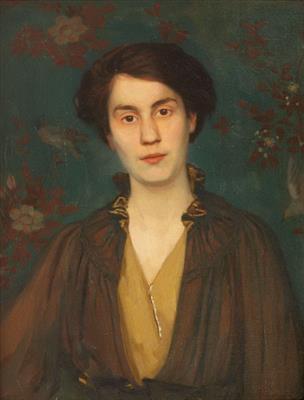
Madame Countess Adèle de Toulouse-Lautrec in the Garden of Malromé by Henri de Toulouse-Lautrec
La danse mauresque by Henri de Toulouse-Lautrec by Henri de Toulouse-Lautrec
Still Life with The Dance by Henri Matisse
Where Do We Come From? What Are We? Where Are We Going? by Paul Gauguin
Wheatfield under Thunderclouds by Vincent van Gogh
View of Auvers-sur-Oise by Paul Cézanne
Still Life with Bread and Eggs by Paul Cézanne
Boulevard Montmartre, Mid-Lent by Camille Pissarro
Boulevard Montmartre, morning, cloudy weather by Camille Pissarro
Still life with pears and wineglass by Samuel Peploe
Still Life with Coffee Pot by Samuel Peploe
Landscape at Grandcamp by Georges Seurat

Post-Impressionism

35 artists · 1880–1910

Post-Impressionism[5] was never a unified movement. It was a loose constellation of artists working in France between roughly 1886 and 1910, each pushing past Impressionism in a different direction. Where the Impressionists had pursued fleeting light and optical sensation, the Post-Impressionists wanted something more permanent: structure, emotion, symbolic meaning, or pure colour freed from description. Paul Cezanne built paintings from geometric planes. Vincent van Gogh[11] loaded his canvases with raw feeling through heavy brushwork and heightened colour. Paul Gauguin[17] flattened form and sought spiritual content in non-Western cultures. Georges Seurat[12] subjected colour mixing to scientific method. The term itself was an afterthought. British critic Roger Fry coined it in 1910 for his London exhibition at the Grafton Galleries, needing a label broad enough to contain these wildly different approaches. Post-Impressionism is defined less by shared technique than by a shared refusal to accept that painting should merely record what the eye sees. Its practitioners opened every door that twentieth-century art would walk through.

Key Ideas

  • Structure Beyond Sensation

    The Impressionists dissolved form into light. Post-Impressionism reversed that priority. Cezanne sought to rebuild pictorial architecture, reducing landscape and still life to underlying geometric volumes. Seurat replaced instinctive brushwork with calculated dot patterns derived from optical science. Cezanne famously stated his aim was to make of Impressionism something solid and durable, like the art of the museums.

  • Colour as Autonomous Force

    Van Gogh and Gauguin broke colour free from its descriptive function. Van Gogh used exaggerated yellows and blues to externalise psychological states. Gauguin flattened his palette into broad fields of unmodulated colour that operated symbolically. Maurice Denis declared in 1890 that a painting is essentially a flat surface covered with colours assembled in a certain order. Colour was no longer the servant of natural appearance. It had become the subject.

  • Subjective Vision Over Objective Record

    Impressionism prized direct observation. Post-Impressionism asserted that the artist's interior world mattered as much as the exterior one. Van Gogh painted not what he saw but what he felt. Gauguin sought meaning in myth, religion and non-Western cultures. Toulouse-Lautrec turned the same subjective intensity toward modern urban life. Each insisted that art should express something beyond surface appearance.

  • The Dissolution of a Unified Style

    Post-Impressionism was never a single movement with a shared manifesto. The term was applied retrospectively by Roger Fry in 1910. Cezanne, Seurat, Van Gogh and Gauguin pursued incompatible goals. Their only common ground was the conviction that Impressionism was a starting point, not a destination. This productive disagreement made Post-Impressionism the seedbed for nearly every major movement that followed.

  • Beyond Paris: New Geographies of Inspiration

    Post-Impressionism expanded the geography of French art. Gauguin left Paris for Pont-Aven, then Tahiti. Van Gogh abandoned the grey north for Arles. Cezanne retreated to Aix-en-Provence. The Nabis drew on Japanese prints, medieval tapestry and Breton folk art. This outward reach broke the monopoly that Parisian studio practice had held over advanced painting since the 1860s.

Origins

The Last Impressionist Exhibition and Its Aftermath

The eighth and final Impressionist exhibition opened in Paris in May 1886. By then the original group had splintered. Seurat's A Sunday on La Grande Jatte, which used Impressionist colour but rejected Impressionist spontaneity, was the exhibition's most discussed work. Impressionism had won its battle for acceptance. The question was what came next.

Rival Directions: Science, Symbol and Emotion

Post-Impressionism appeared as several parallel reactions to Impressionism. Seurat pursued optical science. Cezanne pursued structural analysis. Van Gogh pursued emotional expression. Gauguin pursued symbolic meaning. These four directions were often in tension. Yet all shared a conviction that Impressionism's focus on surface appearance was insufficient.

Pont-Aven, the Nabis and the Spread of New Ideas

Gauguin's summers at Pont-Aven between 1886 and 1890 created a second centre of gravity outside Paris. Serusier visited in 1888 and painted The Talisman. When he returned to Paris, the small panel catalysed the formation of the Nabis: Denis, Bonnard, Vuillard, Roussel. Denis published his manifesto in 1890.

Roger Fry and the Naming of a Movement

The term Post-Impressionism did not exist until 1910, when Roger Fry organised the exhibition Manet and the Post-Impressionists at the Grafton Galleries in London. The show ran from November 1910 to January 1911. Over 25,000 visitors came. A second exhibition followed in 1912. Fry's exhibitions did not create the movement; they named it after the fact.

In Their Words

“Treat nature by the cylinder, the sphere, the cone.”
Paul Cezanne, Letter to Emile Bernard, 15 April 1904
“Instead of trying to reproduce exactly what I see before me, I make more arbitrary use of colour to express myself more forcefully.”
Vincent van Gogh, Letter to Theo van Gogh, 11 August 1888
“Remember that a picture, before being a battle horse, a female nude or some sort of anecdote, is essentially a flat surface covered with colours assembled in a certain order.”
Maurice Denis, Art et Critique, August 1890
“Art is either plagiarism or revolution.”
Paul Gauguin, Attributed in James Huneker, The Pathos of Distance, 1913

All Post-Impressionism Artists

29 artists.

Recommended Reading

  • Post-Impressionism: From Van Gogh to Gauguin

    Post-Impressionism: From Van Gogh to Gauguin

    John Rewald · 1956

    The standard scholarly history based on extensive primary research.

  • Cezanne: A Life

    Cezanne: A Life

    Alex Danchev · 2012

    A biography that doubles as intellectual history of Cezanne's working methods.

  • Van Gogh: The Life

    Van Gogh: The Life

    Steven Naifeh and Gregory White Smith · 2011

    The most comprehensive biography, drawing on the complete edition of his letters.

  • The Art of Paul Gauguin

    The Art of Paul Gauguin

    Richard Brettell et al. · 1988

    The major retrospective catalogue with detailed provenance and formal analysis.

Frequently Asked Questions

  • What is Post-Impressionism?
    Post-Impressionism[5] is an umbrella term for the French painters who worked after Impressionism peaked around 1886 and rejected its focus on surface appearance. They kept the Impressionists' bright palette and independent exhibition culture but pushed painting towards symbolic meaning, formal structure, or emotional expression. The term was coined retrospectively by the English critic Roger Fry for his 1910 London exhibition.
  • Who are the main Post-Impressionist artists?
    The four indispensable figures are Paul Cézanne, Vincent van Gogh[11], Paul Gauguin[17] and Georges Seurat[12]. Each pursued a different direction: Cézanne sought geometric structure beneath nature, Van Gogh used saturated colour for emotional charge, Gauguin abandoned Europe for Tahitian spiritual simplicity, and Seurat developed the scientific dot-pigment system called pointillism or divisionism.
  • How does Post-Impressionism differ from Impressionism?
    Impressionism recorded the world's shifting surface under natural light. Post-Impressionism[5] used the Impressionist palette as a starting point but sought what lay beneath appearance: structural order for Cézanne, psychological intensity for Van Gogh, spiritual meaning for Gauguin. Post-Impressionists painted in the studio as often as outdoors, thought of their work as permanently valid rather than momentary, and laid the direct groundwork for Cubism, Fauvism and Expressionism.
  • Why was Van Gogh important to Post-Impressionism?
    Van Gogh took colour further than any other Post-Impressionist. His sunflowers, wheatfields and portraits use non-descriptive hue (a yellow sky, a blue chair) to convey feeling rather than record light. He produced his greatest works in under three years (1888 to 1890) in Arles and Auvers-sur-Oise, influencing every subsequent expressionist movement from Fauvism[5] in 1905 to German Expressionism from 1910 onwards.
  • What is pointillism and how does it fit in?
    Pointillism[5] is the technique developed by Georges Seurat[12] around 1886 of applying tiny dots of pure, unmixed colour that the viewer's eye blends at a distance. It applied contemporary colour theory (Chevreul, Rood) to painting as a scientific method. Seurat's A Sunday on La Grande Jatte (1884 to 1886, Art Institute of Chicago) is the defining work. Paul Signac continued the method into the 1900s and influenced Matisse's early Fauvist palette.
  • When did Post-Impressionism end?
    The movement has no clean end date. Its four central figures had all died by 1906 (Seurat 1891, Van Gogh 1890, Gauguin 1903, Cézanne 1906), and by then Fauvism[5] and Cubism were already drawing on their innovations. Scholars usually treat 1886 as its start and 1905 to 1910 as its absorption into early Modernism, when Cézanne's late geometry became the explicit template for Picasso and Braque's Cubist experiments.
  • Where can I see the best Post-Impressionist paintings?
    The Musée d'Orsay in Paris holds the largest single collection. The Van Gogh Museum in Amsterdam has over 200 works by the artist. The Museum of Modern Art in New York owns The Starry Night. Cézanne is strongly represented at the Barnes Foundation in Philadelphia, the Metropolitan Museum, and the Courtauld Gallery in London. Chicago has Seurat's Grande Jatte; Boston's MFA has an exceptional Gauguin holding.

Sources

Post-Impressionism editorial draws on the following published scholarship.

  1. [1] book John Rewald, Post-Impressionism: From Van Gogh to Gauguin, 1956 Used for: biography, stylistic analysis.
  2. [2] book Alex Danchev, Cezanne: A Life, 2012 Used for: influences, stylistic analysis, technique.
  3. [3] book Steven Naifeh and Gregory White Smith, Van Gogh: The Life, 2011 Used for: biography, stylistic analysis.
  4. [4] book Richard Brettell et al., The Art of Paul Gauguin, 1988 Used for: biography, stylistic analysis, technique.
  5. [5] wikipedia Wikipedia: Post-Impressionism Used for: biography.
  6. [6] book Typesetter01, 3638_W_Kleiner.FM_V2.qxd Used for: biography.
  7. [7] book Fred S. Kleiner, Gardner's Art through the Ages: A Concise History of Western Art, 2nd ed. Used for: biography.
  8. [8] wikipedia Wikipedia: Camille Pissarro Used for: biography.
  9. [9] wikipedia Wikipedia: Christopher Wood Used for: biography.
  10. [10] wikipedia Wikipedia: Edouard Vuillard Used for: biography.
  11. [11] wikipedia Wikipedia: Vincent van Gogh Used for: biography.
  12. [12] wikipedia Wikipedia: Georges Seurat Used for: biography.
  13. [13] wikipedia Wikipedia: Henri Rousseau Used for: biography.
  14. [14] wikipedia Wikipedia: Henri Matisse Used for: biography.
  15. [15] wikipedia Wikipedia: Pablo Picasso Used for: biography.
  16. [16] wikipedia Wikipedia: Piet Mondrian Used for: biography.
  17. [17] wikipedia Wikipedia: Paul Gauguin Used for: biography.

Editorial overseen by Solis Prints. Sources verified 2026-05-30. Click a source for details, or hover over [N] in the page above to preview.

See Post-Impressionism art in person.

Plan your visit to see Post-Impressionism art →

Take Post-Impressionism home.

See all Post-Impressionism prints →
Back to Discover