



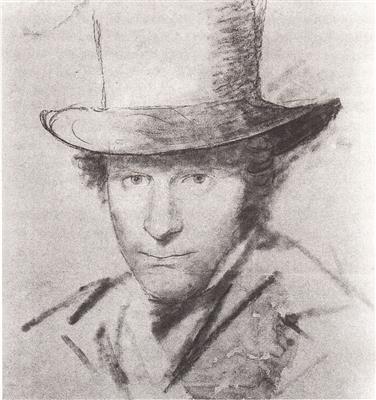
August von Pettenkofen
- landscape painting
Pettenkofen found his subject matter in the wrong country. A Viennese painter trained at the Academy of Fine Arts under Leopold Kupelwieser, he abandoned Biedermeier genre conventions after witnessing the 1848[1] revolutions and followed the Austrian[1] military into Hungary. The town of Szolnok, on the Tisza river, changed everything: its flat light, its peasant life, and its Romani communities became the source material for the work he is remembered by today.
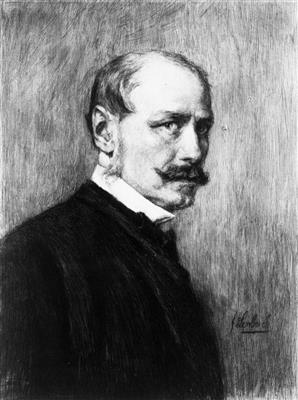
Biography
What set him apart was restraint. Where other painters turned Hungarian subjects into picturesque novelties, Pettenkofen rendered the uneventful melancholy of provincial life with something close to anthropological patience. Works such as The Village Scribe and Gypsy Children avoided theatrical pathos entirely. By 1851[1], he was applying the same cool observation to military subjects; Austrian[1] Soldiers Crossing a Ford (Belvedere, Vienna) belongs to this period.
Paris arrived in 1852[1], and with it the Barbizon influence. Pettenkofen absorbed the French school's tonal approach without abandoning Central European subjects, a combination that gave his mature work a quality difficult to place geographically. His Montmartre apartment became a gathering point for German-speaking painters: Max Liebermann, Franz von Lenbach, Mihaly Munkacsy, and Rudolf Ribarz were regulars. He spent the 1870s dividing time between Venice, Hungary, and Paris, earning honorary membership at the Munich Academy in 1872 and a knighthood in 1876.
His influence on younger painters operated largely off the record. He encouraged Eugen Jettel toward Holland and Hungary as painting destinations and contributed staffage figures to several of Jettel's canvases. When Pettenkofen died in 1889[1] at a Viennese sanatorium, the city named a street in Landstrasse after him. Viktor Tilgner designed the monument at his grave of honour at the Zentralfriedhof.
Timeline
- 1822Born in Vienna.
- 1848Witnessed the revolutions and followed the Austrian military into Hungary.
- 1851Painted "Austrian Soldiers Crossing a Ford".
- 1852Moved to Paris and absorbed the Barbizon influence.
- 1872Became an honorary member of the Munich Academy.
- 1876Received a knighthood.
- 1889Died in a Viennese sanatorium at 67. A street in Landstrasse was named after him.
Notable Works
Tap to view larger.
Next stop
Browse the movements →
Every movement in the collection, from the Renaissance to Pop art.
Related Artists

Frequently Asked Questions
What is August von Pettenkofen known for?
August von Pettenkofen is known for his paintings of Hungarian subjects, particularly peasant life and Romani communities. He is remembered for his restrained approach, rendering the uneventful melancholy of provincial life with a cool observation.What is August von Pettenkofen's most famous work?
August von Pettenkofen (1822[1]-1889[1]) was an Austrian[1] painter known for his genre scenes and depictions of rural life. Although he produced a substantial body of work, pinpointing a single, universally recognised "most famous work" is difficult. His paintings often featured scenes of peasant life, markets, and military subjects, reflecting the social and political climate of 19th-century Austria-Hungary. Pettenkofen's artistic approach involved careful observation and a talent for capturing the atmosphere of everyday life. He worked primarily in oil paint, and his style is characterised by realistic detail and attention to light. Some of his better-known paintings include "Markttag in Ungarn" (Market Day in Hungary), which captures a bustling market scene with figures in traditional dress, and depictions of soldiers. These works are held in museum collections, such as the Albertina in Vienna. While no single piece eclipses all others in fame, his market and military scenes are representative of his artistic strengths and are frequently reproduced.What should I know about August von Pettenkofen's prints?
August von Pettenkofen (1822[1]-1889[1]) was an Austrian[1] painter, mainly of genre and military scenes. While he is not primarily known as a printmaker, his works were reproduced as prints, following a common practice of the time. Prints offered a way for a wider audience to access an artist's work. These reproductions allowed people who could not afford original paintings to still enjoy and collect images of Pettenkofen's compositions. The prints would vary in quality and technique, depending on the publisher and intended market. Some would be simple, mass-produced items, while others would be carefully crafted art objects in their own right. To understand Pettenkofen's prints, consider the context of 19th-century print culture. Print collecting was popular, and a market existed for both original prints and reproductions of paintings. Collectors often kept prints in albums or portfolios. Some early collectors even pasted prints into books. The medium allowed Pettenkofen's images to circulate widely, contributing to his fame beyond Austria.What style or movement did August von Pettenkofen belong to?
August von Pettenkofen (1822[1]-1889[1]) was an Austrian[1] painter associated with the Realist movement. He is known for his genre scenes depicting rural life, particularly in Hungary. Pettenkofen studied at the Academy of Fine Arts in Vienna. Initially, he focused on historical subjects and military scenes. However, his style shifted after travels to Hungary in the 1850s. He became interested in portraying everyday life, the peasantry, and the landscape of the region. His work displays careful observation and naturalistic detail. Pettenkofen's paintings often feature scenes of village markets, festivals, and military life. He had an ability to capture the character of the people he painted, and his works offer insight into the social conditions of the time. He was part of a circle of artists who moved away from academic traditions in favour of more realistic depictions of contemporary life. His paintings gained popularity during his lifetime, and he received recognition for his contribution to Austrian art.What was August von Pettenkofen known for?
August von Pettenkofen, born in Vienna in 1822[1], is associated with atmospheric depictions. In Austria, this approach is also linked with Emil Jakob Schindler. Schindler saw atmosphere as significant; he felt artists could now paint and awaken atmosphere as never before. He believed artists should start with nature to arrive at the work and crystallise the artistic act from nature's elements. Pettenkofen's "Austrian[1] Soldiers Crossing a Ford", from 1851[1], is held at the Belvedere, Vienna. Ludwig Hevesi considered the "progress of the Viennese landscape" as linked with Schindler, calling him the "master of the Viennese atmospheric landscape" and "the most purely lyrical personality in recent Austrian art." Hartwig Fischel summarised that Schindler always created an atmospheric world full of poetic charm. Schindler considered each artwork an independent creation dependent on nature.When did August von Pettenkofen live and work?
August von Pettenkofen (1822[1]-1889[1]) was an Austrian[1] painter. He is best known for genre scenes depicting rural life in Hungary. Pettenkofen was born in Vienna on 10 May 1822[1]. He began his artistic training at the Academy of Fine Arts Vienna in 1834. He initially studied under Leopold Kupelwieser. Pettenkofen discontinued his formal studies in 1841. He then began a military career. He joined the Imperial Army and was stationed in Italy. He left the army to pursue painting full time. Pettenkofen travelled extensively throughout his career. He visited Hungary, France, and Italy. These travels provided inspiration for his paintings. He settled in Szolnok, Hungary, for a period. He was influenced by the Hungarian countryside and peasant life. Many of his works from this period depict scenes of Hungarian daily life. Later in his career, Pettenkofen moved back to Vienna. He died there on 21 March 1889. He was a member of the Vienna Academy. His work earned him recognition during his lifetime.Where can I see August von Pettenkofen's work?
August von Pettenkofen's paintings are held in several central European museums. The Hungarian National Gallery in Budapest holds a collection of his works, as does the Österreichische Galerie Belvedere in Vienna. Other museums with his paintings include the Albertina, Vienna; the Neue Pinakothek, Munich; and the Kunsthaus Zürich. These collections offer opportunities to view a range of Pettenkofen's output, from early genre scenes to later works focusing on rural life. Smaller regional museums in Austria and Hungary may also hold examples of his art. Auction catalogues from major auction houses such as Dorotheum in Vienna are another resource for tracking his work. These catalogues often contain detailed images and provenance information. Art-historical databases and online museum collections can further aid in locating specific pieces and exhibition histories.Who did August von Pettenkofen influence?
August von Pettenkofen (1822[1]-1889[1]) was an Austrian[1] painter known for his genre scenes and military subjects. He is associated with the Austrian school of genre painting. Pettenkofen's influence is most apparent in the work of artists who followed his approach to genre painting, particularly those who focused on scenes of peasant life and military subjects. His impact can be seen in the works of painters such as Johann Matthias Ranftl (1805-1888[1]), also an Austrian genre painter. Ranftl shared Pettenkofen's interest in depicting everyday life, often with a critical or sympathetic eye. Pettenkofen's style, characterised by its attention to detail and realistic depiction of figures, influenced younger artists who adopted similar techniques. His focus on Hungarian subjects also inspired others to explore similar themes in their work. Although not as widely recognised as some of his contemporaries, Pettenkofen played a role in shaping the direction of Austrian genre painting during the 19th century.Who influenced August von Pettenkofen?
August von Pettenkofen (1822[1]-1889[1]) was an Austrian[1] painter known for his genre scenes of rural life, particularly his depictions of Hungarian peasants and soldiers. Several artists influenced his development. Initially, Pettenkofen studied at the Academy of Fine Arts in Vienna. There, he was taught by Leopold Kupelwieser, a painter associated with the Nazarene movement. However, Pettenkofen moved away from Kupelwieser's more idealised style. He was more interested in Realism. A significant influence was the work of Dutch Golden Age painters. Artists such as Adriaen van Ostade and David Teniers the Younger, known for their scenes of everyday life, provided a model for Pettenkofen's subject matter and style. He carefully observed and represented the details of peasant life. Furthermore, Pettenkofen's travels to Hungary exposed him to the work of Hungarian artists. Their depictions of local customs and costumes likely shaped his approach to representing Hungarian subjects. He aimed to capture the character of the people and the atmosphere of the Hungarian countryside.Who was August von Pettenkofen?
August von Pettenkofen (1822[1]-1889[1]) was an Austrian[1] painter and printmaker. He is associated with several other artists of the period. In 1869[1]-70, he met Eugen Jettel via the art dealer Georg Plach. Pettenkofen became a friend and mentor to Jettel, encouraging him to travel to Holland in 1870 and Hungary in 1871. He also added figures to some of Jettel's paintings. Jettel, in turn, met other artists in Paris, including Pettenkofen. Pettenkofen's work, Austrian Soldiers Crossing a Ford (1851), is held in the collection of the Belvedere in Vienna. He is considered part of a generation of artists working in the decades after Neoclassicism and Romanticism. During this time, Munich became a centre for the arts, attracting artists from across Europe.Why are August von Pettenkofen's works important today?
August von Pettenkofen (1822[1]-1889[1]) was an Austrian[1] painter whose works offer insight into 19th-century Central European art. While not a figure of international fame, his paintings are important for several reasons. His depictions of military life, such as *Austrian Soldiers Crossing a Ford* (1851[1]), provide a glimpse into the Austrian army and its place in society. These works are valuable historical documents, showing uniforms, equipment, and the everyday lives of soldiers. Pettenkofen's art also connects to broader trends in Austrian art. He was a contemporary of Emil Jakob Schindler, an artist associated with atmospheric painting. The focus on capturing atmosphere and the effects of light was a significant aspect of art in Vienna during this period. Pettenkofen's works contribute to our understanding of this artistic milieu. His paintings may not be as well known as those of some of his contemporaries; however, they provide a valuable record of Austrian military history and contribute to the study of 19th-century Austrian art.What was August von Pettenkofen's art style?
August von Pettenkofen's mature art style combined Central European subjects with the tonal approach of the Barbizon school. This combination gave his work a quality difficult to place geographically.
Sources
Editorial draws on the following primary and tertiary references for August von Pettenkofen.
- [1] wikipedia Wikipedia: August von Pettenkofen Used for: biography, birth dates, death dates, identifiers, movement attribution, nationality.
- [2] book Horst Bredekamp;, Galileo's Thinking Hand Used for: stylistic analysis.
- [3] book Gianlorenzo Bernini: new aspects of his art and thought : a commemorative volume Used for: stylistic analysis.
- [4] book Husslein-Arco, Agnes, editor; Koja, Stephan, editor; Law, Rebecca (Translator), translator; McInnes, Robert (Translator), translator; Somers, Nick, translator; Monet, Claude, 1840-1926. Paintings. Selections; Österreichische Galerie Belvedere, h Used for: biography.
- [5] book Masterpieces of western art : a history of art in 900 individual studies from the Gothic to the present day Used for: biography.
- [6] book Post-impressionism : cross-currents in European painting Used for: biography.
Editorial overseen by Solis Prints. Sources verified 2026-09-30. Click a source for details, or hover over [N] in the page above to preview.
Editorial standardsMethodologyCorrectionsAI disclosureAbout the editorial team