



Carl Blechen
- landscape painting
Carl Blechen died in Berlin in 1840[2], two months after Caspar David Friedrich, the painter to whom he was most often compared and from whom he most fundamentally differed. Where Friedrich placed nature in a register of spiritual mystery, Blechen insisted that even the strangest atmospheric effects had a physical explanation, and that this made them no less worth painting. The most useful scholarly formulation positions him between Romanticism and Realism: he kept Friedrich's drama but stripped out the metaphysics.
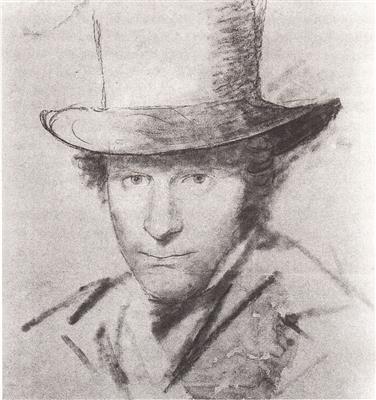
Biography
Blechen was born in Berlin in 1798[2], and his decisive formation came from a journey to Italy in 1828[2]-29. The Italian journey transformed the art of every German[2] painter who undertook it, but Blechen's Italy was not the sunlit classical idyll his contemporaries preferred. His Monks at the Gulf of Naples (1829, oil on panel, 37.5 x 29 cm, Wallraf-Richartz-Museum, Cologne) echoes the compositional structure of Friedrich's Chalk Cliffs on Rügen but replaces its longing for infinity with sheltering figures and rocks that look like bleached bones. The mood is withdrawal, not transcendence.
The Gardens of the Villa d'Este (c. 1830[2], 126 x 93 cm, Nationalgalerie Berlin) shows his greatest strength: extreme contrasts of light and shadow in which historical figures move like ghosts through cypress alleys, suffused in violet hues. Scholars have described Blechen here as an artist "inebriated by contrasts of light." Building the Devil's Bridge (1833, 77.6 x 104.5 cm, Neue Pinakothek, Munich) appears to promise Gothic terror but systematically deflates it: the crane is just a crane, the prone figures are simply tired workmen. He was in the business of demystification.
By the late 1830s his mental health had deteriorated severely, and he stopped painting years before his death at forty-two. His closest comparable in sensibility is Corot; German[2] scholars of the following generation claimed him as a direct forerunner of naturalist painting.
Timeline
- 1798Born in Berlin.
- 1828Travelled to Italy; this journey had a transformative effect on his art.
- 1829Painted "Monks at the Gulf of Naples".
- 1830Painted "The Gardens of the Villa d'Este".
- 1833Painted "Building the Devil's Bridge".
- 1837His mental health deteriorated severely, and he stopped painting.
- 1840Died in Berlin at 42.
Notable Works
Tap to view larger.
Where to See Carl Blechen
1 museum worldwide.
-
 2 works
Kunsthalle Bremen
Bremen, Germany
Tue 10:00–21:00, Wed–Sun 10:00–17:00/18:00 (seasonal), closed Mondays · €12–€15 adults
Next stop
Browse the movements →
Every movement in the collection, from the Renaissance to Pop art.
Related Artists
Frequently Asked Questions
What is Carl Blechen known for?
Carl Blechen is known for extreme contrasts of light and shadow. He is also known for demystifying Gothic terror, as seen in his painting, Building the Devil's Bridge.What is Carl Blechen's most famous work?
Blechen is best known for his atmospheric paintings, particularly those produced during his travels in Italy. Although he created many notable works, *The Palm House in Potsdam* (1832[2]-33) is often considered his most famous. This painting depicts the interior of the greenhouse at the Pfaueninsel (Peacock Island) near Potsdam. It is celebrated for its innovative use of light and shadow, creating a dramatic and almost theatrical space. The play of sunlight through the glass panes and the dense foliage captures the exotic atmosphere of the palm house. Blechen's approach was unusual for his time. He moved away from traditional, idealised depictions of nature, instead focusing on the raw, untamed aspects of the natural world. *The Palm House in Potsdam* demonstrates this shift. It shows his interest in capturing the immediate sensory experience of a place, rather than presenting a carefully constructed, romanticised view. The painting is held at the Alte Nationalgalerie, Berlin.What should I know about Carl Blechen's prints?
Carl Blechen's prints, while not as numerous as his paintings, offer a glimpse into his artistic range. Although he is better known for his oil paintings and drawings, Blechen also explored printmaking techniques, including etching and lithography. Prints were becoming more accessible and affordable during Blechen's time. The rise of printmaking allowed artists to reach a wider audience, and Blechen likely saw this as an opportunity to disseminate his work and ideas. The graphic arts in Germany experienced a resurgence in the early 20th century, with Expressionist groups like Die Brücke reviving woodcuts and other techniques. Though Blechen predates this movement, his prints can be appreciated in the context of this broader interest in graphic media. Collectors of prints often value the artistic content and the artist's intention, rather than focusing solely on rarity or technical details.What style or movement did Carl Blechen belong to?
Carl Blechen, born in 1798[2], is usually associated with the Romantic movement, although some scholars note his move toward naturalism late in his career. Blechen, 24 years younger than Caspar David Friedrich, initially employed abstract colour symbolism. However, he rejected Friedrich's mysticism, seeking physical explanations for nature's moods. Unlike Friedrich, Blechen did not suggest hidden mystery; instead, he aimed to reveal the "wonderful" aesthetics of nature. He demystified symbolic pictorial elements, presenting simple answers rather than open questions. After travels in Italy around 1828[2]-1829[2], Blechen's work began to verge on naturalism. His dramatic effects stemmed from nature itself, such as a coming thunderstorm. Some art historians draw parallels between Blechen and Camille Corot, noting Blechen's proximity to the French artist's approach to the natural world. Blechen aimed to record natural phenomena directly onto canvas in the open air, which prepared the way for naturalism in German[2] painting.What techniques or materials did Carl Blechen use?
Carl Blechen (1798[2]-1840[2]) was a German[2] painter, printmaker, and draughtsman. He is best known for his atmospheric paintings and drawings. Blechen began his artistic training at the Berlin Academy in 1822[2]. Initially, he focused on theatrical design. He studied with Karl Wilhelm Gropius, a painter of architectural views and stage sets. This training influenced his approach to composition and perspective. Blechen primarily worked in oil paint and watercolour. He often created preparatory sketches in pencil or pen and ink. His oil paintings are characterised by a careful attention to light and shadow. He built up layers of thin glazes to create a luminous effect. His brushwork varies from smooth and blended passages to more textured, impasto-like strokes. Blechen's watercolours demonstrate his skill in capturing fleeting atmospheric conditions. He used a variety of techniques, including washes, dry brushwork, and scratching into the paper to create texture. His prints, mainly etchings, show a similar interest in light and atmosphere. He manipulated the etching process to achieve a range of tonal effects.What was Carl Blechen known for?
Carl Blechen (1798[2]-1840[2]) was a German[2] painter who worked in the Romantic style. Blechen, like his contemporary Caspar David Friedrich, explored landscape painting[2], but rejected Friedrich's mysticism. Blechen sought physical explanations for nature's moods, representing them for their aesthetic value. He aimed to open viewers' eyes to the 'wonderful' aesthetics of nature. After 1828[2], Blechen's travels in Italy influenced him, moving him towards naturalism. His painting *The Bay of Rapallo*, circa 1829-30, demonstrates this shift. Blechen's approach to outdoors painting links him to the French artist Camille Corot and makes him a forerunner to the next generation of German painters. Blechen sought to record natural phenomena directly onto canvas in the open air, which paved the way for Naturalism. His painting *Monks at the Gulf of Naples*, 1829, presents an unconventional view of Italy. Rather than an idyllic scene, Blechen depicts a reclusive existence, contrasting with Friedrich's evocation of spiritual freedom. Blechen's *The Gardens of the Villa d’Este*, circa 1830, captures the extreme contrasts of light and dark in the Italian Renaissance park.When did Carl Blechen live and work?
Carl Blechen was born in 1798[2] and died in 1840[2]. The Berlin painter is considered by some to be a successor to Caspar David Friedrich, though Blechen rejected Friedrich's mysticism. Blechen sought physical explanations for nature's moods, representing them for their own sake. He aimed to open viewers' eyes to nature's aesthetics, rather than presenting nature as a wonder. His painting *Building the Devil’s Bridge* (1833[2]) demonstrates this approach, demystifying pictorial elements that might appear symbolic. After 1828 or 1829, Blechen's travels in Italy moved him towards naturalism. He was close to Camille Corot and the *paysage intime* approach to art. Blechen aimed to record natural phenomena directly onto canvas in the open air, prefiguring naturalism. His *The Bay of Rapallo*, painted around 1829-30, shows this development.Where can I see Carl Blechen's work?
Carl Blechen's work can be viewed in several European and North American museums. In Germany, you can find his paintings at the Nationalgalerie and the Brücke Museum in Berlin; the Kunsthalle in Bremen; the Ludwig Museum and Wallraf-Richartz Museum in Cologne; the Folkwang Museum in Essen; the Kunsthalle in Hamburg; the Niedersächsisches Landesmuseum in Hanover; the Städtische Kunsthalle in Mannheim; the Bayerische Staatsgemäldesammlungen in Munich; and the Von der Heydt Museum in Wuppertal. Outside of Germany, Blechen's art is held by the Kunstmuseum in Basel, the Museum of Fine Arts in Boston, the Art Institute of Chicago, the Detroit Institute of Arts, the Minneapolis Institute of Arts, the Museum of Modern Art in New York, and the National Gallery of Art in Washington, DC.Where was Carl Blechen from?
Carl Blechen was born in Cottbus, a town in the Prussian province of Brandenburg. Cottbus is about 125 kilometres south-east of Berlin. His birthdate was 29 July 1798[2]. Blechen's father was a tax official. Although the family was not wealthy, they were able to provide Carl with a good education. He attended grammar school in Cottbus and later studied at the Academy of Art in Berlin. Blechen's artistic career began with an apprenticeship at a Berlin bank in 1815[2]. However, his interest in art led him to abandon banking for the Berlin Academy in 1822, where he studied until 1824. He initially focused on stage design at the Königstadt Theatre in Berlin. He became a member of the Berlin Artists' Association in 1827. His career took him to various locations, but his origins remained in Brandenburg. He died in Berlin in 1840[2].Who did Carl Blechen influence?
Carl Blechen's art affected later painters, particularly those interested in Dutch art. He and Johann Wilhelm Schirmer, of the Düsseldorf Academy, were close to the Dutch masters in style. Schirmer was even called the "new Ruisdael". Blechen's general colour range, and the way he bathed scenes in light from a heavy sky, recall the style of Jacob Isaacksz. van Ruisdael. Schirmer's colour range and tree depictions also show Ruisdael's influence. Arnold Böcklin, who studied with Schirmer, learned to admire the Dutch master. Böcklin, along with Caspar Scheuren and Alexandre Calame, appreciated Ruisdael's use of ruins and monasteries in his compositions. Blechen, who died shortly after Caspar David Friedrich, has been compared to Camille Corot. He has also been compared to Caspar David Friedrich, though Blechen rejected Friedrich's mysticism.Who influenced Carl Blechen?
Carl Blechen (1798[2]-1840[2]) was a German[2] painter, printmaker and draughtsman. He is best known for his atmospheric, sometimes melancholic, paintings. Blechen's early artistic education included studies at the Berlin Academy from 1822[2]. There, he was exposed to the prevailing academic styles. His early work shows the influence of artists such as Caspar David Friedrich. Friedrich's Romantic approach to nature, with its emphasis on emotion and symbolism, can be seen in Blechen's earlier works. A trip to Italy in 1828-29 proved formative. There, he encountered a different artistic tradition. He was particularly drawn to the work of French painter Nicolas Poussin (1594-1665[2]). Poussin's classical compositions and use of light had a marked effect on Blechen's style. Blechen's Italian period saw a shift towards brighter colours and a greater interest in depicting the effects of light and atmosphere. Later in his career, Blechen's work also reflected the influence of Dutch Masters. Their attention to detail and realistic depictions of everyday life are evident in his later paintings.Who was Carl Blechen?
Carl Blechen (1798[2]-1840[2]) was a German[2] painter from Berlin. Although he is sometimes compared to Caspar David Friedrich, Blechen rejected Friedrich's mysticism and colour symbolism. Blechen sought physical explanations for nature's strange moods, and he aimed to show viewers the 'wonderful' aesthetics of nature. He demystified pictorial elements that others treated symbolically. After 1828[2], Blechen's travels in Italy took him toward naturalism. He has been likened to Camille Corot, because both artists recorded natural phenomena directly onto canvas in the open air. Blechen's approach prepared the way for naturalism. His works include *Monks at the Gulf of Naples* (1829), *The Gardens of the Villa d’Este* (c. 1830), *Building the Devil’s Bridge* (1833), and *The Bay of Rapallo* (c. 1829-30).
Sources
Editorial draws on the following primary and tertiary references for Carl Blechen.
- [1] museum Kunsthalle Bremen Used for: museum holdings.
- [2] wikipedia Wikipedia: Carl Blechen Used for: biography, birth dates, death dates, identifiers, movement attribution, nationality.
- [3] book Susie Hodge, Art Used for: biography.
- [4] book Rosales Rodríguez, Agnieszka,Michałowicz, Klaudyna, In the Footsteps of the Old Masters Used for: biography, stylistic analysis.
- [5] book Masterpieces of western art : a history of art in 900 individual studies from the Gothic to the present day Used for: biography, stylistic analysis.
- [6] book Neoclassicism and romanticism : architecture, sculpture, painting, drawings, 1750-1848 Used for: biography, stylistic analysis.
Editorial overseen by Solis Prints. Sources verified 2026-10-12. Click a source for details, or hover over [N] in the page above to preview.
Editorial standardsMethodologyCorrectionsAI disclosureAbout the editorial team