

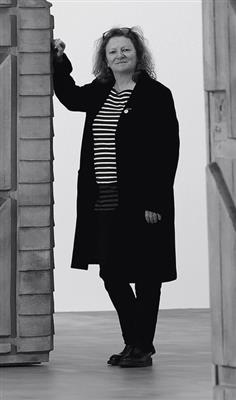
Rachel Whiteread
- YBA
- Contemporary
- Sculpture
Rachel Whiteread, born in 1963, made headlines in 1993 when she became the first woman to win the Turner Prize. Her winning work, *House*, was a concrete cast of the entire interior of a Victorian terraced house in London's East End. This ambitious sculpture inverted the building, making visible the spaces typically unseen. The project drew considerable public attention and debate, particularly after its eventual demolition just months later.
Biography
Whiteread's artistic practice consistently explores the concept of negative space. She casts the voids around and within everyday objects, transforming them into solid forms. From mattresses and hot water bottles to entire rooms, her sculptures capture the absence, giving it a tangible presence. This method invites viewers to reconsider familiar surroundings and the memories attached to them.
Her earlier work often involved casting domestic furniture, such as her plaster casts of bath interiors. Later, she expanded her scale and materials. For example, *Untitled (Book Corridors)* from 1997 created library-like structures from cast resin. Whiteread's pieces often evoke a sense of quiet contemplation, drawing attention to overlooked details of human habitation.
Beyond *House*, Whiteread has completed several significant public commissions. Among these is the Holocaust Memorial in Vienna, unveiled in 2000, which takes the form of a cast library with the books turned inwards. Her work continues to investigate the relationship between objects, memory, and the spaces we inhabit, turning the invisible into something concrete and reflective.
Timeline
- 1963Born in 1963.
- 1993Won the Turner Prize for 'House'.
- 1993'House' was a concrete cast of a Victorian terraced house.
- 1997Created 'Untitled (Book Corridors)' from cast resin.
- 2000Holocaust Memorial in Vienna unveiled.
Notable Works
Tap to view larger.
Next stop
Browse the movements →
Every movement in the collection, from the Renaissance to Pop art.
Related Artists

_%E2%80%93_LOC.jpg)
Frequently Asked Questions
What is Rachel Whiteread known for?
Rachel Whiteread is known for her sculptures that explore negative space. She casts the voids around and within everyday objects, transforming them into solid forms, as seen in *Ghost*, a plaster cast of a Victorian living room.What is Rachel Whiteread's most famous work?
Rachel Whiteread is best known for her cast sculptures of negative spaces. One of her early, recognised works is *Ghost* (1990), a plaster cast of a Victorian living room in north London. Whiteread made the piece by covering the interior walls of an abandoned house with plaster moulds, then reassembling them around a steel frame. The cast captures details such as the walls, windows, fireplace, and door. As Whiteread explained, the intention was to 'mummify the air in the room'. Whiteread continued this theme in 1993 with *House*, a concrete cast of the inside of an entire house in East London. The local authorities later demolished it, sparking public debate. Whiteread has also produced casts of other rooms, staircases, and furniture. In 1995, she represented Britain at the Venice Biennale. She was later commissioned to create a Holocaust memorial in Vienna, unveiled in 2000.What should I know about Rachel Whiteread's prints?
Rachel Whiteread is known for sculpture and installation art; her printmaking is less well known. When considering her prints, understanding some basic printmaking terminology is helpful. A print "edition" refers to a set of identical prints made from the same block or blocks. The artist decides the edition size; it is not limited by the block's physical characteristics. Each print in a limited edition is numbered, for example, "1/20" meaning it is the first print of twenty. The print number and edition size are written in pencil on the bottom left margin of the print. The print's title is in the centre, and the artist's signature is on the right. Printmaking involves meticulous checking and correction at each stage. "Proofing" allows the artist to assess the impact of adjustments to the blocks or colours. This process informs decisions about colour blocks, ink opacity, printing order, paper choice, and edition size. Using a roller press requires careful attention to pressure and avoiding ink transfer to the blanket, which is achieved using a sacrificial sheet of paper.What style or movement did Rachel Whiteread belong to?
Rachel Whiteread, born in 1963, is associated with the Young British Artists (YBAs), a group that emerged in London during the 1990s. The YBAs, including Damien Hirst, Sarah Lucas, and Tracey Emin, gained recognition for their diverse practices and entrepreneurial approach to the art world. Many of them had studied at Goldsmiths University in London under Michael Craig-Martin, a conceptual artist whose teaching disregarded traditional divisions between artistic materials and disciplines. Whiteread's work involves casting everyday objects and interior spaces, often focusing on negative space to explore themes of memory and absence. Her public commission, House (1993), generated considerable media attention and controversy, solidifying her position within the YBA movement. The YBAs' rise coincided with a convergence of art markets, youth cultures, and popular culture, contributing to a renewed interest in British art and culture during the 1990s.What techniques or materials did Rachel Whiteread use?
Rachel Whiteread is known for her casting techniques, which she uses to create negative impressions of objects and spaces. After studying painting at Brighton Polytechnic, she shifted to sculpture at the Slade School of Art (1985-1987). There, she experimented with casting parts of her own body. Whiteread typically casts commonplace, pre-owned objects, such as beds, chairs, bathtubs, and floors. She often focuses on the interior of these objects, making the space they occupy the artwork itself. The resulting sculptures, made from materials such as plaster, rubber, or resin, represent the "negative" of the original item. Her method involves marking a surface, then covering it with a substance that hardens against it. Once the material sets, the cast can be removed. This process leaves a negative impression of the surface. Whiteread often stops after this step, leaving the cast as a negative form. For example, she created "Ghost" (1990), a plaster cast of a Victorian living room interior. She has also cast entire houses, like "House" (1993).What was Rachel Whiteread known for?
Rachel Whiteread, born in 1963, is known for her casting technique, which she learned while a student at Brighton Polytechnic from 1982 to 1985. Whiteread makes casts of domestic spaces and objects; these include rooms, staircases, and furniture. Her work explores space, interior and exterior forms, and everyday things. Whiteread's 1993 work, *Ghost*, is a plaster cast of the interior of a Victorian living room in north London. She has stated that, in this work, the viewer becomes the wall. She intended to 'mummify the air in the room'. Whiteread often uses objects that suggest a human presence. She searches for items with a past in secondhand shops, then makes casts of them in her studio. The interior of these objects then becomes the artwork. The resulting sculptures, made of plaster, rubber, or resin, are the 'negative' of the object. Whiteread was associated with the Young British Artists (YBAs), many of whom studied at Goldsmiths University in London.When did Rachel Whiteread live and work?
Rachel Whiteread was born in 1963. She is a British artist who is known for her sculptures, often casts of everyday objects or architectural spaces. Whiteread studied painting at Brighton Polytechnic from 1982 to 1985, then sculpture at the Slade School of Fine Art, University College London, from 1985 to 1987. She gained attention in the 1990s. One of her well-known early works is "Ghost" (1990), a plaster cast of the interior of a Victorian living room. In 1993, she created "House", a concrete cast of the inside of a terraced house in London's East End. This project generated considerable public debate and was eventually demolished. Whiteread continues to produce work and exhibit internationally. Her practice involves casting, using materials such as plaster, concrete, resin, rubber, and paper. These casts often explore negative space and memory. She was the subject of a survey exhibition at Tate Britain in 2017-2018.Where can I see Rachel Whiteread's work?
Rachel Whiteread has exhibited extensively since her first solo show in London in 1988. Her work has appeared in many locations, including a 1996 exhibition titled "Shedding Life" at the Tate Gallery in Liverpool, which then travelled to the Museo Nacional Centro de Arte Reina Sofia, in Madrid, in 1997. Other European venues that have hosted Whiteread's art include the Stedelijk Van Abbemuseum in Eindhoven (1992-1993), the Kunsthalle Basel (1994), and the British Pavilion at the Venice Biennale (1997). In the United States, Whiteread's sculptures have been on display at the Museum of Contemporary Art in Chicago (1993), the Institute of Contemporary Art in Philadelphia (1995), and the Luhring Augustine Gallery in New York on multiple occasions. "Ghost" (1990), a plaster cast of a Victorian room, is in the collection of the National Gallery of Art, Washington, DC. Whiteread was commissioned to create a Holocaust memorial in Vienna following her appearance at the Venice Biennale in 1995.Where was Rachel Whiteread from?
Born in 1963, Rachel Whiteread is British. She first studied painting at Brighton Polytechnic. From 1985 to 1987, she studied sculpture at the Slade School of Fine Art in London. Whiteread gained attention in 1988 with her first solo exhibition. In 1993, she created "House" in Grove Road, London E3. It was commissioned by the Artangel Trust. The work existed from 25 October 1993 to 11 January 1994. In 1993, she was also the first woman to win the Turner Prize. Whiteread represented Britain at the Venice Biennale in 1995. This led to a commission for a Holocaust memorial in Vienna, unveiled in 2000. Other public projects include "Water Tower" in New York (1998) and "Monument" in London's Trafalgar Square (2001).Who did Rachel Whiteread influence?
Rachel Whiteread's art had an impact on a number of artists, particularly those working with sculpture and installation in the late 20th and early 21st centuries. Her influence can be seen in the work of artists who explore themes of memory, absence, and the built environment. While it is difficult to definitively state who was directly influenced by Whiteread, her approach to casting everyday objects and architectural spaces has resonated with many. Artists who work with similar themes, such as Doris Salcedo, who creates sculptures that memorialise victims of violence, or Mona Hatoum, known for her installations that explore displacement and conflict, share some common ground with Whiteread's practice. Whiteread's use of negative space and her ability to transform the ordinary into something thought-provoking has inspired artists to reconsider the potential of sculpture and its relationship to the surrounding environment. Her work has also contributed to a broader interest in site-specific art and interventions in public spaces.Who influenced Rachel Whiteread?
Rachel Whiteread's artistic development involved several influences. During the late 1970s, sculptors such as Carl Andre, Donald Judd, and Eva Hesse broke with modernist sculpture by eliminating the artist's hand, systemising processes, and developing negative forms. Whiteread used the strategies of these predecessors, transforming negative into positive form. Whiteread studied painting at Brighton Polytechnic before turning to sculpture at the Slade School of Art in London between 1985 and 1987. Initially, she made casts of her own body, but rejected these as too personal. She then explored the body through everyday objects, such as beds, chairs, and bathtubs. Whiteread has acknowledged the influence of American art after 1940, particularly its monumental dimensions. She cites Gordon Matta-Clark, Tony Smith, and Louise Bourgeois as other important figures. Her work also makes direct reference to other artists; for example, *Untitled (One Hundred Spaces)* (1995) relates to Bruce Nauman's *A Cast of the Space under My Chair* (1965-68). Whiteread has said that she has a "female sensibility" regarding materials and colours.Who was Rachel Whiteread?
Rachel Whiteread (born 1963) is an English artist known for her sculptures, often casts of everyday objects or architectural spaces. She was one of the Young British Artists who emerged in the late 1980s and gained prominence in the 1990s. Whiteread's early work involved casting furniture, such as wardrobes and mattresses, using plaster. These pieces explored themes of absence, memory, and the traces left by human existence. One of her most recognised works is "House" (1993), a concrete cast of the interior of a terraced house in London's East End. The work generated considerable public debate and was eventually demolished. In 1997, Whiteread represented Britain at the Venice Biennale, and she has continued to exhibit her work internationally. Her practice has expanded to include casts of entire rooms, staircases, and even water towers. These large-scale works invite viewers to consider the negative space that surrounds us and the hidden forms within familiar structures. Whiteread was awarded the Turner Prize in 1993 and has received several other awards and honours for her contributions to contemporary art.
Sources
Editorial draws on the following primary and tertiary references for Rachel Whiteread.
- [1] book Beard, Lee, 1973- author, Butler, Adam, author; Van Cleave, Claire, author; Fortenberry, Diane, author; Stirling, Susan, author, Beard, Lee, 1973- author, Butler, Adam, author; Van Cleave, Claire, author; Fortenberry, Diane, author; Stirling, Susan, author - The Art Book_ New Edition, Mini Format Used for: biography, stylistic analysis.
- [2] book guggenheim-rachelwhit00whit Used for: biography, stylistic analysis.
- [3] book Hodge, Susie, 1960- author, The short story of women artists : a pocket guide to movements, works, breakthroughs, & themes Used for: biography, stylistic analysis.
Editorial overseen by Solis Prints. Sources verified 2026-10-13. Click a source for details, or hover over [N] in the page above to preview.
Editorial standardsMethodologyCorrectionsAI disclosureAbout the editorial team