



About Adolf Eberle
German · 1843–1914
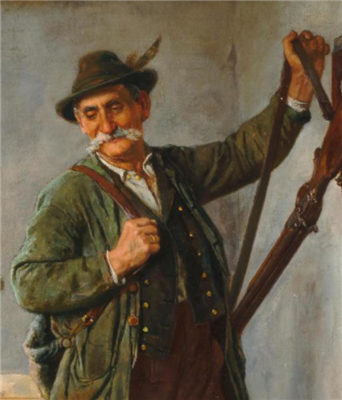
Munich genre painter who depicted Bavarian peasant life with warmth, scoring his first engraved success at just eighteen years old.
Museums3
Countries3
Largest reported holdingAlte Nationalgalerie, Berlin · 1 recorded work
Loading map…
Where to see Adolf Eberle
Collection holdings are reported here; current display varies. Check with each museum before visiting.
-
1 recorded work
Alte Nationalgalerie
Berlin, Germany
-
1 recorded work
Royal Collection
London, United Kingdom


-
1 recorded work
National Museum of Fine Arts of Cuba
Havana, Cuba

Frequently Asked Questions
Where can I see Adolf Eberle's work?
It is difficult to provide a comprehensive list of locations holding works by Adolf Eberle. However, some European museums with collections of German[1] art may hold his paintings. These include the Brucke Museum and Nationalgalerie in Berlin, the Kunsthalle and Sammlung Bottcherstrasse in Bremen, the Ludwig Museum and Wallraf-Richartz Museum in Cologne, the Folkwang Museum and Gesellschaft Kruppsche Gemaldesammlung in Essen, and the Kunsthalle in Hamburg. Additional museums are the Niedersachsisches Landesmuseum in Hanover, the Stadtische Kunsthalle in Mannheim, the Bayerische Staatsgemaldesammlungen in Munich, the Stiftung Ada und Emil Nolde in Seebull, and the Von der Heydt Museum in Wuppertal. It may be useful to consult museum databases, specialist catalogues, and auction records to ascertain the current locations of particular works by Eberle.What should I know about Adolf Eberle's prints?
Adolf Eberle (1843[1]-1914[1]) was a German[1] genre painter. Prints of his work are most likely to be offset reproductions, canvas transfers, or giclée prints, rather than original prints. Original prints, such as woodcuts, engravings, or lithographs, are produced by hand, with the artist creating the artwork directly on the plate or block. Each print is considered an original. These are sold through specialist galleries, frame shops, and fine-art galleries. Offset reproductions are produced by photochemical means. There is no physical limit to the number of prints that can be made. Giclée prints are fine-art prints made using colour-copier technology. Canvas transfers involve transferring the image onto canvas, giving it the appearance of a painting. When buying prints, look for a signature; this testifies to the authenticity of a print and the artist's approval. Artists often number their prints, for example 35/100, where 100 is the total number of prints in the edition, and 35 is the sequential number of that particular print.Who did Adolf Eberle influence?
It is difficult to say precisely who Adolf Eberle influenced. However, Albrecht Dürer had a wide-ranging effect on artists of the 16th century and beyond. Limewood sculptors borrowed from his prints, and Italian artists responded to his work. During the "Dürer Renaissance" (approximately 1570 to 1630), Hans Hoffmann produced faithful replicas of Dürer's drawings. In the 17th century, artists such as Caravaggio and Diego Velázquez appear to have drawn inspiration from Dürer's woodcuts and engravings. Rembrandt owned Dürer's book on proportion and adapted figures from his prints. In the 19th century, Dürer's importance rose with nationalistic revivalism. Twentieth-century artists, including Otto Dix, Lucian Freud, and Norman Rockwell, engaged with Dürer's work in various ways. Dürer's graphic style also influenced stained-glass design. Hans Baldung, Hans Schäufelein, and Hans Leu the Younger carried his legacy to other cities. Hans von Kulmbach, who worked in Dürer's circle, adopted his graphic language for monumental windows. Sebald Beham and Georg Pencz also emulated Dürer's style in their designs.What is Adolf Eberle's most famous work?
There is no consensus regarding Adolf Eberle's single most famous work; his output was consistent rather than focused on one specific piece. He is best known for genre paintings, often depicting scenes of everyday life in rural Bavaria. Eberle's paintings frequently feature peasants, farmers, and hunters in detailed, anecdotal situations. These works are characterised by careful attention to detail, particularly in the rendering of costumes and settings. Examples of his popular works include scenes of village life, hunting expeditions, and interactions within rural communities. While no single painting overshadows his other works, his body of work collectively provides a valuable insight into 19th-century Bavarian life. Eberle's paintings are appreciated for their realistic portrayal of rural existence and their contribution to genre painting.What style or movement did Adolf Eberle belong to?
Adolf Eberle (1843[1]-1887[1]) was a German[1] painter associated with genre painting, a style that gained popularity in the 19th century. Genre art focuses on scenes from everyday life, often depicting ordinary people engaged in common activities. Eberle's works frequently portrayed Bavarian peasants, village life, and hunting scenes, capturing the customs and costumes of the time. These paintings often had anecdotal or sentimental qualities. Genre painting emerged as a significant movement in the 19th century, reflecting a growing interest in realism and the lives of the middle and lower classes. Artists like Eberle contributed to this trend by creating accessible and relatable images of contemporary life, which appealed to a broad audience. His attention to detail in costume and setting provides insight into Bavarian culture during this period.What is Adolf Eberle known for?
Adolf Eberle is known for his genre scenes depicting the daily lives of Bavarian and Tyrolean farmers, huntsmen, and their animals. His painting Erster Rehbock (First Stag) was well received at Munich's international exposition in 1879[1].
Sources
Where to See guide aggregates verified holdings of Adolf Eberle's works across the following collections.
- [1] wikipedia Wikipedia: Adolf Eberle Used for: biography.
- [2] book Husslein-Arco, Agnes, editor; Koja, Stephan, editor; Law, Rebecca (Translator), translator; McInnes, Robert (Translator), translator; Somers, Nick, translator; Monet, Claude, 1840-1926. Paintings. Selections; Österreichische Galerie Belvedere, h Used for: biography.
- [3] book Masterpieces of western art : a history of art in 900 individual studies from the Gothic to the present day Used for: biography.
Editorial overseen by Solis Prints. Sources verified 2026-09-30. Click a source for details, or hover over [N] in the page above to preview.
Editorial standardsMethodologyCorrectionsAI disclosureAbout the editorial team