



About Eduard von Gebhardt
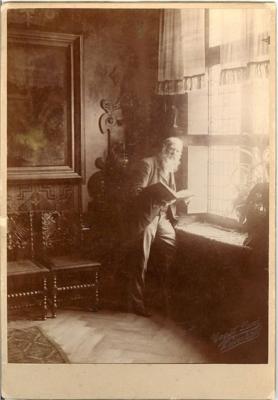
- portrait
Baltic German painter of meticulous biblical scenes modelled on Dutch and German masters, and a long-serving professor at the Düsseldorf Kunstakademie.
Where to see Eduard von Gebhardt
Collection holdings are reported here; current display varies. Check with each museum before visiting.
-
5 recorded works
Alte Nationalgalerie
Berlin, Germany
-
2 recorded works
Hermitage Museum
Saint Petersburg, Russia


-
1 recorded work
Wallraf–Richartz Museum
Cologne, Germany

Own a piece of it
Eduard von Gebhardt prints
Hand-finished archival prints from Eduard von Gebhardt's body of work.

Can't travel? Bring Eduard von Gebhardt home.
See all Eduard von Gebhardt prints →Frequently Asked Questions
Why are Eduard von Gebhardt's works important today?
Eduard von Gebhardt (1838[1]-1925[1]) was a Baltic-German historical painter. He is best known for his religious scenes and depictions of the Protestant Reformation. Gebhardt's approach combined historical accuracy with a realistic style, setting him apart from earlier, more romanticised history paintings. Born in Saint Petersburg, he studied at the Saint Petersburg Academy of Arts and later at the Düsseldorf Academy. In Düsseldorf, he was influenced by Wilhelm Schadow and Karl Ferdinand Sohn. He became a professor at the Düsseldorf Academy in 1873[1], teaching for many years. Gebhardt's paintings often feature scenes from the life of Martin Luther and other Reformation figures. These works reflect his own strong Protestant faith and his interest in historical detail. His paintings are valued for their naturalistic portrayal of people and settings, as well as their narrative power. Although his style is not considered avant-garde, his dedication to realism within historical painting makes his work a valuable record of 19th-century historical and religious thought. His works offer insights into the period's cultural and religious values.Who did Eduard von Gebhardt influence?
It is difficult to identify specific individuals directly influenced by Eduard von Gebhardt. However, some general connections can be drawn between his style and later artists. Theodor von Hoérmann, Emilie Mediz-Pelikan, and Rudolf Junk were all influenced by French Impressionism, particularly Claude Monet. Hoérmann systematically investigated lighting conditions, as seen in his 1891[1] series, *Ice Floes on the Bank of the Thaya*. Mediz-Pelikan methodically traced atmospheric changes in her paintings of Stein in winter. Junk's paintings of Lake Attersee and Steinbach in the Vienna Woods (1906/07) show buildings and trees dissolved into areas of colour, reminiscent of Monet's *Houses of Parliament* series. Gustave Courbet's landscapes had a notable effect on twentieth-century German art. Emil Nolde's seascapes, with their compositional energy and thick surfaces, evoke Courbet's techniques. Gerhard Richter's work shares parallels with Courbet's use of the palette knife and layering.Who influenced Eduard von Gebhardt?
Without more specific source material, it is difficult to provide a detailed account of Eduard von Gebhardt's influences. However, some context can be offered regarding artistic training in the 1800s. During the 1800s, a revived interest in classical Greek art and design took hold in architectural studies. This elevated the purity and dignity of Greek art, establishing it as the basis for advanced architectural study. Simultaneously, there was a rejection of what was perceived as the corrupted taste that predominated during the 18th century. This shift moved away from mere academic use of historical architectural styles. Instead, the focus changed to geometrical systems, moving beyond the imitation of historical models.What is Eduard von Gebhardt's most famous work?
Eduard von Gebhardt (1838[1]-1925[1]) was a Baltic German painter who is best known for his history paintings, particularly those depicting scenes from the life of Martin Luther and the Protestant Reformation. His most recognised work is probably "The Sermon on the Mount" (Die Bergpredigt), finished in 1866[1]. This painting depicts Jesus delivering his famous sermon to a crowd of listeners. Gebhardt's approach was to portray biblical events with a sense of realism, setting them in plausible historical contexts. He aimed for authenticity in his depictions of people, clothing, and settings. Gebhardt's style moved away from the more idealised or dramatic interpretations common in earlier religious art. Instead, he presented a more human and relatable view of religious figures and events. This approach was influential on other artists of his time who sought to bring a sense of historical accuracy to their religious paintings. He became a professor at the Düsseldorf Academy, where he further promoted his artistic ideas.What style or movement did Eduard von Gebhardt belong to?
Eduard von Gebhardt (1838[1]-1925[1]) is usually associated with the Düsseldorf school of painting. This movement, which gained prominence in the 19th century, was characterised by its focus on narrative and historical subjects, as well as its attention to detail. The Düsseldorf school emerged from the Düsseldorf Academy, which emphasised a return to earlier artistic traditions. Artists associated with the school often depicted scenes from the Bible, historical events, or genre subjects, aiming for realism in their representations. They also explored the emotional states of their subjects. Gebhardt's work aligns with these characteristics through his depictions of religious scenes, particularly those related to the Protestant Reformation. His paintings often feature figures in historical costumes, set within carefully rendered architectural spaces. He paid close attention to the expressions and gestures of his subjects, seeking to convey their inner emotions and psychological states.What was Eduard von Gebhardt known for?
Eduard von Gebhardt (1838[1]-1925[1]) was a Baltic German historical painter, known particularly for his paintings on religious subjects. He studied at the St Petersburg Academy from 1855[1] to 1858, then at the Düsseldorf Academy. Gebhardt is associated with the Düsseldorf school of painting. His style moved away from romanticism, towards realism. He is considered one of the founders of the realistic tendency in German religious painting. Gebhardt was a professor at the Düsseldorf Academy from 1873. His best-known works depict scenes from the life of Martin Luther and the Protestant Reformation. He aimed to portray biblical events in a realistic and accessible manner, often setting them in contemporary German settings. This approach was innovative for its time, moving away from idealised or stylised depictions of religious subjects.What was Eduard von Gebhardt's art style?
Eduard von Gebhardt's biblical paintings drew deliberately on 15th and 16th-century Dutch and German masters. He was particularly influenced by the unidealized figures of Lucas van Leyden and Albrecht Dürer. His gospel scenes were often set in the plain domestic settings of northern European peasant life.
Sources
Where to See guide aggregates verified holdings of Eduard von Gebhardt's works across the following collections.
- [1] wikipedia Wikipedia: Eduard von Gebhardt Used for: biography.
- [2] book guggenheim-kandinskyinmunic00kand Used for: biography.
- [3] book Allison Lee Palmer, Historical Dictionary of Neoclassical Art and Architecture Used for: biography.
- [4] book Palmer, Allison Lee, Historical Dictionary of Neoclassical Art and Architecture Used for: biography.
- [5] book Masterpieces of western art : a history of art in 900 individual studies from the Gothic to the present day Used for: biography.
- [6] book Post-impressionism : cross-currents in European painting Used for: biography.
- [7] book Post-impressionism : cross-currents in European painting Used for: biography.
Editorial overseen by Solis Prints. Sources verified 2026-10-14. Click a source for details, or hover over [N] in the page above to preview.
Editorial standardsMethodologyCorrectionsAI disclosureAbout the editorial team