



About José Guerrero
Spanish · 1914–1991
a Spaniard who walked into New York Abstract Expressionism and exhibited alongside the Americans at Betty Parsons
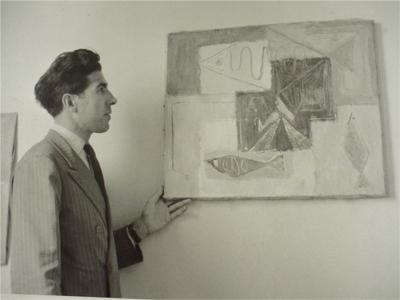
Museums8
Countries2
Largest reported holdingMuseo Nacional Centro de Arte Reina Sofía, Madrid · 11 recorded works
Loading map…
Where to see José Guerrero
Collection holdings are reported here; current display varies. Check with each museum before visiting.
-
11 recorded works
Museo Nacional Centro de Arte Reina Sofía
Madrid, Spain
-
3 recorded works
Yale University Art Gallery
New Haven, United States


-
1 recorded work
Buffalo AKG Art Museum
Buffalo, United States
-
1 recorded work
Carnegie Museum of Art
Pittsburgh, United States
-
1 recorded work
Pennsylvania Academy of the Fine Arts
Philadelphia, United States
-
1 recorded work
Solomon R. Guggenheim Museum
New York City, United States
-
1 recorded work
Indianapolis Museum of Art
Indianapolis, United States
-
1 recorded work
RISD Museum
Providence, United States


Frequently Asked Questions
Where can I see José Guerrero's work?
José Guerrero (1914-1991) was a Spanish-American abstract expressionist painter. His works can be found in numerous public and private collections internationally. In Spain, major holdings of Guerrero's paintings are at the Museo Nacional Centro de Arte Reina Sofía in Madrid and the Centro José Guerrero in Granada. The Reina Sofía has several significant pieces, providing a good overview of his artistic development. The Granada centre, dedicated specifically to Guerrero, offers an in-depth look at his life and art; it often hosts temporary exhibitions and maintains a permanent collection. Outside Spain, important collections include those at the Museum of Modern Art (MoMA) and the Whitney Museum of American Art in New York City. These museums hold key examples of his abstract expressionist paintings from his time in the United States. Smaller collections of his work can be found in other museums across Europe and the Americas. Check museum websites for current exhibitions and collection details.What should I know about José Guerrero's prints?
José Guerrero worked at printmaking studios such as Universal Limited Art Editions (ULAE), Graphicstudio/University of South Florida, Gemini GEL, and Tyler Graphics Ltd, in both the United States and Europe. These workshops share common elements such as woodblocks for relief printing; metal plates for etching; prepared limestone or metal plates for lithography; and mounted screens for screenprints. They also contain supplies such as liquids, crayons, masking materials, delineative tools, greases, gums, waxes and dangerous acids for etching. Founded in 1966, Gemini GEL became known for its technological skill, use of materials and processes, and series of works. After Tyler left the partnership and founded Tyler Graphics Ltd in 1975, his interest in making paper by hand deepened, becoming a cornerstone of his new enterprise.Why are José Guerrero's works important today?
José Guerrero (1914-1991) was a Spanish-American painter known for his abstract expressionist works. His art is important for its synthesis of European and American artistic traditions. Guerrero moved to the United States in 1947, where he studied at the Académie de la Grande Chaumière in Paris and later at Greenwich House in New York. Guerrero's time in New York exposed him to abstract expressionism, which greatly influenced his style. He developed a distinctive approach, characterised by bold colours and dynamic compositions. His paintings often feature geometric forms and energetic brushstrokes. Guerrero aimed to create visual experiences that evoked emotion. His work gained recognition in both the United States and Spain. He exhibited extensively and received several awards. Guerrero's art is held in the collections of major museums, including the Museo Nacional Centro de Arte Reina Sofía in Madrid and the Museum of Modern Art in New York. Guerrero's unique style and his contribution to the development of abstract art make his work significant.Who is jose guerrero?
José Guerrero was a Spanish abstract painter who integrated into the New York Abstract Expressionist scene. Guerrero exhibited at the Betty Parsons Gallery and appeared in group shows at the Whitney Museum. He was born in Granada in 1914 and died in Barcelona in 1991.What techniques or materials did José Guerrero use?
José Guerrero was a painter who worked primarily in an abstract style. He is known for his use of colour and form. Guerrero began his studies at the Escuela de Bellas Artes de San Fernando in Madrid. Later, he moved to Paris where he was exposed to new artistic ideas. He then relocated to New York City in 1950, where he further developed his style. Throughout his career, Guerrero experimented with different media, including oil paint and collage. His paintings often feature bold, geometric shapes and contrasting colours. He explored the relationship between colour and space, creating works that are both dynamic and contemplative. Guerrero's work can be seen as part of the broader Abstract Expressionist movement, but he developed his own unique approach to abstraction. He often incorporated elements of his Spanish heritage into his art, blending international styles with personal expression.Who did José Guerrero influence?
José Guerrero's impact can be seen in several artists. The Nicaraguan painter Armando Morales (born 1927) is one such example. Morales, considered one of Central America's greatest artists, gained recognition in 1959 when he won the Ernst Wolf Prize at the V Sao Paulo Bienal in Brazil. His distinctive visual style showed the influence of Robert Motherwell, Antoni Tàpies, and Serge Poliakoff. One notable work from Morales's early period, Guerrillo muerto I (1958), demonstrates this. It bears a clear debt to Motherwell’s “Spanish Elegy” series. Like Motherwell's anti-fascist imagery, Morales used morose megalithic forms in black, marked by organic contours. This connection to Motherwell's memorial to the Spanish Republic was significant for Morales, whose professor at the National School of Fine Arts in Managua, Augusto, was a Spanish exile.Who influenced José Guerrero?
José Guerrero's artistic development involved several influences. Early on, he was impressed by a Cubist still life by Braque, which he encountered in Caracas. This led him to study Cubism, and he soon understood the work of Picasso. He also explored Cézanne and van Gogh. Although he was briefly drawn to Gauguin, he was not convinced by his forms or symbolic vision, and he was later disappointed by the colours in person. After moving to Paris, Guerrero sought to add movement to Mondrian's works, but he realised that Mondrian had already addressed this issue in *Broadway Boogie Woogie*. He found the work of Moholy-Nagy important, as well as that of Calder, Marcel Duchamp, and Gabo. Guerrero aimed to take the elements that these artists had introduced further, seeking to answer the questions they had raised but not fully resolved. He also expressed interest in Klee's exploration of perspective from different viewpoints.What style or movement did José Guerrero belong to?
José Guerrero is associated with Abstract Expressionism, an American post-war art movement that first gained prominence in New York during the 1940s. The name encompasses a wide range of American painting from this period, which established the United States as a centre for avant-garde art for the first time. Abstract Expressionism is also known as painterly abstraction and Action Painting. These terms describe abstract works characterised by loose brushstrokes, gestural techniques, and the artist's unconscious impulses, or personal dramas. The expressive aspect of the art is linked to early Expressionism's subjective heroism, as well as the Surrealist technique of automatic writing. Key figures connected to Abstract Expressionism include Jackson Pollock, Willem de Kooning, Arshile Gorky, and Mark Rothko. Pollock, considered a leading figure, placed his canvases on the floor, pouring and splashing paint from all angles, moving away from the traditional easel. Other members of the school used large blocks of colour, often evoking unseen spiritual states.
Sources
Where to See guide aggregates verified holdings of José Guerrero's works across the following collections.
- [1] book guggenheim-guhe00solo Used for: biography.
- [2] book guggenheim-masterp00solo Used for: biography.
- [3] book guggenheim-twopri00weis Used for: biography.
Editorial overseen by Solis Prints. Sources verified 2026-09-30. Click a source for details, or hover over [N] in the page above to preview.
Editorial standardsMethodologyCorrectionsAI disclosureAbout the editorial team