

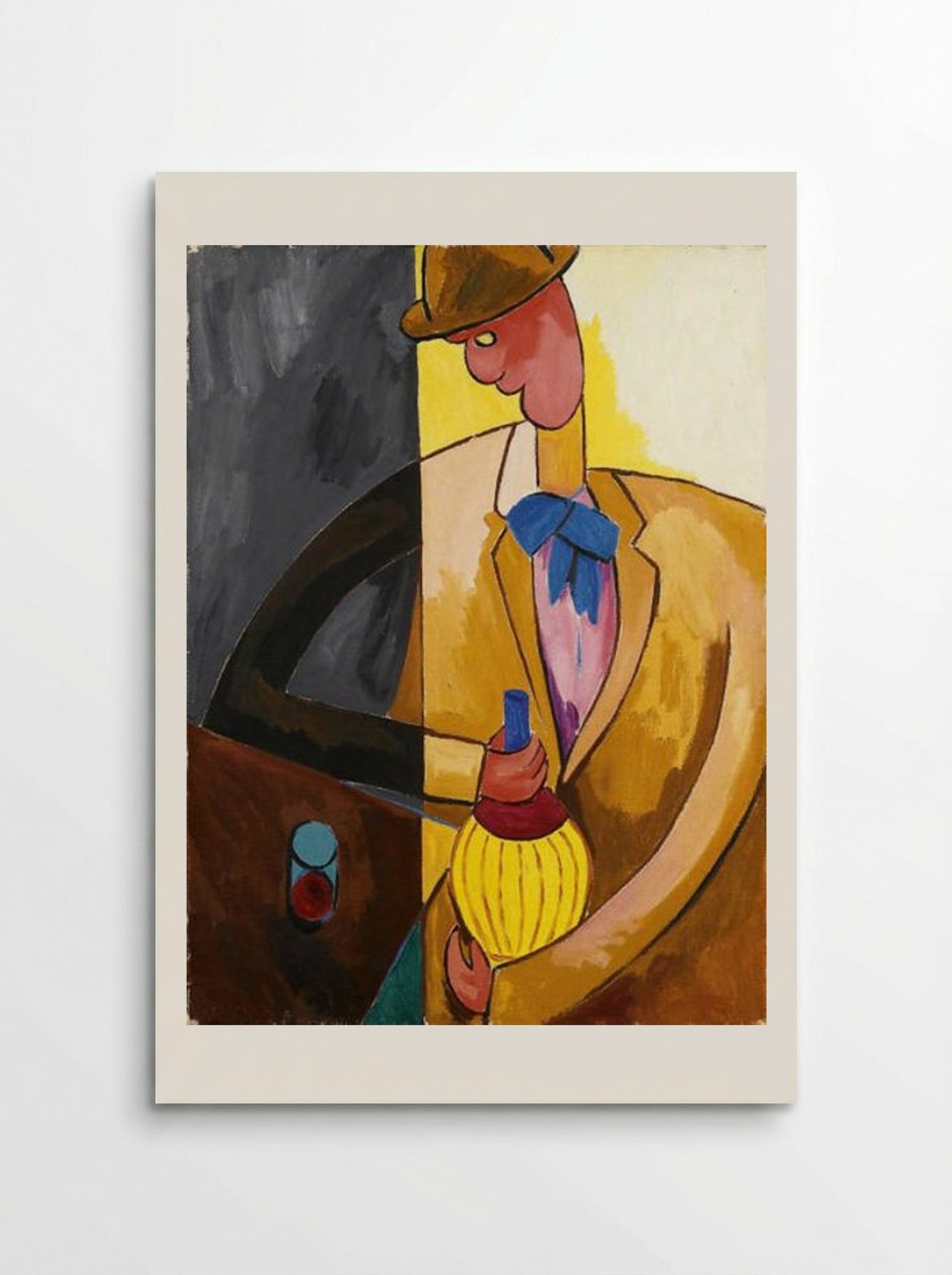
The Drunk Man - Alberto Magnelli
Archival giclée
Frames arrive ready to hang
Secure checkout
Made to order
Description
A stylised, semi-abstract figure rendered in bold colours and simplified forms, Alberto Magnelli's "The Drunk Man" uses a limited palette to convey a sense of disequilibrium and caricature.
Alberto Magnelli's "The Drunk Man" presents a stylised, semi-abstract figure rendered in bold colours and simplified forms. Magnelli, an Italian artist who moved from early experiments with Cubism to a more personal form of abstract art, here uses a limited palette to convey a sense of disequilibrium and caricature. The figure, presumably the titular drunk man, is depicted wearing a brown hat and a yellow suit, with a blue bow tie and a pink shirt. He holds a bottle, its form reduced to stacked geometric shapes. The background is divided into contrasting sections of grey and yellow, further enhancing the sense of unease. Magnelli's work often explored the relationship between geometric abstraction and the human figure. In this painting, the figure is not entirely dissolved into abstraction; instead, it retains enough recognisable features to suggest a narrative. The painting's title adds another layer of meaning, suggesting a commentary on human behaviour and the effects of intoxication. The composition, with its strong lines and flat planes of colour, reflects the influence of early 20th-century avant-garde movements, while the subject matter hints at a more personal and expressive approach.
Return policy
Because every print is made to order, we don't offer change-of-mind returns, refunds or exchanges. If your order arrives faulty, damaged or incorrect, we'll replace it free of charge — just contact us within 48 hours of delivery. See our refunds page for full details.
Shipping
We ship worldwide, printing at the production hub nearest to your delivery address. Delivery times and costs vary by destination — you'll see the options available to you at checkout.
Manufacturing
Each print is produced to order using 12-colour giclée printing on FSC-certified archival paper. Designed in Britain and printed at your nearest production hub to reduce waste and speed up delivery.
Care and materials
Specific Features
Every Solis piece is made to order with archival, gallery-quality materials built to last.
- Museum-grade giclée printing for rich, fade-resistant colour
- Archival matte fine-art paper, FSC-certified
- Multiple sizes and framing options available
- Frames in black, natural wood, dark wood or white
- Framed prints arrive ready to hang
Care & Cleaning
To keep your artwork looking its best:
- Dust gently with a soft, dry cloth
- Avoid prolonged direct sunlight
- Never use liquid cleaners on the print or canvas surface
- Keep in a dry, room-temperature space
- Handle prints with clean, dry hands
Materials & Sizing
Museum-grade giclée on FSC-certified archival matte paper, with framed and canvas options.
- Paper sizes: A4, A3, A2, A1, A0 and B2 (50×70 cm)
- Canvas: XS (20×30 cm) to Large (60×90 cm)
- Frames: black, natural wood, dark wood or white
The Drunk Man - Alberto Magnelli

Artist Biography
Alberto Magnelli
Born in Florence in 1888, Magnelli spent time in Paris in the early twentieth century before returning to Italy, where the Composizioni emerged in 1915. He then largely set abstraction aside. The sustained return came in the 1930s: in 1935 he was included in the landmark grouping of Italian non-figurative painters at the second Quadriennale in Rome, the first occasion on which Bogliardi, Ghiringhelli, Reggiani, Licini, Soldati, and Magnelli exhibited together as a collective front. The records note that Magnelli was 'living in Paris' by then: he had already relocated and would remain there for the rest of his life.
In Paris he moved in the circle of Hans Arp and Sonia and Robert Delaunay. He was among the first to identify Nicolas de Stael's talent, alongside Arp and the Delaunays, encouraging the young Russian-born painter before he had found an audience.
His output is catalogued in Anne Maisonnier's catalogue raisonne, Alberto Magnelli: L'Oeuvre peint, published in Paris in 1975. A centenary exhibition was held at the Palais des Papes in Avignon in 1988. He died in 1971.
Why Choose Us ?
Damage-free delivery guarantee
Fast Shipping
Museum-Quality Materials
You May Also Like