



Constantin Artachino
- academic art
- Post-Impressionism
- Symbolism
- Tinerimea artistică
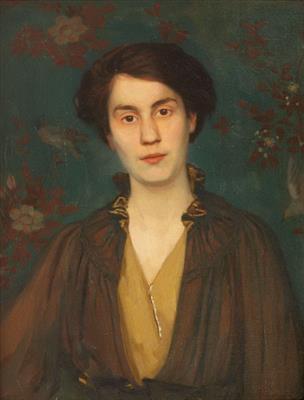
Artachino's artistic formation began not in a bohemian garret but in the offices of a Bucharest commercial school, where teachers spotted his aptitude for drawing and redirected his life accordingly. A scholarship from banker Zerleti sent him to Paris and the Académie Julian, where he studied under William-Adolphe Bouguereau, Henri Lucien Doucet, and Cormot, sketching in Barbizon and at Fontainebleau.
Biography
He returned to Romania a trained colourist with a particular attraction to the landscapes of Dobrogea, the Black Sea-adjacent region where Ottoman, Bulgarian, and Greek cultures mixed in ways unlike anywhere else in the country. His portraits and genre scenes from that region carry a warmth and specificity that distinguish them from the more conventional salon output of his contemporaries.
In 1897[1] he co-founded the Society for the Arts in Romania (known as Ileana) alongside Stefan Luchian and Nicolae Vermont, an early attempt to organise Romanian[1] artists outside the official exhibition apparatus. Four years later he was a founding member of Artistic Youth, a broader association that included Frederic Storck, Arthur Verona, and George Petrascu. He spent the latter part of his career as a professor, first at the School of Fine Arts in Iasi, then in Bucharest, where he taught until his retirement in 1935.
Artachino lived to eighty-three, dying in February 1954[1], having witnessed the transformation of Romanian[1] art from late nineteenth-century academic naturalism to the upheavals of socialist realism.
Timeline
- 1870Born in Romania.
- 1897Co-founded the Society for the Arts in Romania (Ileana) with Stefan Luchian and Nicolae Vermont.
- 1901Became a founding member of Artistic Youth, alongside Frederic Storck, Arthur Verona, and George Petrascu.
- 1935Retired from his professorship in Bucharest.
- 1954Died in February, aged 83. He had witnessed the transformation of Romanian art.
Notable Works
Tap to view larger.
Next stop
Browse the movements →
Every movement in the collection, from the Renaissance to Pop art.
Related Artists




Frequently Asked Questions
What is Constantin Artachino known for?
Constantin Artachino is known for his landscapes, portraits, and genre scenes, particularly those depicting the Dobrogea region. His work from that area is distinguished by its warmth and specificity.What is Constantin Artachino's most famous work?
It is difficult to identify Constantin Artachino's single most famous work, as references to his paintings are scarce in the available texts. Without more information, it is impossible to make a definitive statement about which piece brought him the most attention. Lists of paintings by various artists do not include any works by Artachino. Mentions of other artists' important works, such as Simone Martini's *Christ Discovered in the Temple*, do not provide a basis for comparison. Similarly, descriptions of pieces like Caravaggio's *Madonna of Loreto* do not offer any insight into Artachino's body of work. Further research would be needed to determine which painting, if any, is considered Artachino's most well-known.Where can I see Constantin Artachino's work?
Constantin Artachino's work can be viewed in several museums. In the United States, these include the Charles Hosmer Morse Museum of American Art (Winter Park, Florida), the Los Angeles County Museum of Art (Los Angeles), the Metropolitan Museum of Art (New York), the Minneapolis Institute of Arts (Minneapolis), the Museum of Modern Art (New York), the Virginia Museum of Fine Arts (Richmond), and the Wolfsonian at Florida International University (Miami Beach). In Canada, his pieces are held at the Royal Ontario Museum in Toronto. In the United Kingdom, you can find Artachino's art at the Bakelite Museum (Williton), Brighton Museum & Art Gallery (Brighton), the Geffrye Museum (London), Manchester Art Gallery (Manchester), the National Museums of Scotland Royal Museum (Edinburgh), and the Victoria & Albert Museum (London).Who did Constantin Artachino influence?
Constantin Artachino's influence is difficult to measure directly. However, his historical context provides some insight. He worked in an Italy that, in the late 19th century, felt itself lagging behind other European nations in industrial and cultural development. This sense of backwardness spurred a desire to catch up, which manifested in art through two main avenues. Some artists, like Guttuso and Marini, cultivated a strong sense of continuity with past Italian models. Others saw abstract art as the style of political and creative freedom. Fontana, Burri, and Vedova led this creative explosion. Later, artists such as Chia, Paladino, Cucchi, and Clemente gained attention. These artists, part of the transavanguardia movement, drew on local traditions and earlier Italian art, especially from the 1920s and 1930s. Artachino's career occurred before these developments; any influence would be indirect, through the general cultural trends of his time.Who influenced Constantin Artachino?
Constantin Artachino's artistic development saw him influenced by a range of figures. As a student, he drew inspiration from Surrealism, Francis Bacon, and Hieronymus Bosch. He also expressed admiration for Michelangelo and Baroque artists. Pablo Picasso was an important idol for Artachino, who appreciated his ability to assimilate and personalise the work of others. Among contemporary artists, Artachino cited Robert Rauschenberg, Jasper Johns, Cy Twombly, and Joseph Beuys as influences. Rauschenberg's handling of materials, along with his rich imagery, particularly appealed to Artachino. He also closely studied early abstract European art, such as Cubism, Piet Mondrian, and Paul Klee. Klee's work, with its engagement with art, reality, symbolism, and literary elements, was of particular interest. Artachino sought to create a broad statement in his own art, maintaining a connection with the past while forging a personal style.Why are Constantin Artachino's works important today?
Constantin Artachino's importance does not rest on his historical notability, but rather on his contribution to a particular artistic sensibility. His works appeal to contemporary audiences because of their formal qualities and their engagement with certain themes. Artachino's art balances colour and line in deceptively simple forms. These forms are beautifully colourful and handsomely functional. This combination creates an art that perpetuates the refinement and transcendent vitality of a formal ideal. His pieces offer a serene painterly vision, even when employing revolutionary notions. This serenity, coupled with a detached objectivity, provides a perspective that remains relevant in today's rapidly changing artistic environment. Artachino's focus on formal ideals and his ability to balance simplicity with sophistication continue to resonate with those seeking a sense of refinement in art.What was Constantin Artachino's art style?
Constantin Artachino was a trained colourist who worked in late nineteenth-century academic naturalism. His early training gave him an aptitude for drawing.How did Constantin Artachino die?
Constantin Artachino died in 1954[1] at the age of 84.
Sources
Editorial draws on the following primary and tertiary references for Constantin Artachino.
- [1] wikipedia Wikipedia: Constantin Artachino Used for: biography, birth dates, death dates, identifiers, movement attribution, nationality.
- [2] book guggenheim-handboo00pegg Used for: biography.
- [3] book guggenheim-meisterw00kren Used for: biography.
- [4] book Janson, H. W. (Horst Woldemar), 1913-1982, History of art Used for: biography.
- [5] book Masterpieces of western art : a history of art in 900 individual studies from the Gothic to the present day Used for: biography.
- [6] book Rafa Quirini-Popawski;, The Art of the Genoese Colonies of the Black Sea Basin (1261-1475) Used for: biography.
- [7] book Suzawa, Yukako, The Genesis of Early Christian Art_ Syncretic juxtapostion in the Roman world_ Syncretic juxtapostion in the Roman world Used for: biography.
Editorial overseen by Solis Prints. Sources verified 2026-10-14. Click a source for details, or hover over [N] in the page above to preview.
Editorial standardsMethodologyCorrectionsAI disclosureAbout the editorial team