



Dorothea Tanning
Tanning published her first poetry collection at ninety-four and her second at a hundred and one. She called herself the oldest emerging poet. She had spent the previous seven decades as a painter and sculptor.
Biography
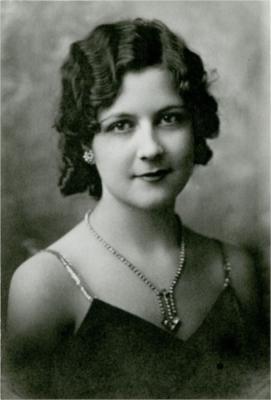
She was born in Galesburg, Illinois, in 1910 and left for New York at twenty with twenty-five dollars. Her painting Birthday (1942) is a self-portrait: bare-torsoed, standing beside an infinite row of open doors, with a winged creature at her feet. Max Ernst saw it when he visited her studio. They married in 1946 in a double wedding with Man Ray and Juliet Browner. They lived first in Sedona, Arizona, then in Huismes, France, for decades. After Ernst died in 1976, she returned to New York.
She was published in The Yale Review, Poetry, The Paris Review, and The New Yorker, as a poet. She also wrote a memoir (Birthday, 1986), a novel (Chasm: A Weekend, 2004), and a second memoir (Between Lives, 2001). She endowed the Wallace Stevens Award at the Academy of American Poets. She died in 2012, in her Manhattan home, aged a hundred and one.
Timeline
- 1945Painted "The Temptation of Saint Anthony".
- 1952Painted "Some Roses and Their Phantoms".
- 1973Painted "Table Tragique (Tragic Table) from Hôtel du Pavot, Chambre 202".
- 1973Painted "Hôtel du Pavot, Chambre 202 (Poppy Hotel, Room 202)".
- 1979Painted "Still in the Studio".
- 1987Painted "Woman Artist, Nude, Standing".
Notable Works
Tap to view larger.
Where to See Dorothea Tanning
5 museums worldwide.
-

-
 1 works
Crystal Bridges Museum of American Art
Bentonville, United States
Sat–Mon & Wed 10:00–18:00, Thu–Fri 10:00–20:00, closed Tuesdays · Free
-
1 works
Museum of Modern Art
New York City, United States
Daily 10:30–17:30 (Sat until 19:00; first Fri of month until 20:00) · Adults $30, students $17
-
 1 works
Neue Nationalgalerie
Berlin, Germany
Tue–Wed 10:00–18:00, Thu 10:00–20:00, Fri–Sun 10:00–18:00, closed Mondays
-
 1 works
Philadelphia Museum of Art
Philadelphia, United States
Mon 10:00–17:00, Tue–Wed closed, Thu 10:00–17:00, Fri 10:00–20:45, Sat–Sun 10:00–17:00

Next stop
Surrealism →
Explore the artists and ideas of Surrealism.
Dorothea Tanning prints
Hand-finished archival prints from Dorothea Tanning's body of work.


Related Artists


.jpg!Portrait.jpg)
Take Dorothea Tanning home.
See all Dorothea Tanning prints →Frequently Asked Questions
Dorothea tanning art movement?
The 1936 “Fantastic Art, Dada and Surrealism” show at the Museum of Modern Art sparked Dorothea Tanning's interest in surrealism.Was dorothea tanning a feminist?
Dorothea Tanning stated that there is no such thing as a woman artist, just as there is no such thing as a man artist.What is dorothea tanning known for?
Dorothea Tanning is known as an American painter and sculptor. Critical study has begun to reposition Tanning's writing at the centre of her creative output, focusing on her short story, "Abyss".What is Dorothea Tanning's most famous work?
Dorothea Tanning is associated with Surrealism, and her art often evokes a sense of enchantment and sensuality. Her early artistic inclinations were stirred by Aubrey Beardsley's illustrations, leading her to create allegorical images. Despite initial family disapproval, she pursued her artistic interests, briefly studying painting in Chicago before moving to New York. There, she supported herself through commercial illustration, puppetry, and modelling, while also visiting galleries and museums. The 1936 exhibition *Fantastic Art, Dada, Surrealism* at the Museum of Modern Art proved a revelation, solidifying her determination to express her childhood fantasies through lyrical and visual means. She employed light and shadow to create an atmosphere reminiscent of gothic novels. Tanning participated in the Exhibition by 31 Women at Peggy Guggenheim's Art of This Century. She met Max Ernst, one of the jurors, and they married in 1946, settling in Arizona. From 1943 to 1952, Tanning continued to explore surreal themes in her work. Later, around 1971, she began creating peculiar objects from quilted fabric, mirroring the hard and soft aspects of her artistic obsessions.What should I know about Dorothea Tanning's prints?
Dorothea Tanning (born 1910) was an American artist associated with Surrealism. She also designed sets and costumes for George Balanchine's ballets Night Shadow and Bayou. Tanning's early work was influenced by Aubrey Beardsley, and the 1936 "Fantastic Art, Dada, Surrealism" exhibition inspired her to give visual form to her childhood fantasies. Light and shadow were important to her atmospheric effects, reminiscent of Gothic novels. She participated in the "Exhibition by 31 Women" at Peggy Guggenheim's Art of This Century gallery. There, she met Max Ernst; they married in 1946 and settled in Arizona. From 1943 to 1952, Tanning invented dreamlike situations in her art. Her painting became more evanescent, with plots of desire suggested in hazy variations. Around 1971, she created peculiar objects out of quilted fabric, expressing hard and soft aspects of her obsessions.What style or movement did Dorothea Tanning belong to?
Dorothea Tanning is associated with Surrealism, an artistic and literary movement that originated in France around 1924. Surrealism was formalised by André Breton, who published the *Manifesto of Surrealism*. The movement explored the unconscious mind, drawing influence from the psychoanalyst Sigmund Freud's theories on dreams, chance encounters, and irrationality. Surrealist artists employed techniques such as automatic drawing and painting to express ideas and images from their unconscious. Others, like Tanning, depicted dreamlike or fantasy worlds in a more realistic style. Tanning aimed to represent 'unknown but knowable states', combining everyday elements with the unexpected. She participated in the Exhibition by 31 Women at Peggy Guggenheim's Art of This Century. There, she met Max Ernst, whom she married in 1946.What techniques or materials did Dorothea Tanning use?
Dorothea Tanning's artistic practice encompassed a range of materials and techniques. She prepared her surfaces to be as smooth as polished ivory, favouring resistant surfaces like walls or panels over canvas on an easel. Tanning employed both opaque and transparent pigments, using a medium and a surfacing wax, both of which she noted had a pleasant smell. She began with a full-sized detailed drawing, which she then traced onto her prepared surface. Opaque colours were applied smoothly, followed by glazes of transparent colours. Tanning aimed for sculptural results in her paintings, viewing drawing and painting as branches of sculpture. She considered drawing to be two-dimensional sculpture, and painting to be two-dimensional coloured sculpture. This meticulous and time-consuming method required many consecutive hours of work.What was Dorothea Tanning known for?
Dorothea Tanning (born 1910) was an American painter and poet associated with Surrealism. Her work often explored themes of sensuality and fantasy, evoking a dreamlike atmosphere. Initially working as an advertising illustrator in New York, Tanning's artistic direction shifted after seeing the "Fantastic Art, Dada, Surrealism" exhibition in 1936. This experience encouraged her to express her childhood fantasies through lyrical, visual means. Her paintings from the 1940s and early 1950s feature young girls in unusual situations, creating an unsettling atmosphere. Tanning participated in the "Exhibition by 31 Women" at Peggy Guggenheim's Art of This Century gallery. There, she met Max Ernst, whom she married in 1946. From 1953, Tanning and Ernst lived in France. Later in her career, around 1971, she began creating peculiar, soft sculptures from quilted fabric, which, like her paintings, expressed hard and soft aspects of her obsessions. She also designed sets and costumes for George Balanchine ballets.When did dorothea tanning die?
Dorothea Tanning died in 2012 at the age of 102.When did Dorothea Tanning live and work?
Dorothea Tanning (1910-2012) was an American painter, sculptor, printmaker, illustrator, and writer. She is best known for her association with Surrealism. Born in Galesburg, Illinois, Tanning moved to New York in the 1930s. A 1936 exhibition of Surrealist art at the Museum of Modern Art had a considerable effect on her direction. By the 1940s, she was exhibiting at Peggy Guggenheim's Art of This Century gallery, and she married fellow Surrealist Max Ernst in 1946. They relocated to Sedona, Arizona, and later to France. Her early paintings, such as "Birthday" (1942), display a precise, representational style and dreamlike imagery characteristic of Surrealism. After Ernst's death in 1976, Tanning moved back to New York City. In later life, she concentrated more on writing, publishing memoirs and poetry. Her work can be found in the collections of the Tate Modern, the Centre Pompidou, and the Metropolitan Museum of Art, among others.Where can I see Dorothea Tanning's work?
Dorothea Tanning's work can be viewed in several museums and public collections worldwide. In the United States, her art can be found at the Art Institute of Chicago, the Cincinnati Art Museum, the Cleveland Museum of Art, the Metropolitan Museum of Art in New York, the Museum of Modern Art in New York, and the Solomon R. Guggenheim Museum, also in New York. Additionally, the Busch-Reisinger Museum at Harvard University and the Museum of Art at the Carnegie Institute in Pittsburgh hold pieces by her. In Europe, Tanning's work is held by the Musée National d'Art Moderne, Centre Georges Pompidou, in Paris, and the Museum am Ostwall in Dortmund. Other locations include the Aarhus Kunstmuseum in Denmark, the Amos Andersonin Taidemuseo in Helsinki, the Louisiana Museum of Modern Art in Humlebaek, Denmark, and the Moderna Museet in Stockholm.Where did dorothea tanning live?
Dorothea Tanning attended art school in Chicago before moving to New York in the 1930s.
Sources
Editorial draws on the following primary and tertiary references for Dorothea Tanning.
- [1] museum National Galleries Scotland Used for: museum holdings.
- [2] museum Neue Nationalgalerie Used for: museum holdings.
- [3] museum Whitney Museum of American Art Used for: museum holdings.
- [4] museum National Gallery of Art Used for: museum holdings.
- [5] museum Pennsylvania Academy of the Fine Arts Used for: museum holdings.
- [6] museum Miyazaki Prefectural Art Museum Used for: museum holdings.
- [7] book guggenheim-twopri00weis Used for: biography.
- [8] book Charlene Spretnak (auth.), The Spiritual Dynamic in Modern Art _ Art History Reconsidered, 1800 to the Present Used for: biography.
Editorial overseen by Solis Prints. Sources verified 2026-09-16. Click a source for details, or hover over [N] in the page above to preview.
Editorial standardsMethodologyCorrectionsAI disclosureAbout the editorial team