



Émile Bayard
- academic art
A single image made Émile Bayard famous. His illustration of Cosette for Victor Hugo's Les Misérables, a small girl clutching a broom in the lamplight, became so embedded in the cultural imagination that when Cameron Mackintosh staged the musical in London in 1985, the promotional image was drawn directly from Bayard's original. More than a century separated the book from the stage production, yet Bayard's composition proved so definitive it required no replacement.
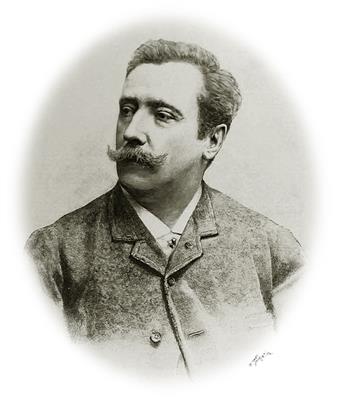
Biography
Born on 2 November 1837[2] in La Ferté-sous-Jouarre, Bayard began publishing cartoons at fifteen under the pseudonym Abel De Miray. He studied painting under Léon Cogniet and worked across charcoal, watercolour, engraving, and lithography before finding his métier in book illustration. For much of the 1860s and early 1870s he documented historical events including the Franco-Prussian War, but as photography began displacing drawn reportage, Bayard turned towards literary illustration.
His partnership with Jules Verne produced some of the most striking images of the era. His illustrations for De la Terre à la Lune (From the Earth to the Moon) in 1865[2] are considered among the first scientifically grounded depictions of space travel in visual art: no floating figures, no allegorical clouds, but a steel projectile aimed at a plausible void. They predate NASA's first photographs by nearly a century and retain a peculiar authority.
Bayard illustrated Uncle Tom's Cabin and Robinson Crusoe, among dozens of other works. He died on 6 December 1891[2] in Cairo, aged 54, while travelling in Egypt.
Timeline
- 1837Born in La Ferté-sous-Jouarre on 2 November.
- 1852Began publishing cartoons at fifteen under the pseudonym Abel De Miray.
- 1860Documented historical events, including the Franco-Prussian War, throughout the 1860s.
- 1865Created illustrations for Jules Verne's "De la Terre à la Lune (From the Earth to the Moon)".
- 1885His illustration of Cosette from Victor Hugo's "Les Misérables" was used in the promotional image for the London stage production.
- 1891Died in Cairo, Egypt, on 6 December, aged 54.
Notable Works
Tap to view larger.
Where to See Émile Bayard
1 museum worldwide.
-
 1 works
Maison de Victor Hugo
Paris, France
Next stop
Browse the movements →
Every movement in the collection, from the Renaissance to Pop art.
Related Artists


Frequently Asked Questions
What is Émile Bayard known for?
Émile Bayard is best known for his illustration of Cosette from Victor Hugo's Les Misérables; this image became iconic and was used in the 1985 London stage production. He is also known for his scientifically grounded illustrations for Jules Verne's De la Terre à la Lune (From the Earth to the Moon).What is Émile Bayard's most famous work?
Émile Bayard is best known as the illustrator of the first edition of Gustave Flaubert's novel *Madame Bovary*. Published in 1869[2], Bayard's illustrations brought the characters and settings of Flaubert's story to life for a wide audience. Bayard's artwork contributed to the novel's initial success and has since become an integral part of its visual history. He captured the atmosphere of provincial France and the psychological complexity of Emma Bovary, the novel's protagonist. The images remain closely associated with the novel. Beyond *Madame Bovary*, Bayard was a prolific artist, creating illustrations for numerous books and magazines during his career. He also worked as a painter, producing portraits and genre scenes. However, it is his illustrations for *Madame Bovary* that have secured his place in the history of art and literature.What should I know about Émile Bayard's prints?
Émile Bayard (1837[2]-1891[2]) was a French[2] artist best known for illustrating Victor Hugo's novel *Les Misérables*. Bayard's prints often feature scenes from daily life, historical events, and portraits. He worked in various printmaking techniques, including wood engraving and lithography; his wood engravings sometimes resemble etchings. Bayard's illustrations for *Les Misérables* are perhaps his most recognised works. These images helped shape the public's perception of the novel's characters and scenes. Bayard also created illustrations for other books and periodicals, further establishing his reputation as a skilled and versatile artist. His work captures a sense of realism and drama, reflecting the social and political climate of 19th-century France. His prints offer insight into the visual culture of his time.What style or movement did Émile Bayard belong to?
Émile Bayard's artistic affiliations can be understood in the context of 19th-century European art. During this period, art academies held considerable influence, and artists often needed acceptance into a major national academy to achieve success. These institutions, such as the Académie des Beaux-Arts in Paris (formed in 1816), became increasingly conservative, favouring a blend of Neoclassicism and Romanticism. Academic art, as it was known, emphasised technical skill over individual expression. Artists were trained to employ precise lines, detailed and lifelike representations, and subtle colour blending. The academies also prioritised specific subjects, with historical, biblical, and mythological themes, along with portraiture, considered most prestigious. Alongside Academic art, Realism also emerged as a significant movement. It is worth noting that many artists navigated both Academic and Realist styles during their careers, sometimes simultaneously, depending on the commission or their personal artistic direction.Where can I see Émile Bayard's work?
Émile Bayard's work can be viewed in several museums, mainly in Europe and North America. In France, one can visit the Musée des Arts Décoratifs (105-107 Rue de Rivoli, 75001 Paris) and the Musée des Beaux-Arts (3 Place Stanislas, 54000 Nancy). Other European locations include the Brangwyn Museum (Dijver 16, 8000 Brugge, Belgium), the Clockarium Museum in Brussels (163 Reyers Boulevard, 1030 Brussels, Schaerbeek, Belgium), the Museu Calouste Gulbenkian (Av. de Berna 45A, 1067-001 Lisbon, Portugal), and the Museu d’Art Modern (MNAC) (Parc de la Ciutadella, 08003 Barcelona, Spain). In the United States, collections are held at the Metropolitan Museum of Art (1000 Fifth Avenue, New York, NY 10028), the Minneapolis Institute of Arts (2400 Third Avenue South, Minneapolis, MN 55404), and the Charles Hosmer Morse Museum of American Art (445 North Park Avenue, Winter Park, FL 32789). The Royal Ontario Museum (100 Queens Park, Toronto, Ontario M5S 2C6) in Canada also holds relevant works.Who did Émile Bayard influence?
Émile Bayard (1837[2]-1891[2]) was a French[2] artist best known for his illustrations. He worked in a variety of media, including painting and drawing, and his illustrations appeared in books and periodicals. While it is difficult to identify specific individuals directly influenced by Bayard, we can consider his impact on the broader field of illustration. Bayard's work, particularly his illustrations for Victor Hugo's *Les Misérables*, reached a wide audience. These images helped shape public perceptions of the characters and scenes in the novel. His style, characterised by realism and attention to detail, set a standard for other illustrators of his time. Many artists working in popular illustration during the late 19th century would have been familiar with Bayard's images, and his approach to visual storytelling likely had an impact on their work. Furthermore, Bayard taught at the École des Beaux-Arts, where he would have interacted with and instructed many students. While the names of specific, prominent artists who studied with Bayard are not readily available, his role as an instructor suggests that he played a part in shaping the artistic development of a generation of French artists.Who influenced Émile Bayard?
Émile Bayard's artistic development occurred during a period of significant stylistic change. He would have been exposed to a range of influences. Gustave Moreau, who taught many of the Fauves, had a considerable impact on aspects of Post-Impressionism. Although Moreau belonged to a generation that admired Delacroix and Chassériau, his own work, literary in inspiration, appealed to writers such as Huysmans and Mallarmé. Moreau's style was ornate and exotic. Puvis de Chavannes, who studied under Delacroix and Couture, dedicated himself to mural and decorative painting. Uninfluenced by Impressionism, he favoured placid mythological and symbolic subjects. Younger artists of the late 19th century greatly admired him. These artists represent some of the aesthetic currents that may have affected Bayard's artistic formation.Why are Émile Bayard's works important today?
Émile Bayard (1837[2]-1891[2]) was a French[2] artist best known for his illustration work. Although he was a Salon painter, he gained wider recognition for his drawings made for novels and newspapers. His images were reproduced as woodcuts in periodicals such as *Le Journal Illustré*. Bayard's images are important as cultural documents of their time. He created the widely recognised image of Cosette from Victor Hugo's *Les Misérables*. Bayard also produced illustrations for Harriet Beecher Stowe's *Uncle Tom's Cabin*. His work provides insight into the visual culture and popular imagination of 19th-century France and Europe, particularly regarding literary themes. His illustrations offer a glimpse into the artistic conventions, social values, and publishing practices of the period. As a historical record, Bayard's art allows modern audiences to connect with the past.How did Émile Bayard die?
Émile Bayard died in 1891[2] at the age of 54.
Sources
Editorial draws on the following primary and tertiary references for Émile Bayard.
- [1] museum Maison de Victor Hugo Used for: museum holdings.
- [2] wikipedia Wikipedia: Émile Bayard Used for: biography, birth dates, death dates, identifiers, movement attribution, nationality.
- [3] book Kalba, Laura Anne, Color in the Age of Impressionism Used for: biography, stylistic analysis.
- [4] book Masterpieces of western art : a history of art in 900 individual studies from the Gothic to the present day Used for: biography.
- [5] book Post-impressionism : cross-currents in European painting Used for: biography.
- [6] book Post-impressionism : cross-currents in European painting Used for: biography.
- [7] book Elliott, Bridget;Windover, Michael;, The Routledge Companion to Art Deco Used for: biography, stylistic analysis.
Editorial overseen by Solis Prints. Sources verified 2026-09-30. Click a source for details, or hover over [N] in the page above to preview.
Editorial standardsMethodologyCorrectionsAI disclosureAbout the editorial team