



About Antony Gormley
British · 1950–present
- Contemporary
- Sculpture
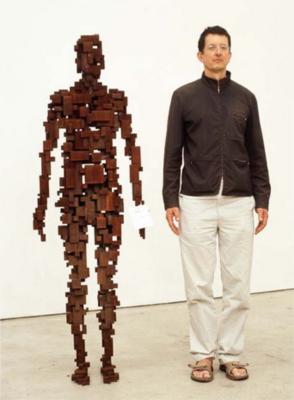
Antony Gormley is a British sculptor known for using his own body as a mould to explore human form and space.
Museums6
Countries4
Largest reported holdingArts Council Collection, Southbank Centre, London · 1 recorded work
Loading map…
Where to see Antony Gormley
Collection holdings are reported here; current display varies. Check with each museum before visiting.
-
1 recorded work
Arts Council Collection, Southbank Centre
London, United Kingdom
-
1 recorded work
Scottish National Gallery of Modern Art
Edinburgh, United Kingdom
Also here (4)

-
1 recorded work
Middelheim Museum
Antwerp, Belgium
-
1 recorded work
Museum Boijmans Van Beuningen
Rotterdam, Netherlands
-
1 recorded work
Artscape Nordland
Meløy, Norway
Also here (2)
-
1 recorded work
Victoria and Albert Museum
London, United Kingdom


Frequently Asked Questions
Where can I see Antony Gormley's work?
Antony Gormley's artwork can be viewed in various locations. Within London, several institutions hold pieces, including the British Museum, the National Gallery, the National Portrait Gallery, the Saatchi Gallery, Tate Modern, and the Victoria and Albert Museum. Outside of London, but still within the UK, you can find his work at the National Museum of Wales (Cardiff), the National Gallery of Scotland and the Scottish National Gallery of Modern Art (Edinburgh), the Burrell Collection (Glasgow), the Jersey Museum and Art Gallery (St Helier), and the Leeds City Art Gallery. Further afield, Gormley's art is held in museums such as the Musée National Fernand Léger (Biot, France), the Musée d’Orsay (Paris), and the Muzeul de Arta (Craiova, Romania).What should I know about Antony Gormley's prints?
Antony Gormley is primarily known as a sculptor, but he also produces prints, often in limited editions. When buying a print, it is important to understand printmaking conventions. An edition is a set of identical prints made from the same block or blocks. Editions can be 'open' (unlimited) or 'limited' (with a fixed number of impressions). The artist decides whether to limit an edition; it is not dictated by the medium. A woodblock, for example, can produce a very large number of prints if cared for properly. Thomas Bewick's wood engraving of Newcastle was printed 900,000 times. Limited edition prints are numbered. The edition number is written on the bottom left margin of the print, as a fraction. The print number appears above the edition size. The print's title is in the centre, and the artist's signature is on the right. These markings are usually in pencil. These conventions are widely respected among printmakers. Although there are no specific legal rules governing printmaking, the Trade Descriptions Act of 1968 requires commercial sellers to describe their products truthfully.What techniques or materials did Antony Gormley use?
Antony Gormley is known for his sculptures, installations and public artworks that consider the human body's relationship to space. He often uses his own body to create works that explore fundamental questions about humanity's place in nature. Gormley's work involves a range of materials and techniques. Many of his sculptures are cast in iron, such as the figures in *Another Place* (1997) near Liverpool. *Sound II* (1986), a pensive figure in Winchester Cathedral, is made of lead and fibreglass. The lost-wax process is often used to create bronze replicas from plaster or wax models. This involves making a negative plaster mould, pouring hot wax inside to create a copy, and then creating a solid core inside the wax copy. The wax is melted out, and molten bronze is poured into the space, creating a bronze version of the original sculpture. After the bronze cools, the mould is broken open, and the sculpture is filed and smoothed.Who did Antony Gormley influence?
Antony Gormley's artistic approach, particularly his use of body casts and exploration of the human form in relation to space, sets him apart. His work is influenced by Catholicism and vipassana meditation. His sculptures often evoke empathy and contemplation, inviting viewers to consider their place in the world. Gormley's work, such as the *Angel of the North* (1998), explores the relationship between the human form, space, and the spiritual. One artist whose work has some relation to Gormley is April Gornik. She studied conceptual art, but moved into light-filled imagined views. She has cited the influence of the Roman Catholic Church on her work, as well as artists such as Vermeer, Arthur Dove, Charles Burchfield, and Emily Carr.Who influenced Antony Gormley?
Antony Gormley's sculptures, installations and public artworks explore the human body's relationship to space. His work builds on developments in sculpture since the 1960s. He engages critically with his own body and those of others, confronting questions about humanity's place in nature and the cosmos. Gormley's influences include sculptors such as P Archipenko, Donatello, Henri Gaudier-Brzeska, Alberto Giacometti and George Segal. These artists, like Gormley, worked with the human form. Gormley seeks to identify art as a place of becoming. He hopes his work will allow new behaviours, thoughts and feelings to arise. His sculptures often evoke powerful emotions connected to their surroundings. One example is *Sound II* (1986), a lead and fibreglass figure in Winchester Cathedral. The figure stands in the crypt, which is often flooded, exploring the relationship of the human form to space and the spiritual. Another example is *Another Place* (1997) near Liverpool, where cast-iron figures face the sea.What is Antony Gormley's most famous work?
Antony Gormley, born in London in 1950, is known for his sculptures, installations and public artworks that consider the relationship between the human body and space. While he has created many pieces that have gained recognition, his most famous is likely *Angel of the North* (1998). This sculpture is a steel angel, 20 metres tall, with a 54-metre wingspan, located in Gateshead, England. Other well-known works include *Another Place* (1997), consisting of cast-iron figures facing the sea near Liverpool, and *Sound II* (1986), a figure in the crypt of Winchester Cathedral, often partially submerged in water. Gormley's *Inside Australia* (2003) is installed at Lake Ballard, Western Australia. He was awarded the Turner Prize in 1994, and he has been a Royal Academician since 2003.What style or movement did Antony Gormley belong to?
Antony Gormley's sculptures, installations, and public artworks explore the relationship between the human body and space. His practice builds on developments in sculpture since the 1960s. Gormley critically engages with his own body and those of others, confronting questions about humanity's place in nature and the cosmos. His work attempts to identify art as a place of becoming, where new behaviours, thoughts, and feelings can arise. Gormley's sculptures often evoke emotions connected to their surroundings. *Sound II* (1986), a lead and fibreglass figure in Winchester Cathedral, is often partially submerged by water. *Another Place* (1997) features cast-iron figures facing the sea near Liverpool. Permanent public works include *Angel of the North* (Gateshead, England), *Inside Australia* (Lake Ballard, Western Australia), and *Exposure* (Lelystad, The Netherlands). Gormley was awarded the Turner Prize in 1994. He has been a Royal Academician since 2003 and a British Museum Trustee since 2007.What was Antony Gormley known for?
Antony Gormley is known for his sculptures, installations and public artworks. These often explore the relationship of the human body to space. His work builds on sculptural developments since the 1960s. He critically engages with his own body and the bodies of others. His art confronts questions about humanity's place in nature and the cosmos. Gormley sees art as a space for new behaviours, thoughts, and feelings to emerge. Gormley's permanent public works include *Angel of the North* (Gateshead), *Another Place* (Crosby Beach), *Inside Australia* (Lake Ballard, Western Australia), and *Exposure* (Lelystad, The Netherlands). His 1986 sculpture *Sound II*, a lead and fibreglass figure in Winchester Cathedral, is often partially submerged due to flooding in the crypt. This work embodies Gormley's interest in the relationship between the human form, space, and the spiritual. Gormley received the Turner Prize in 1994, the South Bank Prize for Visual Art in 1999, the Bernhard Heiliger Award for Sculpture in 2007, the Obayashi Prize in 2012 and the Praemium Imperiale in 2013. He was made an OBE in 1997 and knighted in 2014. He has been a Royal Academician since 2003 and a British Museum Trustee since 2007.
Sources
Where to See guide aggregates verified holdings of Antony Gormley's works across the following collections.
- [1] book Antony Gormley, Antony Gormley on Sculpture Used for: biography.
- [2] book Beard, Lee, 1973- author, Butler, Adam, author; Van Cleave, Claire, author; Fortenberry, Diane, author; Stirling, Susan, author, Beard, Lee, 1973- author, Butler, Adam, author; Van Cleave, Claire, author; Fortenberry, Diane, author; Stirling, Susan, author - The Art Book_ New Edition, Mini Format Used for: biography.
Editorial overseen by Solis Prints. Sources verified 2026-09-30. Click a source for details, or hover over [N] in the page above to preview.
Editorial standardsMethodologyCorrectionsAI disclosureAbout the editorial team