



About Patrick Caulfield
varnishing chocolates at Crosse and Blackwell before painting flat, bold interiors that looked like Pop Art but were not
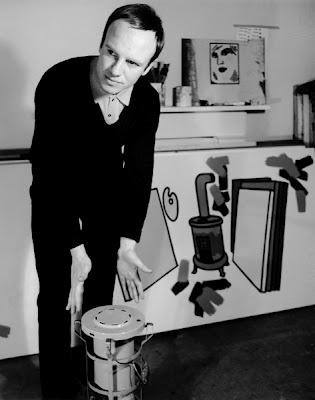
Where to see Patrick Caulfield
Ranked by works you can see in person.
-
 12 works
Tate
London, United Kingdom
-
7 works
Pallant House Gallery
Chichester, United Kingdom

-
0 works
Vanderbilt Museum of Art
Nashville, United States
-
4 works
Arts Council Collection, Southbank Centre
London, United Kingdom
-
 3 works
British Council
London, United Kingdom
-
2 works
Government Art Collection
London, United Kingdom
-
2 works
National Museum Cardiff
Cardiff, United Kingdom
-
1 works
Ulster Museum
Belfast, United Kingdom
-
1 works
National Galleries Scotland
Edinburgh, United Kingdom
-
1 works
Royal Academy of Arts
London, United Kingdom


Own a piece of it
Patrick Caulfield prints
Hand-finished archival prints from Patrick Caulfield's body of work.
 Found Objects - Patrick Caulfield
From £28.00
Found Objects - Patrick Caulfield
From £28.00
 Les Demoiselles d'Avignon vues de derrière - Patrick Caulfield
From £30.00
Les Demoiselles d'Avignon vues de derrière - Patrick Caulfield
From £30.00
 Second Glass of Whisky - Patrick Caulfield
From £28.00
Second Glass of Whisky - Patrick Caulfield
From £28.00
 Portrait of Juan Gris - Patrick Caulfield
From £37.00
Portrait of Juan Gris - Patrick Caulfield
From £37.00
 And I am alone in my house - Patrick Caulfield
From £28.00
And I am alone in my house - Patrick Caulfield
From £28.00
 Cigar - Patrick Caulfield
From £37.00
Cigar - Patrick Caulfield
From £37.00
 Hemingway Never Ate Here - Patrick Caulfield
From £37.00
Hemingway Never Ate Here - Patrick Caulfield
From £37.00
 Two Whiting - Patrick Caulfield
From £28.00
Two Whiting - Patrick Caulfield
From £28.00
View all 23 museums
-
1 works
Royal College of Art
London, United Kingdom
-
1 works
Whitworth Art Gallery
Manchester, United Kingdom
-
1 works
Walker Art Gallery
Liverpool, United Kingdom
-
1 works
Museo Nacional Centro de Arte Reina Sofía
Madrid, Spain
-
1 works
Manchester Art Gallery
Manchester, United Kingdom
-
1 works
Wolverhampton Art Gallery
Wolverhampton, United Kingdom
Also here (2)
-
1 works
RISD Museum
Providence, United States
-
1 works
Abbot Hall Art Gallery
Kendal, United Kingdom
-
1 works
Sheffield Galleries and Museums Trust
Sheffield, United Kingdom
-
1 works
Birmingham Museums Trust
Birmingham, United Kingdom
-
0 works
National Gallery of Art
Washington D.C., United States
-
0 works
University of York Art Collection
York, United Kingdom
Also here (3)


Can't travel? Bring Patrick Caulfield home.
See all Patrick Caulfield prints →Frequently Asked Questions
Where can I see Patrick Caulfield's work?
To view work by Patrick Caulfield, begin with the public collections in the United Kingdom. Several London museums own his prints and paintings; these include the Tate, the Victoria & Albert Museum, the National Gallery, the National Portrait Gallery, and the Courtauld Institute Galleries. Outside London, try the Manchester Art Gallery, the Brighton Museum & Art Gallery, the Ulster Museum[2] (Belfast), the Scottish National Gallery of Modern Art (Edinburgh), the Aberdeen Art Gallery and Museum, the Walker Art Gallery (Liverpool), the Leeds City Art Gallery, and the Southampton Art Gallery. In the United States, see the collections at the Metropolitan Museum of Art (New York), the Museum of Modern Art (New York), the Los Angeles County Museum of Art, the Minneapolis Institute of Arts, the Virginia Museum of Fine Arts (Richmond), and the Wolfsonian at Florida International University (Miami Beach). There is also work at the Royal Ontario Museum in Toronto.Where did Patrick Caulfield live?
The biography states that Patrick Caulfield was born in Acton, and a street there was later renamed Caulfield Road in his honour. He studied at the Royal College of Art[5] in London, and returned to London in 1968 after a brief time in Malibu.What should I know about Patrick Caulfield's prints?
Patrick Caulfield (1936-2005) is known for his screenprints, often characterised by flat planes of colour enclosed by black lines. He studied at Chelsea School of Art (1956-1960) and the Royal College of Art[5] (1960-1963), and his work is associated with British Pop Art, although he rejected the label. Caulfield made prints throughout his career, sometimes working with Editions Alecto. His prints often rework or relate to his paintings. For example, the print *Ruins* (1964) shares its subject with a painting of the same year. Some prints, such as the *Suite 22*, are closely related as a series. His style often incorporates elements of photorealism alongside simplified, almost cartoonish, areas. Caulfield's prints frequently depict interiors or still lifes, using a limited colour palette to create a sense of coolness and detachment. He sometimes included areas of flat, unprinted paper as a compositional element. Later in his career, his prints became more complex, with greater variation in colour and texture.Why are Patrick Caulfield's works important today?
Patrick Caulfield (1936-2005) is known for his distinctive style of Pop Art. His paintings often depict commonplace objects and interiors. He simplifies these subjects into flat planes of colour, outlined with bold, black lines. This approach combines aspects of both representational and abstract art. Caulfield's importance stems from his unique approach to Pop Art. Unlike some of his contemporaries, who directly appropriated imagery from popular culture, Caulfield maintained a more detached and formal approach. His works engage with art history, referencing artists such as Juan Gris and Fernand Léger. "After Lunch" (1975) is a still life that demonstrates this. His use of colour is also significant. He often juxtaposed areas of bright, saturated colour with areas of monochrome. This creates a striking visual effect. Caulfield's paintings are characterised by their clarity and precision. His work offers a sophisticated commentary on the relationship between art and everyday life. His influence can be seen in the work of many contemporary artists who explore similar themes.Who was Patrick Caulfield inspired by?
Patrick Caulfield decided to become an artist after watching the 1952 film Moulin Rouge about Toulouse-Lautrec.What techniques or materials did Patrick Caulfield use?
Patrick Caulfield is known for paintings that combine flat areas of colour with bold, black lines. He often depicted commonplace objects and interiors in a style that is both representational and abstract. Caulfield's early work, such as the painting *View of the Rooftops* (1963), used hardboard and household paint. This gave his pictures a flat, graphic quality. He sometimes incorporated areas of textured paint to create contrast. Screenprinting was another technique Caulfield used, attracted by its capacity for producing flat, unmodulated colour. He produced many prints throughout his career, including a series based on poems by Jules Laforgue. These prints demonstrate his interest in line, colour, and simplified forms. Later in his career, Caulfield began to incorporate more subtle tonal variations and details into his work. He would sometimes include areas of photorealism within his otherwise stylised compositions. This can be seen in paintings such as *After Lunch* (1975), which includes a photo-realistic still-life element.Who did Patrick Caulfield influence?
Patrick Caulfield's cool, impersonal style, coupled with his use of acrylic and commercial household paint, has affinities with Pop art, Op art, and Arte Povera. Although it is difficult to identify specific artists directly influenced by him, Caulfield's work shares characteristics with that of other artists. His paintings have a shared outlook with American artists. Like David Hockney, Caulfield worked in acrylic or commercial household paint for a time. Some critics have compared the edge-bounded forms in Richard Diebenkorn's art to Henri Matisse's paintings from his Cubism-exploring years. Ed Ruscha's still lifes have been interpreted as satire of Morris Louis's Color Field paintings. Richard Hamilton mixed conventions, such as diagrams and photographs, with sensuous paint.Who influenced Patrick Caulfield?
Patrick Caulfield's artistic development involved a range of influences, from early modern masters to Pop Art contemporaries. Studying at the Royal College of Art[5] between 1956 and 1960, Caulfield encountered American abstract expressionism; however, he found it less compelling than the work of artists such as Juan Gris, Fernand Léger, and Giorgio Morandi. These painters offered Caulfield approaches to form and composition that resonated with his artistic sensibilities. Caulfield's work also shows the impact of Pop Art. Although he resisted being labelled a Pop artist, the movement's interest in everyday imagery and commercial techniques informed his practice. Caulfield shared Pop Art's engagement with popular culture, but he maintained a distinct aesthetic. His use of flat colour and bold outlines, combined with an interest in formal structure, set him apart. By synthesising these diverse influences, Caulfield created a unique and recognisable style.
Sources
Where to See guide aggregates verified holdings of Patrick Caulfield's works across the following collections.
- [1] museum Government Art Collection Used for: museum holdings.
- [2] museum Ulster Museum Used for: museum holdings.
- [3] museum National Galleries Scotland Used for: museum holdings.
- [4] museum Royal Academy of Arts Used for: museum holdings.
- [5] museum Royal College of Art Used for: museum holdings.
- [6] museum Whitworth Art Gallery Used for: museum holdings.
- [7] book Hodge, Susie;, Artists at Home Used for: museum holdings.
- [8] book Beard, Lee, 1973- author, Butler, Adam, author; Van Cleave, Claire, author; Fortenberry, Diane, author; Stirling, Susan, author, Beard, Lee, 1973- author, Butler, Adam, author; Van Cleave, Claire, author; Fortenberry, Diane, author; Stirling, Susan, author - The Art Book_ New Edition, Mini Format Used for: stylistic analysis.
- [9] book guggenheim-museum00solo Used for: stylistic analysis.
- [10] book guggenheim-richardhamilton00hami Used for: biography.
- [11] book Masterpieces of western art : a history of art in 900 individual studies from the Gothic to the present day Used for: biography.
- [12] book David Hockney, Secret knowledge _ rediscovering the lost techniques of the old masters Used for: biography.
- [13] book Beckett, Wendy, Sister Wendy's odyssey : a journey of artistic discovery Used for: biography.
- [14] book Anfam, David A;Callen, Anthea. Techniques of the impressionists, Techniques of the great masters of art Used for: biography, stylistic analysis.
- [15] book Landauer, Susan, The not-so-still life : a century of California painting and sculpture Used for: biography.
Editorial overseen by Solis Prints. Sources verified 2026-08-29. Click a source for details, or hover over [N] in the page above to preview.
Editorial standardsMethodologyCorrectionsAI disclosureAbout the editorial team