



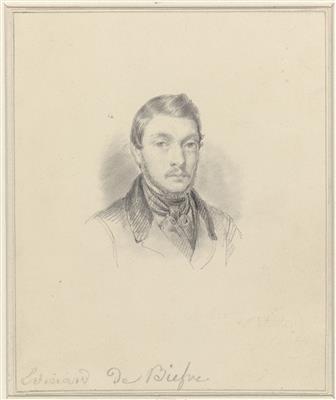
About Édouard De Bièfve
Museums4
Countries2
Largest reported holdingRoyal Museum of Fine Arts Antwerp, Antwerp · 1 recorded work
Loading map…
Where to see Édouard De Bièfve
Collection holdings are reported here; current display varies. Check with each museum before visiting.
-
1 recorded work
Royal Museum of Fine Arts Antwerp
Antwerp, Belgium
-
1 recorded work
Westphalian State Museum of Art and Cultural History
Münster, Germany


-
1 recorded work
Museum of Fine Arts Ghent (MSK)
Ghent, Belgium
-
1 recorded work
Alte Nationalgalerie
Berlin, Germany


Frequently Asked Questions
Where can I see Édouard De Bièfve's work?
Édouard De Bièfve (1808[1]-1882[1]) was a Belgian[1] history painter. His paintings can be found in several European museums, primarily in Belgium and France. The Royal Museums of Fine Arts in Brussels hold some of his most important works. These include historical paintings that established his early reputation. Another significant collection is at the Musée des Beaux-Arts in Ghent. Beyond Belgium, De Bièfve's paintings have entered French public collections. The Palace of Versailles collection includes works related to French history, fitting the Palace's focus. Smaller collections may occasionally display his work, so checking museum catalogues is worthwhile if planning a visit. These museums offer the most consistent access to his art.Why are Édouard De Bièfve's works important today?
Édouard De Bièfve (1808[1]-1882[1]) was a Belgian[1] painter associated with the Romantic and historical painting styles. He is remembered today for his contributions to Belgian national identity and his technical skill. De Bièfve played a role in the development of Belgian art after the country gained independence in 1830[1]. Artists sought to create a distinct national artistic identity. His history paintings often depicted significant events in Belgian history, helping to shape a shared cultural memory. One example is "The Compromise of the Nobles", completed in 1841. It portrays a key moment in the lead-up to the Dutch Revolt. His style is characterised by its dramatic compositions, attention to detail, and use of colour to create mood. Although he is not as widely known as some of his contemporaries, his works offer insight into the artistic and cultural aspirations of 19th-century Belgium. They show the period's interest in history, nationalism, and the Romantic aesthetic. His paintings are valued for their historical content and artistic qualities.What techniques or materials did Édouard De Bièfve use?
Information on De Bièfve's specific techniques is scarce; however, a general overview of similar period techniques is available. Sculptors commonly used tools made of wood or metal. Wooden tools needed regular sharpening because clay is abrasive. Metal tools were more durable, but wood might have been preferred for its lightness and non-rusting properties. Oval-tip and toothed tools were used for modelling. Cloths and brushes aided in smoothing. Chisels, rasps, and saws made alterations in hardened clay after firing. Brushes for smoothing surfaces ranged in size, with bristles that could be stiff or soft. Stiffer brushes were used on works such as the Angel with the Scourge. Chisels of the type used for wood carving were occasionally used to trim works before firing. Other pieces were trimmed after firing, possibly to fit within wooden architectural models. Marks from wetted cloths, used to keep clay models moist and regulate drying, are found on many clay models. Some artists used their fingernails to manipulate clay, leaving impressions in the material.Who did Édouard De Bièfve influence?
Édouard De Bièfve's influence can be seen in the work of Henri Evenepoel, who initially studied at the Academie Royale des Beaux-Arts in Brussels. In October 1892, Evenepoel moved to Paris to attend the École des Beaux-Arts. There, he studied under Galland, then in Moreau's atelier, where he encountered Matisse, Simon Bussy, and Rouault. Evenepoel was highly receptive to the art in Paris. He swiftly transitioned from sombre history paintings to genre pictures and portraits. These later works displayed an increasingly heightened colour-range and flattened space. Due to ill health, he spent some months in Algeria. During his short life, Evenepoel exhibited with groups such as the Société des Artistes Français from 1894 and the Ghent Salon in 1899. He also contributed to the Cercle Artistique de Bruxelles and the 1900 Libre Esthétique.What is Édouard De Bièfve's most famous work?
Édouard De Bièfve (1808[1]-1882[1]) was a Belgian[1] history painter. Although it is difficult to assess which work is definitively his "most famous", several paintings have received attention. One notable work is "The Compromise of the Nobles", painted in 1841[1]. This painting depicts a historical event in which Belgian nobles signed a petition against the Inquisition in 1566. It is regarded as an important work of Belgian Romanticism, and a version of it is held at the Palace of the Nation (the Belgian Parliament). De Bièfve also painted "Count Egmont's Death" (1848), showing the execution of Lamoral, Count of Egmont, another significant figure in Belgian history. Other history paintings by De Bièfve include "The Abdication of Charles V" and portraits of Queen Louise-Marie and Léopold I. His work often focused on patriotic and historical subjects, fitting with the artistic tastes of the time in Belgium.What style or movement did Édouard De Bièfve belong to?
Édouard De Bièfve (1808[1]-1882[1]) was a Belgian[1] history painter associated with the Romantic movement. He is best known for grand-scale depictions of historical or patriotic subjects, rendered in a detailed, academic style. De Bièfve's training at the Royal Academy of Fine Arts in Brussels instilled in him a strong understanding of traditional techniques. He combined this skill with a Romantic sensibility, which emphasised emotion and drama. This is evident in works such as "The Compromise of the Nobles" (1841[1]), which portrays a key moment in Belgian history with heightened emotion. His style aligns with other Romantic painters of the period, who sought to evoke feelings of awe, patriotism, or moral instruction through their art. While his work contains elements of Neoclassicism, such as a concern for accuracy and detail, the emphasis on emotional expression firmly places him within the Romantic tradition. He aimed to capture the spirit of the past, rather than simply recreating it with precise accuracy.What was Édouard De Bièfve known for?
Édouard De Bièfve (1808[1]-1882[1]) was a Belgian[1] history painter. He is associated with the Romantic movement. He is best known for grand, theatrical depictions of historical or patriotic subjects. De Bièfve studied at the Royal Academy of Fine Arts in Brussels. There, he was a pupil of François-Joseph Navez. Early in his career, De Bièfve painted portraits. He soon turned to historical painting, achieving success in the 1830s. His 1834[1] painting *The Compromise of the Nobles* depicts a key moment in the lead-up to the Dutch Revolt. It cemented his reputation. Another important work is *The Abdication of Charles V* (1841). This painting is in the collection of the Royal Museums of Fine Arts of Belgium. De Bièfve's work often aimed to promote Belgian national identity. He received commissions from the Belgian government. He also painted portraits of prominent figures. These included Leopold I, the first King of the Belgians.
Sources
Where to See guide aggregates verified holdings of Édouard De Bièfve's works across the following collections.
- [1] wikipedia Wikipedia: Édouard De Bièfve Used for: biography.
- [2] book Tromp, Henk, A Real Van Gogh Used for: biography.
- [3] book Art, the ape of nature : studies in honor of H. W. Janson Used for: biography, stylistic analysis.
- [4] book Beard, Lee, 1973- author, Butler, Adam, author; Van Cleave, Claire, author; Fortenberry, Diane, author; Stirling, Susan, author, Beard, Lee, 1973- author, Butler, Adam, author; Van Cleave, Claire, author; Fortenberry, Diane, author; Stirling, Susan, author - The Art Book_ New Edition, Mini Format Used for: biography.
- [5] book John Tavenor Perry, Dinanderie_ A History And Description Of Mediæval Art Work In Copper, Brass And Bronze Used for: biography.
- [6] book Post-impressionism : cross-currents in European painting Used for: biography.
- [7] book Post-impressionism : cross-currents in European painting Used for: biography.
- [8] book C. Currie;, The Bruegel Success Story Used for: stylistic analysis.
Editorial overseen by Solis Prints. Sources verified 2026-09-30. Click a source for details, or hover over [N] in the page above to preview.
Editorial standardsMethodologyCorrectionsAI disclosureAbout the editorial team