

About Edward Weston
1886–1958
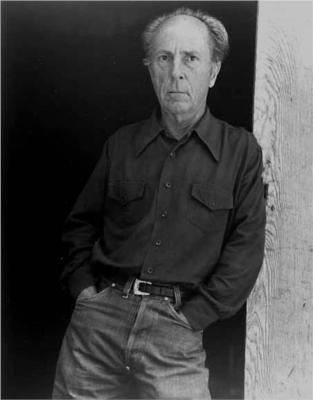
American modernist photographer whose formally rigorous images of shells, vegetables, and California coastlines transformed 20th-century photography.
Museums5
Countries3
Largest reported holdingNational Gallery of Art, Washington D.C. · 8 recorded works
Loading map…
Where to see Edward Weston
Collection holdings are reported here; current display varies. Check with each museum before visiting.
-
8 recorded works
National Gallery of Art
Washington D.C., United States
-
2 recorded works
Cleveland Museum of Art
Cleveland, United States


-
2 recorded works
Museum of Modern Art
New York City, United States
-
1 recorded work
Israel Museum
Jerusalem, Israel
-
1 recorded work
collection of the Musée d’art contemporain de Montréal
Montreal, Canada


Frequently Asked Questions
What should I know about Edward Weston's prints?
Edward Weston was a 20th-century American photographer, known for his sharp focus and close-up compositions. He worked primarily with an 8x10 view camera, producing contact prints from his large negatives. Weston's printing process was meticulous. He favoured glossy papers to capture fine detail and a full tonal range. His early work often has a soft, diffused quality, but by the 1920s he had moved to a more direct, unmanipulated style. He sought to capture the essential form and texture of his subjects, whether shells, vegetables, or nudes. Collectors should be aware of the different periods in Weston's career, as well as the print's provenance. Weston sometimes reprinted his earlier negatives later in life, and these later prints may differ in tonality or contrast from his vintage prints. The Weston estate, managed by his son Cole Weston, produced prints after Edward's death in 1958[1]. These estate prints are generally less valuable than prints made by Edward himself. Condition is also a factor: look for prints that are free from scratches, fading, or other damage.Why are Edward Weston's works important today?
Edward Weston (1886[1]-1958[1]) was an American photographer. He is known for his close-up, sharply focused images, especially of natural forms. Weston's work is important for several reasons. He helped elevate photography to fine art status. His approach, which emphasised clarity and detail, influenced many subsequent photographers. Weston co-founded Group f/64 in 1932[1]. This association of photographers promoted "pure" or "straight" photography, favouring unmanipulated prints. They believed photographs should celebrate, not disguise, their medium. His series of nudes, still lifes, and California landscapes are particularly celebrated. Weston's photographs of shells, peppers, and human bodies reveal the abstract forms within these subjects. His images are not merely records; they are interpretations that invite viewers to see the world differently. Weston received a Guggenheim Fellowship in 1937. This allowed him to photograph extensively across the American West. These images further cemented his reputation as a master of the medium. His technical skill and artistic vision continue to inspire.What is Edward Weston's most famous work?
Edward Weston is well known for his still-life photography, especially his close-up images of vegetables. One of his most recognisable photographs is *Pepper No. 30*, taken in 1930[1]. Weston created a series of pepper photographs, experimenting with lighting and composition. Weston's approach involved carefully arranging the pepper to emphasise its form and texture. He used natural light to create dramatic shadows and highlights, giving the pepper a sculptural quality. The photograph is celebrated for its sharp focus and tonal range. Weston aimed to capture the essence of the pepper, transforming an ordinary object into a work of art. Weston's other notable works include his photographs of shells, nudes, and the California coast. He co-founded Group f/64, promoting straight photography, which favoured sharp focus and unmanipulated images. His work had a significant impact on the development of fine art photography.What was Edward Weston known for?
Edward Weston (born in Illinois, 1886[1]; died in California, 1958[1]) was a photographer known for his modernist aesthetic, which combined an appreciation for both nature and the machine age. Initially, Weston worked in the pictorialist style, producing softly focused images. A trip to the East Coast in 1922[1] marked a transition. He created stark architectural studies of the Armco Steel Mills, devoid of pictorialism's romantic qualities. From 1923 to 1926, living in Mexico City, he adopted a "straight" photographic style. Inspired by Mexican folk art, he sought to depict form and passion. His portraits were heroic, his nudes became more explicit, and everyday objects became worthy of contemplation. Upon returning to the United States, Weston's work influenced the direction of 20th-century photography. In 1932, he co-founded Group f/64, an informal association that promoted images of maximum clarity with minimal darkroom manipulation. Weston's photographs transformed the coastline of Point Lobos, California, into images that celebrated the natural world. In 1938, he received a Guggenheim Fellowship and extensively photographed California and the West. In 1941, he began a photographic tour of the United States to illustrate Walt Whitman's *Leaves of Grass*. Forced to retire in 1948 due to Parkinson's disease, Weston oversaw the printing of over eight hundred of his favourite images, known as the "project prints".What is Edward Weston known for?
Edward Weston is known for defining the direction of American art photography after World War I. He developed a modernist aesthetic for photography that embraced both nature and the machine age. He is also known for still lifes of natural objects, such as vegetables and shells.What was Edward Weston's art style?
Edward Weston developed a modernist aesthetic for photography. This aesthetic embraced both nature and the machine age, combining personal passions and objective vision.
Sources
Where to See guide aggregates verified holdings of Edward Weston's works across the following collections.
- [1] wikipedia Wikipedia: Edward Weston Used for: biography.
- [2] book Horst Woldemar Janson; Anthony F. Janson, A Basic History of Art Used for: biography, stylistic analysis.
- [3] book Ansel Adams; Beaumont Newhall; Nancy Newhall; Louise Dahl-Wolfe; Aaron Siskind; Richard Avedon; Harry Callahan; Lee Friedlander; Tina Modotti; W. Eugene Smith; Paul Strand; Edward Weston; Garry Winogrand; Amy Rule, Ansel Adams; Beaumont Newhall; Nancy Newhall; Louise Dahl-Wolfe; Aaron Siskind; Richard Avedon; Harry Callahan; Lee Friedlander; Tina Modotti; W. Eugene Smith; Paul Strand; Edward Weston; Garry Winogrand; Amy Rule - Original sources _ art and ar Used for: biography, stylistic analysis.
- [4] book Beard, Lee, 1973- author, Butler, Adam, author; Van Cleave, Claire, author; Fortenberry, Diane, author; Stirling, Susan, author, Beard, Lee, 1973- author, Butler, Adam, author; Van Cleave, Claire, author; Fortenberry, Diane, author; Stirling, Susan, author - The Art Book_ New Edition, Mini Format Used for: biography, stylistic analysis.
- [5] book Penelope J.E. Davies, Walter B. Denny, Frima Fox Hofrichter, Joseph Jacobs, Ann S. Roberts, David L. Simon, Janson's History of Art_ The Western Tradition (8th Edition) Used for: biography.
Editorial overseen by Solis Prints. Sources verified 2026-09-30. Click a source for details, or hover over [N] in the page above to preview.
Editorial standardsMethodologyCorrectionsAI disclosureAbout the editorial team