

About Albert Irvin
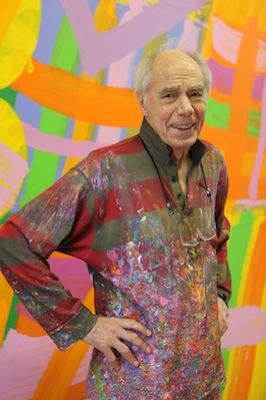
British[1] abstract painter who turned to pure abstraction in the 1950s and maintained vivid, large-scale work until his death at 92.
Where to see Albert Irvin
Ranked by works you can see in person.
-
3 works
Arts Council Collection, Southbank Centre
London, United Kingdom
-
3 works
Tate
London, United Kingdom

-
2 works
Government Art Collection
London, United Kingdom
-
1 works
Royal Academy of Arts
London, United Kingdom
-
1 works
Aberdeen Archives, Gallery and Museums collections
Aberdeen, United Kingdom
-
1 works
Chelsea and Westminster Hospital
London, United Kingdom
Also here (1)
-
1 works
British Council
London, United Kingdom
-
1 works
National Museum Cardiff
Cardiff, United Kingdom
-
1 works
Northampton Museum and Art Gallery
Northampton, United Kingdom
-
1 works
Kirklees Museums and Galleries
Huddersfield, United Kingdom


View all 11 museums
-
1 works
Blackburn Museum and Art Gallery
Blackburn, United Kingdom

Frequently Asked Questions
Where can I see Albert Irvin's work?
You can view Albert Irvin's work at several galleries and museums. In the United Kingdom, collections include the Brighton Museum & Art Gallery, Manchester Art Gallery, the National Museums of Scotland, and the Victoria & Albert Museum in London. The Tate Modern also holds works, though items may be moved, so it is best to check with the gallery before visiting to see a specific piece. Other UK locations include the Aberdeen Art Gallery and Museum, the Ulster Museum, and the Leeds City Art Gallery. In the United States, collections can be found at the Los Angeles County Museum of Art (LACMA), the Metropolitan Museum of Art, the Minneapolis Institute of Arts, and the Museum of Modern Art in New York. Other American museums include the Charles Hosmer Morse Museum of American Art, the Royal Ontario Museum, the Virginia Museum of Fine Arts, and the Wolfsonian at Florida International University.What should I know about Albert Irvin's prints?
Albert Irvin (1922[1]-2015[1]) was a British[1] abstract artist known for his screenprints. He studied at Leeds College of Art before serving in the Royal Air Force during the Second World War. After the war, he attended the Slade School of Fine Art. Irvin's prints are characterised by bold colour and energetic compositions. His work often features overlapping shapes and gestural marks. The artist created original prints, meaning the work was conceived specifically to be a print. Each print in an edition is considered an original because the artist creates the artwork directly on the screen. Prints are often produced in limited editions, a decision made by the artist. Each print is numbered, titled, and signed in pencil, following established printmaking conventions. The edition number appears on the bottom left margin of the print, the title in the centre, and the signature on the right. These conventions add value, assuring the buyer that the print conforms to the claims written on it.Why are Albert Irvin's works important today?
Albert Irvin (1922[1]-2015[1]) was a British[1] abstract artist known for his large-scale, colourful screenprints and paintings. He developed his abstract style in the 1960s, moving away from earlier representational work. Irvin's art is important because of his approach to colour and form. His works often feature bold, contrasting colours applied in layers, creating a sense of depth and movement. The energetic compositions, with their interplay of geometric and organic shapes, offer a distinctive visual experience. Irvin's practice involved a constant exploration of the possibilities of abstraction. He embraced the accidental and the intuitive, allowing the process of painting to guide the final outcome. This emphasis on process and experimentation makes his work relevant to contemporary discussions around artistic creation. His prints and paintings are held in numerous public collections, ensuring his continued influence on artists and viewers.What techniques or materials did Albert Irvin use?
Albert Irvin was known for his use of bold colour and abstract forms. He worked primarily with acrylic paint, favouring its quick-drying properties and the matte finish it provided. Acrylic allowed him to build up layers rapidly and maintain a flat, non-reflective surface. Irvin's technique involved applying paint in a gestural manner, often using large brushes to create sweeping strokes and dynamic compositions. He was less concerned with the physical properties of paint, and more with the ideas it could convey. While Irvin embraced acrylics for their practicality, some artists have noted that oil paint can achieve a dull finish if diluted correctly, though this may compromise the paint's stability. Irvin primed his canvases with acrylic gesso, sometimes sanding the surface to reduce texture.Who did Albert Irvin influence?
It is difficult to identify particular artists directly influenced by Albert Irvin. The available passages offer some context regarding influences among artists of Irvin's generation, and the artistic climate in which he worked. Some artists working in America during the 1980s, for example, were seen to have a kinship with the New York School of painters. This connection was expressed through a shared attraction to a primitive style, where emotions churned in fluid spaces, and primordial symbols were depicted with crudeness. The New York School emerged in response to the École de Paris and shaped the art world for two decades with Abstract Expressionism[1], Drip Painting, and Action Painting. Peggy Guggenheim offered American avant-garde painters a chance to exhibit their works. As a patron and collector, she built relationships with artists such as Pollock, Kline, de Kooning, Motherwell, Still, Newman, Rothko, and Reinhardt. These painters forged a path towards abstraction through Dadaist and Surrealist elements.Who influenced Albert Irvin?
In his college years, Albert Irvin was influenced by Analytic Cubism, particularly the work of Braque and Picasso. He also looked at early Kandinsky and Miró. Along the edges were Matisse and Mondrian. Irvin studied their structure exhaustively. He analysed Matisse's *Blue Window* (1913), Miró's *Person Throwing a Stone at a Bird* (1926[1]), Cézanne's *Card Players* (1890-92), and Mondrian's grid paintings, as well as works by Léger, Renaissance and Quattrocento artists, Old Masters, American masters, and African art. By 1950-51, Pollock, de Kooning, and Rothko, and the entire New York School had become his mentors. He saw Gorky's *Agony* (1947) and *The Liver Is the Cock's Comb* (1944) in his 1951 exhibition at the Whitney. He also saw many of the 1940s Pollocks during that period as well as his later webbed enamel paintings. Later, Irvin was moved by Louis's *Veils and Unfurleds* and Noland's targets and chevrons.What is Albert Irvin's most famous work?
It is difficult to identify one single work as Albert Irvin's most famous. He produced a substantial body of paintings and prints throughout his career; these are held in numerous public and private collections. Irvin is best known for his large-scale abstract paintings, characterised by bright colours and dynamic compositions. These works often feature overlapping shapes and gestural marks. He translated this style into screenprints, producing editions that made his work more accessible. While individual pieces such as *Clouds 1*, *Clouds II*, and *Clouds III* (all 1992[1]) are documented, it is the overall style, rather than a single piece, for which Irvin is most recognised. His approach to abstraction and colour has made him a significant figure in British[1] art.What style or movement did Albert Irvin belong to?
Albert Irvin is generally associated with Abstract Expressionism[1], a movement that gained international prominence in the 1940s and 1950s. This style originated in New York, partly due to the arrival of European artists who had fled the devastations of World War II. Abstract Expressionism is less a specific style than a shared attitude, characterised by a belief in freedom of expression. The artists often explored morally charged, sometimes tragic, themes on a grand scale. The movement encompasses different approaches; some practitioners focused on the emotional resonance of colour, while others, like Jackson Pollock, relied on the expressiveness of energetically applied pigment. Pollock's technique involved dripping and flinging paint onto canvases placed on the floor, influenced by Surrealist theories of automatism. While Abstract Expressionism is often linked to American art, Irvin was a British[1] artist whose work aligns with its principles.
Sources
Where to See guide aggregates verified holdings of Albert Irvin's works across the following collections.
- [1] wikipedia Wikipedia: Albert Irvin Used for: biography.
- [2] book Beard, Lee, 1973- author, Butler, Adam, author; Van Cleave, Claire, author; Fortenberry, Diane, author; Stirling, Susan, author, Beard, Lee, 1973- author, Butler, Adam, author; Van Cleave, Claire, author; Fortenberry, Diane, author; Stirling, Susan, author - The Art Book_ New Edition, Mini Format Used for: biography.
- [3] book guggenheim-guhe00solo Used for: biography.
- [4] book guggenheim-refigur00kren Used for: biography.
Editorial overseen by Solis Prints. Sources verified 2026-08-29. Click a source for details, or hover over [N] in the page above to preview.
Editorial standardsMethodologyCorrectionsAI disclosureAbout the editorial team