



About Ambrosius Bosschaert
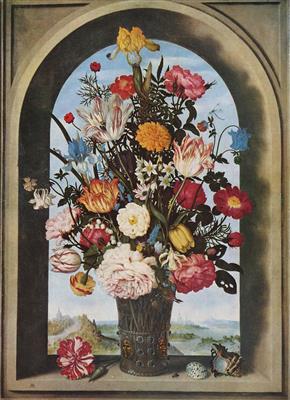
founding the Dutch floral still life as an independent genre, with impossible seasonal bouquets painted on copper
Where to see Ambrosius Bosschaert
Collection holdings are reported here; current display varies. Check with each museum before visiting.
-
 2 recorded works
National Gallery
London, United Kingdom
-
1 recorded work
National Galleries Scotland
Edinburgh, United Kingdom

-
1 recorded work
Liechtenstein Museum
Vienna, Austria
-
1 recorded work
National Gallery Prague
Prague, Czech Republic
-
 1 recorded work
Louvre
Paris, France
-
 1 recorded work
Mauritshuis
The Hague, Netherlands
-
 1 recorded work
Cleveland Museum of Art
Cleveland, United States
-
 1 recorded work
Museum of Fine Arts Boston
Boston, United States
-
1 recorded work
Wallraf–Richartz Museum
Cologne, Germany
-
1 recorded work
J. Paul Getty Museum
Los Angeles, United States


View all 20 museums
-
 1 recorded work
National Gallery of Art
Washington D.C., United States
-
 1 recorded work
Ashmolean Museum
Oxford, United Kingdom
-
 1 recorded work
Nationalmuseum
Stockholm, Sweden
-
 1 recorded work
Kunsthistorisches Museum
Vienna, Austria
-
 1 recorded work
Rijksmuseum
Amsterdam, Netherlands
-
 1 recorded work
National Trust
Swindon, United Kingdom
-
1 recorded work
Metropolitan Museum of Art
New York City, United States
-
 1 recorded work
Los Angeles County Museum of Art
Los Angeles, United States
-
 1 recorded work
Thyssen-Bornemisza Museum
Madrid, Spain
-
 1 recorded work
Statens Museum for Kunst
Copenhagen, Denmark

Frequently Asked Questions
Where can I see Ambrosius Bosschaert's work?
Paintings by Ambrosius Bosschaert are held in various collections. These include the Staatliche Kunstsammlungen in Dresden, and the Hermitage Museum in Leningrad. You can also find his work in the National Gallery[5] of Scotland, in Edinburgh. Other locations include the Detroit Institute of Arts, the National Gallery of Ireland in Dublin, and the Städelsches Kunstinstitut in Frankfurt. Bosschaert's paintings can be seen at the Staatliche Kunsthalle in Karlsruhe, and the Staatliche Kunstsammlungen in Kassel. Works by this artist are also held in the collection of the National Gallery of Victoria, Melbourne, and the Pushkin Museum of Fine Arts, Moscow. These are just some of the places where you can view work by Ambrosius Bosschaert.What should I know about Ambrosius Bosschaert's prints?
Ambrosius Bosschaert the Elder (1573-1621) was a still-life painter of the Dutch Golden Age. He is known for his detailed depictions of flowers; these were typically painted in oil on copper or panel. Bosschaert did not create prints himself. However, his paintings were reproduced as engravings and etchings by other artists, after his death. These prints made his compositions accessible to a wider audience. One example is a print by Bartholomeus van den Winckel after Bosschaert, now in the collection of the Rijksmuseum, Amsterdam. Similar prints after Bosschaert appear occasionally at auction. These are often unsigned, and can be difficult to attribute definitively. Prints after Bosschaert offer a more affordable way to own an image similar to his paintings. However, they lack the colour and textural qualities of his original oil paintings. When considering a print, examine its condition, paper type, and provenance. These factors affect its value and collectability.Why are Ambrosius Bosschaert's works important today?
Ambrosius Bosschaert the Elder (1573-1621) was among the first artists to specialise in still life painting in the Netherlands. His works are admired for their detailed depictions of flowers, insects, and other small objects. These paintings provide insight into the botany and entomology of the period. Bosschaert's compositions often feature symmetrical arrangements and a high level of detail. He painted bouquets that combined flowers which bloom in different seasons. This allowed him to create striking, impossible arrangements. His technique involved meticulous observation and a careful rendering of textures and colours. His paintings are valued for their aesthetic qualities and historical significance. They offer a glimpse into the tastes and interests of the Dutch Golden Age. Furthermore, Bosschaert's influence can be seen in the work of later still life painters. His sons, Ambrosius the Younger and Johannes, as well as his brother-in-law, Balthasar van der Ast, all followed in his style. Museums across Europe hold examples of his work; these paintings continue to be studied by art historians and enjoyed by the public.Ambrosius Bosschaert facts?
Ambrosius Bosschaert was born in Antwerp in 1573 and moved with his family to Middelburg around 1587. He signed his paintings with a stylised A containing a smaller B, a monogram modelled on Albrecht Durer's.Who is Ambrosius Bosschaert?
Ambrosius Bosschaert (1573-1621) was a painter who was one of the first to establish floral still life as an independent genre. He assembled bouquets that could never exist in nature, composing them from sketches made across different seasons.What materials did Ambrosius Bosschaert use?
Ambrosius Bosschaert almost always painted on copper. He arranged his bouquets against open windows with views of the world.What techniques or materials did Ambrosius Bosschaert use?
Ambrosius Bosschaert painted in oils, typically on wood panels. For example, Still Life with Flowers, held at the Fitzwilliam Museum in Cambridge, is oil on panel. The panel has a thin, white ground layer, with a yellow, ochre-coloured imprimatura. The pigments and media that Bosschaert used were in keeping with standard practices of the time. Bosschaert's contemporary, Brueghel, employed a painting method characterised as deliberately slow, which allowed him to achieve a high degree of finish and detail. Brueghel sometimes took months to finish commissions. It is possible that he worked on several paintings at once, allowing the works to dry at various stages. This maintained a crisp appearance, because he avoided applying paint on top of a layer that was still wet. When painting flowers from life, Brueghel had to wait for the flowers to be in season. He also had to have access to them.Who did Ambrosius Bosschaert influence?
Ambrosius Bosschaert's influence is complex. Later Dutch still life was interpreted through the work of Jean-Baptiste-Siméon Chardin, especially in France. Chardin, accepted into the Academy as a painter of animals and fruits, may have encountered Dutch paintings in Parisian collections. Chardin's representations, held in a muted colour range and avoiding excess, had more kinship with the "bourgeois" spirit of the Little Masters of Holland than with the Baroque splendour of court art in Flanders. Chardin broke with the tradition of decorative bouquets and sumptuous tableware by choosing everyday objects, such as kitchen utensils, for the subjects of his still lifes. The illusion of naturalness, simplicity of motifs and composition, and the harmony of colours endowed Chardin’s still lifes with a peaceful atmosphere. These traits owed something to the Haarlem painting tradition, such as the monochromatic compositions of Pieter Claesz. Henri Fantin-Latour was a later painter of expanded-space bourgeois still lifes. The example set by Chardin underlies the work of Fantin-Latour, both in his simple fruit pieces and in his more complex flower-piece table corners. Fantin-Latour was important for Cézanne, particularly for his flower pieces.
Sources
Where to See guide aggregates verified holdings of Ambrosius Bosschaert's works across the following collections.
- [1] museum National Gallery Prague Used for: museum holdings.
- [2] museum Mauritshuis Used for: museum holdings.
- [3] museum Cleveland Museum of Art Used for: museum holdings.
- [4] museum Museum of Fine Arts Boston Used for: museum holdings.
- [5] museum National Gallery Used for: museum holdings.
- [6] museum J. Paul Getty Museum Used for: museum holdings.
- [7] book National Gallery of Art, National Gallery of Art - Painting in the Dutch Golden Age - A Profile of the Seventeenth Century Used for: biography.
Editorial overseen by Solis Prints. Sources verified 2026-09-30. Click a source for details, or hover over [N] in the page above to preview.
Editorial standardsMethodologyCorrectionsAI disclosureAbout the editorial team